Electronic Chart Display and Information System (ECDIS) Explanation:-
Electronic
Chart Display and information Systems (ECIDS) means a navigation information
system which with adequate back-up arrangements can be accepted as complying
with the up-to-date chart required by regulation V/20 of the 1974 SOLAS
Convention, by displaying selected information from a system electronic
navigational chart (SENC) with positional information from navigation sensors
to assist the mariner in route Monitoring, and if required display additional
navigation related information.
Generation of ECDIS:-
The
electronic navigation chart is the data base standardized as to content,
structure and format and is issued by the hydrographic office (HO) under the
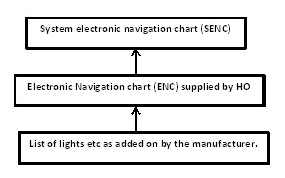
authority of the government, the ENC contains all the chart information
necessary for safe navigation and may contain supplementary information in
addition to that contained in the paper chart (e.g. list of lights and fog
signals etc.) which may be considered necessary for safe navigation.
The
system electronic navigation chart (SENC) is the data base resulting from
transformation of the ENC by the ECDIS for appropriate use, updates to the ENC
by appropriate means and other data added by the mariner. It is the data base
that is actually accessed by the ECDIS for the display generations & other
navigational functions and is equivalent to an up-to-date paper chart.
ECDIS is basically a CPU with a monitor to display electronic chart, SENC is an integral part and below figure can be referred for better understanding which shows that SENC is interfaced with various equipment as mentioned below results in an ECDIS.
Advantages of Electronic Chart Display and Information System (ECDIS):
Availability: One of the great advantages of ECDIS over paper charts is the availability of electronic charts – especially when voyage orders are received at the last minute.
Speed and Accuracy: With ECDIS as the primary source of navigation, the Navigating Officer can plan and summarise the passage much faster than on Paper Charts. Daily reporting data such as Distance to Go, Distance Covered, Average Speed, etc. can be done quickly with hardly any effort.
Corrections: The Navigating Officer now receives weekly updates to the Electronic Charts via Email which he has to download onto a zip drive and upload them to the ECDIS. Even the dreaded T&P notices are now shown electronically on the ECDIS.
Continuous Monitoring of Vessel’s Position: The ECDIS is interfaced with both the vessel’s independent GPS transceivers, thereby making the system work even if one fails.
Anti-Grounding Alarms and Settings: The ability of the ECDIS to warn the user of approaching shallow waters make it one of the most useful equipment on the bridge.
User Determined Alarm Settings: While there are certain safety critical alarms that are ON by defaults and cannot be changed, there are a host of other alarms and warnings which may be switched on or off by the User depending on the situation.
Enhances Search and Rescue Capability onboard: Modern ECDIS units have the option of interfacing NAVTEX and EGC with the ECDIS display. Warnings and Alerts are automatically displayed on the ECDIS screen, whilst at the same time giving an audible and visual indication on the unit itself.
Cost Efficient: Although, Electronic charts are by no means cheap, they still have an edge over paper charts dollar for dollar.
Environmentally Friendly: The ECDIS does pack in a strong punch in reducing the carbon footprint of every vessel which goes paperless.
Disadvantages of Electronic Chart Display and Information System (ECDIS):
Over-Reliance: A vessel could have switched off its AIS and hence might not be displayed on the ECDIS. If the Radar Overlay is not turned on, the vessel will just not be seen on the ECDIS display. Hence, it is very critical that Navigators continue to maintain an efficient lookout and a good radar watch.
Garbage In Garbage Out (GIGO): Erroneous position inputs from the GPS or loss of GPS signal can have grave consequences with the ECDIS going in DR mode. If the alarm is missed out, the result can be disastrous.
Wrong Settings: Feeding in wrong parameters for safety critical settings such as the Safety Depths, Safety Contours etc can give a false sense of safety.
Alarm Deafness: If alarms start going off too frequently, the navigator could end up in a dangerous situation called Alarm Deafness.
System Lag: Modern ECDIS software can have a lot of data to display and with various equipment interfaced with the ECDIS, the system can slow down very easily leading to system lag.
Different Types: Different vessels will have different types of ECDIS equipment.
Anomalies: Every navigator needs to be aware of the anomalies present in that particular equipment. It could be a simple use of the SCAMIN (Scale Minimum) function or something serious where certain depths or symbols might not be visible at a particular scale or appear differently.
Information Overload: It is very easy to over feed information on the ECDIS. A lot of data which was earlier marked on charts such as position for calling Master notices to Engine Room, Echo Sounder Switch on points, Port Control VHF channels etc now have to be fed on the ECDIS.
Advantages of ECDIS over conventional Paper Charts:
Position fixing can be done at required interval without manual interference.
Continuous monitoring of the ship’s position.
When interfaced with ARPA/RADAR, target can be monitored continuously.
If two position fixing system are available, the discrepancy in two systems can be identified.
Charts can be corrected with help of CD/Online.
Passage planning can be done on ECDIS without referring to other publications.
Various alarms can be set on ECDIS.
Progress of the passage can be monitored in more disciplined manner, since other navigational data is available on ECDIS.
Various alarms can be activated to draw the attention of OOW.
The
information presented in a reliability diagram requires knowledge of past and
present hydrographic surveying practices — something most mariners neither have
nor should need. To address this, the Australian Hydrographic Service developed
a system known as “zones of confidence” that has since been adopted
internationally.
On
each nautical chart the accuracy and reliability of the information used to
compile the chart is shown on a “zone of confidence” (ZOC) diagram. Within
official electronic navigational charts (ENCs), the same information is shown
as a layer that can be switched on and off by the mariner.
ZOC
categories warn mariners which parts of the chart are based on good or poor
information and which areas should be navigated with caution. The ZOC system
consists of five quality categories for assessed data, with a sixth category
for data which has not been assessed.
The
table accompanying the ZOC diagram on each chart summarizes the meaning of the
ZOC categories.
DefineENCas applicable to ECDIS:
Electronic Navigational Chart (ENC) means the database, standardized as to content, structure and format, issued for use with ECDIS on the authority of government authorized hydrographic offices. The ENC contains all the chart information necessary for safe navigation and may contain supplementary information in addition to that contained in the paper chart (e.g. sailing directions) which may be considered necessary for safe navigation. Vector charts are an example.
Define SENC as applicable to ECDIS:
System Electronic Navigational Chart (SENC) means a database resulting from the transformation of the ENC (a vector chart) by ECDIS for appropriate use, updates to the ENC by appropriate means and other data added by the mariner. It is the database that is actually accessed by ECDIS for the display generation and other navigational functions and is the equivalent to an up-to-date paper chart. The SENC may also contain information from other sources.
Define Standard Display as applicable to ECDIS:
Standard Display means the SENC information that should be shown when a chart is first displayed on ECDIS. Depending upon the needs of the mariner, the level of the information it provides for route planning or route monitoring may be modified by the mariner.
Define Display Base as applicable to ECDIS:
Display Basemeans the level of SENC information which cannot be removed from the display, consisting of information which is required at all times in all geographic areas and all circumstances. It is not intended to be sufficient for safe navigation.
Define Vector Chart as applicable to ECDIS:
A vector chartis a digital database of all the objects (points, lines, areas, etc.) represented on a chart. Vector charts store information, such as isolated dangers, depths, depth contours, coastline features, cables and pipelines etc in separate layers which can be displayed as per the user’s requirements. Vector charts are also referred to as intelligent charts as they can be interrogated for information not displayed but stored in it’s memory.
Define Raster Chart as applicable to ECDIS:
Raster Chart data is created by scanning the information on a paper chart and storing this information in the form of pixels. Many thousands of pixels together make a flat digital image. Each pixel contains all the data for a particular point: colour, brightness etc. They are also geographically referenced which makes the raster chart identical in every way to the paper chart on which it is based. Raster charts cannot be manipulated or queried. Also referred to as the Raster Chart Display System (RCDS), the information is contained in one single layer only. Information can only be added to this type of chart.
Automatic Identification System (AIS) Explanation:
Very simply, the Automatic Identification System is a broadcast transponder system, operating in the VHF maritime mobile band.
It is capable of sending information such as identification, position, course, speed and more, to other ships and to shore. AIS operates principally on two dedicated VHF frequencies or channels:
AIS 1 – 161.975 MHz – channel 87B (Simplex, for ship to ship)
AIS 2 – 162.025 MHz – channel 88B (Duplex for ship to shore)
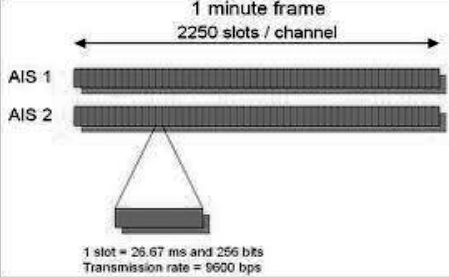
AIS uses Self-Organizing Time Division Multiple Access (SOTDMA) technology to meet this high broadcast rate and ensure reliable ship-to-ship operation. It normally works in an autonomous and continuous mode, regardless of whether it is operating in the open seas, coastal or inland areas.
Although only one radio channel is necessary, each station transmits and receives over two radio channels to avoid interference problems and to allow channels to be shifted without communications loss from other ships.
Each station determines its own transmission schedule (slot), based upon data link traffic history and knowledge of future actions by other stations.
A position report from one AIS station fits into one of 2250 time slots established every 60 seconds.
AIS stations continuously synchronize themselves to each other, to avoid overlap of slot transmissions.
Slot selection by an AIS station is randomized within a defined interval. When a station changes its slot assignment, it pre-announces both the new location and the timeout for that location.
In this way, new stations including those stations which suddenly come within radio range close to other vessels will always be received by those vessels.
Each AIS consists of on VHF transmitter, two VHF TDMA receivers, one VHF DSC receiver, and a standard marine electronic communications link to shipboard display and sensor systems.
Working of AIS:-
AIS is fitted with two receivers, one transmitter VHF DSC receiver Standard marine electronic communication link providing the various input data.
The AIS transmission uses 9.6 kb GMSK FM over 25 or 12.5kHz channel using HDLC Packet control.
Each AIS transmits and receives over two radio channel to avoid interference problems.
Each station determines its own transmission slot based on the data link traffic history and knowledge of future actions by other stations.
Range of AIS is about 20 NM.
Limitation of AIS:-
Small crafts may not be fitted with AIS
AIS might have switched off on other ship
Erroneous data might have entered
Accuracy of data received depend on the accuracy of data transmitted
Error in sensor’s input data,
Failure of sensors to provide data
Cell of vessel may be full
Precautions while using AIS in collision avoidance:-
AIS is an additional source of navigational information. It does not replace other navigational aids.
Should rely solely on AIS.
Watches must be kept as per STCW.
It does not have any impact on the composition of watch arrangement.
Swapping of targets.
Advantages of AIS:
AIS helps in collision avoidance with respect to situational awareness, AIS can calculate the CPA & TCPA which can be compared with ARPA.
Information regarding navigation status cane be beneficial.
By virtue of AIS vessels can be positively identified.
AIS reduced the work load associated with verbal reporting system required by the VTS.
AIS contributes to Maritime security, authorities can monitor the movement of the vessels, multiple AIS coast stations can be linked together to get the extended surveillance.
AIS can pick up targets even during heavy weather & restricted visibility especially due to rain etc.
AIS can pick up targets beyond small islands & bends.
Problem on target swap (for ARPA) will not be experienced in case of AIS.
No problem of range discrimination or bearing discrimination.
Pseudo AIS can be used to generate virtual buoys to indicate dangers.
AIS can also be installed on light houses, beacons for positive identification of these marks.
Pseudo AIS can also be used to generate target in case of SAR operations.
AIS can be used for meteorological & navigational information.
Use of AIS in collision avoidance and SAR operations:
Use of AIS in Collision avoidance: AIS has potential to significantly contribute to safety of navigation. It provides positive identification of targets fitted with AIS along with their static and dynamic information.
This enhances the
navigational effectiveness and it can greatly improve situational awareness and
decision making abilities. AIS also assists OOW in tracking and monitoring
targets, as it also provides information on CPA and TCPA.
Use of AIS in SAR operations:
SAR operations can be used for receiving messages from an AIS-SAR transmitter (SART), which have built in GPS receivers to derive accurate positioning information, on survival craft.
In combined aerial and surface searches AIS may allow the direct presentation of the position on other displays, such as radar, electronic chart systems and ECDIS.
AIS-SART facilitates the task of SAR craft in rescuing distressed seafarers.
For ships in distress without AIS, the on scene co-ordinator could create an AIS target.
Contents & broadcast intervals for each message type for a class A AIS:
A Class A AIS unit broadcasts the following information every 2 to 10 seconds while underway and every 3 minutes while at anchor at a power level of 12.5 watts.
The information broadcast includes:
MMSI number – unique reference able identification
Navigation status – not only are “at anchor” and “underway using engine“ currently defined, but “not under command” is also currently defined.
Rate of turn – right or left, 0 to 720 degrees per minute.
Speed over ground – 1/10 knot resolution from 0 to 102 knots.
Position accuracy – differential GPS or other and an indication if RAIM processing is being used Longitude – to 1/10000 minute and Latitude – to 1/10000 minute.
Course over ground – relative to true north to 1/10th degree.
True Heading – 0 to 359 degrees derived from gyro input.
Time stamp – The universal time to nearest second that this information was generated.
In addition, the Class A AIS unit broadcasts the following
information every 6 minutes:
MMSI number – same unique identification used above, links the data above to described vessel.
IMO number – unique reference able identification (related to ship’s construction).
Radio call sign – international call sign assigned to vessel, often used on voice radio.
Name – Name of ship, 20 characters are provided.
Type of ship/cargo – there is a table of possibilities that are available.
Dimensions of ship – to nearest meter.
Location on ship where reference point for position reports is located.
Type of position fixing device – various options from differential GPS to undefined.
Draught of ship – 1/10 meter to 25.5 meters [note “air-draught” is not provided].
Destination – 20 characters are provided.
Estimated time of Arrival at destination – month, day, hour, and minute in UTC.
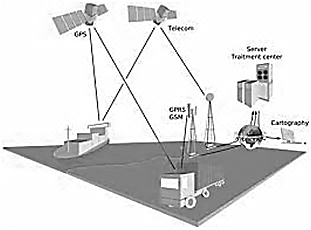
GPS or Global Positioning System is a satellite navigation system that furnishes location and time information in all climate conditions to the user. GPS is used for navigation in planes, ships, cars and trucks also. The system gives critical abilities to military and civilian users around the globe. GPS provides continuous real time, 3-dimensional positioning, navigation and timing worldwide.
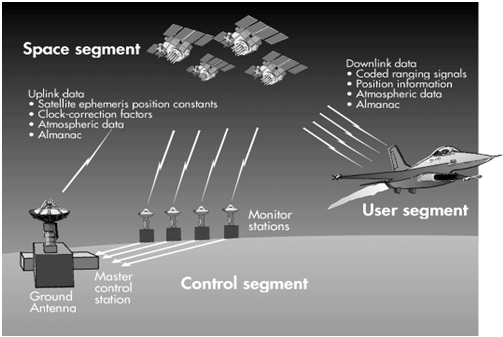
GPS System Working:- The GPS system
consists of three segments:
The space segment: the GPS satellites.
The control system, operated by the U.S. military.
The user segment, which includes both military and civilian users and their GPS equipment.
Space Segment of GPS:
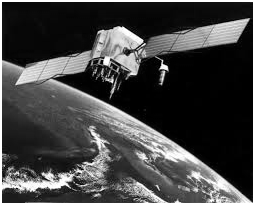
The space segment is the number of satellites in the constellation. It comprises of 29 satellites circling the earth every 12 hours at 12,000 miles in altitude.
The function of the space segment is utilized to route/navigation signals and to store and retransmit the route/navigation message sent by the control segment. These transmissions are controlled by highly stable atomic clocks on the satellites.
The GPS Space Segment is formed by a satellite constellation with enough satellites to ensure that the users will have, at least, 4 simultaneous satellites in view from any point at the Earth surface at any time.
Space segment of GPS
GPS Control Segment:
The control segment comprises of a master control station and five monitor stations outfitted with atomic clocks that are spread around the globe.
The five monitor stations monitor the GPS satellite signals and then send that qualified information to the master control station where abnormalities are revised and sent back to the GPS satellites through ground antennas. Control segment also referred as monitor station.
GPS User Segment:
The user segment comprises of the GPS receiver, which receives the signals from the GPS satellites and determine how far away it is from each satellite.
Mainly this segment is used for the U.S military, missile guidance systems, civilian applications for GPS in almost every field.
Most of the civilian uses this from survey to transportation to natural resources and from there to agriculture purpose and mapping too.
User Segment of GPS
How GPS Determines a Position:
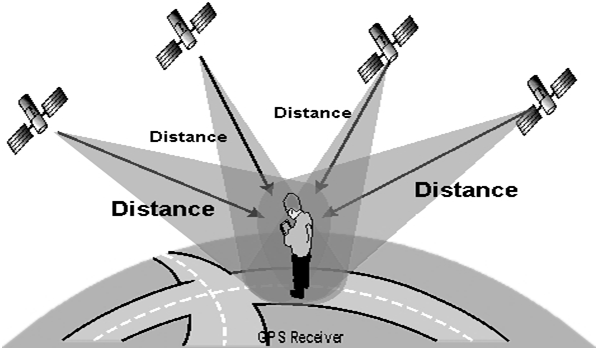
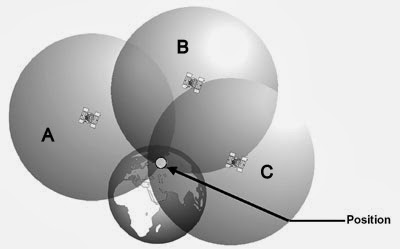
The working/operation of Global positioning system is based on the ‘trilateration’ mathematical principle.
The position is determined from the distance measurements to satellites. From the figure, the four satellites are used to determine the position of the receiver on the earth.
The target location is confirmed by the 4th satellite. And three satellites are used to trace the location place.
A fourth satellite is used to confirm the target location of each of those space vehicles. Global positioning system consists of satellite, control station and monitor station and receiver.
The GPS receiver takes the information from the satellite and uses the method of triangulation to determine a user’s exact position.
GPS Circuit: GPS is used on some incidents in several ways, such as:
To determine position locations; for example, you need to radio a helicopter pilot the coordinates of your position location so the pilot can pick you up.
To navigate from one location to another; for example, you need to travel from a lookout to the fire perimeter.
To create digitized maps; for example, you are assigned to plot the fire perimeter and hot spots.
To determine distance between two different points.
How a GPS receiver determines the ship’s position?
Position Fixing:
The receiver locks on to one satellite, and from this satellite it obtains the almanac of all the other satellites, and thereby selects the most suitable satellites for position fixing.
The position obtained by the receiver is basically by determining the distances from the receiver to each of the selected satellites.
The range measurement is achieved by measuring the propagation time from the selected satellite to the receiver.
Not possible to precisely synchronize satellite and receiver clock hence the pseudo ranges are obtained.
Hence an additional satellite is used to obtain the true ranges.
GPS Position Fixing of a ship
Equation for position fixing:-
R = C X (t-t2)
Range (R) of the satellite to the user.
Where C is the velocity of the radio waves and
(t-t2) = is the time difference (time taken for satellite signals to reach receiver.)
The satellite clock
& the GPS clock may not be perfectly synchronized so this gives rise to an
error in range measurement and the obtained is termed as pseudo range.
Hence, there are
four unknowns i.e. latitudes, longitude, altitude (x, y, z co-ordinates) of the
user as well as the user’s clock error with respect to satellite clock.
The position of the satellite S1 (x1, y1 , z1) is known to the user by the 30 sec navigational message and from this satellite the following equation is obtained:-
Where PR1 is the pseudo rage from satellite S1.
(Cx Δt) is error in range measurement due to the error in the user’s clock.
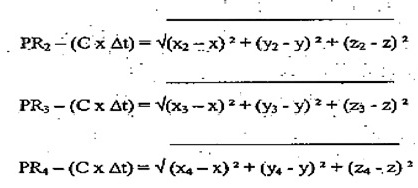
Since there are four unknown, they can be resolved from four equations obtained from four different satellites, the other 3 equations will be following:
With the help of
these equations the 3D-fix can be obtained. In the case of a craft floating on
water, a 2-D fix (i.e. Lat & long) is required and 3 equations from 3
satellites will be sufficient to fix position.
Precise Positioning Service (PPS) of GPS:
Authorised users have access to Precise Positioning Service.
The L1 frequency, transmitted by all Navstar satellites, contains a course/acquisition (C/A) code ranging signal, with a navigation data message, that is available for peaceful civil, commercial, and scientific use; and a precision (P) code ranging signal with a navigation data message, that is reserved for authorized use.
PPS predictably is 30 meters.
Standard Positioning Service (SPS) of GPS:-
Civil Users worldwide use SPS.
The L1 frequency, transmitted by all satellites, contains a coarse/ acquisition (C/A) code ranging signal, with a navigation data message, that is available for peaceful civil, commercial, and scientific use.
SPS predictability Accuracy: within 35 meters.
It is subject to selective availability, intentional down gradation of accuracy.
Now it has been announced by US Govt, that intentional down gradation will not be done.
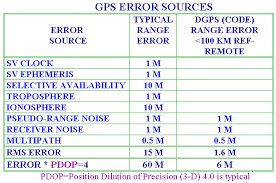
Errors of GPS:
Atmospheric Error: Changing atmospheric conditions change the speed of the GPS signals as they pass through the Earth’s atmosphere and this affects the time difference measurement and the fix will not be accurate. Each satellite transmits its message on two frequencies and hence a dual frequency receiver receives both the frequencies and correction is calculated and compensated within the receiver thus increasing the accuracy of the fix.
Effect is minimized when the satellite is directly overhead.
Becomes greater for satellites nearer the horizon. The receiver is designed to reject satellites with elevation less than 9.5 degrees.
User Clock Error: If the user clock is not perfectly synchronised with the satellite clock, the range measurement will not be accurate. The range measurement along with the clock error is called pseudo range. This error can be eliminated within the receiver by obtaining pseudo range from three satellites and is done automatically within the receiver.
Satellite Clock Error: This error is caused due to the error in the satellite’s clock w.r.t. GPS time. This is monitored by the ground based segments and any error in the satellites clock forms part of the 30 seconds navigational message.
GDOP Error: The GDOP of a satellite determines the angle of cut which in turn governs the quality of the position obtained. Wider the angular separation between the satellites, better the accuracy of the fix. Or, conversely said, the lower the GDOP value, the greater the accuracy of the fix. The GDOP value is indicated on the display unit.
Multipath Error: This error is caused by the satellite signals arriving at the ship’s antenna both directly from the satellite and those that get reflected by some objects. Thus two signals are received simultaneously which will cause the distortion of signal from which range measurement is obtained. Siting the antenna at a suitable place can minimize this error.
Orbital Error: The satellites are monitored and their paths are predicted by the ground based segment. However, between two consecutive monitoring of the same satellite, there may be minor drifts from their predicted paths resulting in small position inaccuracy.
Contents of Navigation Message transmitted by the GPS satellites:
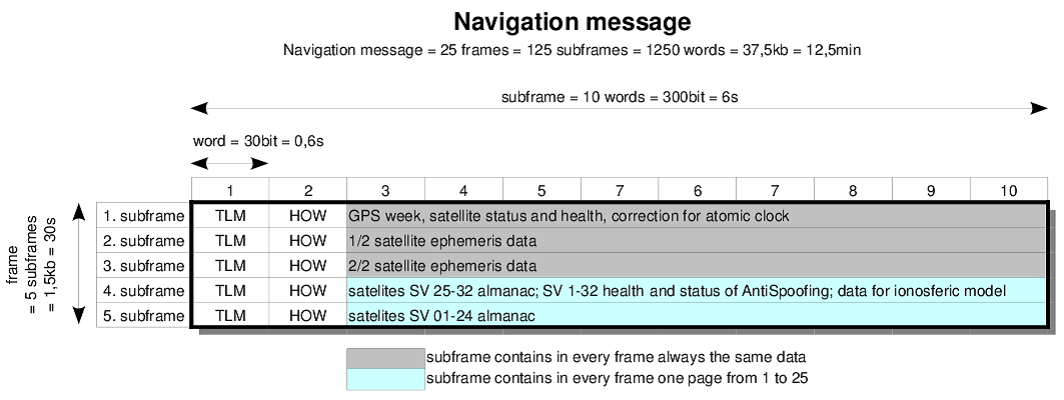
Navigation Message: Essential purpose of the navigation message transmission by satellites is to determine its position by the GPS receiver. Each satellite transmits a navigational message of 30 seconds in the form of 50 bps data frame. This data, which is different for each satellite, is previously supplied to the satellites by master control station and is divided into 5 sub-frames.
Each sub-frame commences
with telemetry word (TLM) containing satellite status followed by hand over word
(HOW) data for acquiring P code from C/A code.
Navigational Message of GPS
The sub-frames are:
The 1st sub-frame contains data relating to satellite clock correction.
The 2nd and 3rd sub-frames contain the satellite ephemeris defining the position of the satellite.
The 4th sub-frame passes the alpha-numeric data to the user and will only be used when upload station has a need to pass specific messages.
The 5th sub-frame gives the almanac of all the other satellites which includes the identity codes thus allowing the user the best choice of satellites for position fixing.
Differential GPS (DGPS) enhances the accuracy of the ship’s position:
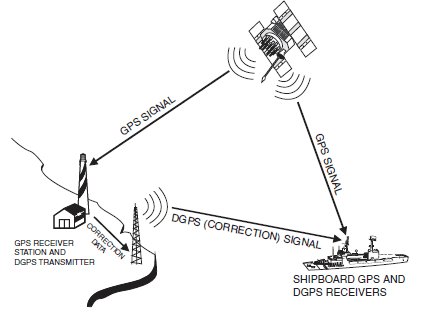
Differential GPS (DGPS) is a system in which differences between observed and computed co-ordinates ranges (known as differential corrections) at a particular known point are transmitted to users (GPS receivers at other points) to upgrade the accuracy of the users receivers position.
Differential Correction:- Differential correction is a technique that greatly increases the accuracy of the collected DGPS data. It involves using a receiver at a known location – the “base station“ and comparing that data with DGPS positions collected from unknown locations with “roving receivers.”
Limitation & Errors of DGPS:-
International Limitation of Accuracy
Receiver Independent Exchange Format
Reference System Co-ordinates
Methods used to Transmit Corrections:-
Computing & transmitting – a position correction in terms of Lat, Long & altitude i.e. x, y, z co-ordinates.
Computation of pseudo range correction to each satellite which is then broadcasted to the user and applied to the user’s pseudo range measurement before the position is calculated by the onboard receiver resulting in a higher accuracy of position fix.
DGPS removes common-mode errors, those errors common to both the reference and remove receivers (not multipath or receiver noise). Errors are more often common when receivers are close together (less than 100 km). Differential position accuracies of 1-10 meters are possible with DGPS based on C/A code SPS Signal.
Explanation of how the DGPS calculate even more accurate position than the GPS:
Differential Global Positioning System (DGPS) is an enhancement to Global Positioning System that provides improved location accuracy, from the 15-meter nominal GPS accuracy to about 10 cm in case of the best implementations.
DGPS uses a network of fixed ground-based reference stations to broadcast the difference between the positions indicated by the GPS satellite systems and the known fixed positions.
These stations broadcast the difference between the measured satellite pseudo ranges and actual (internally computed) pseudo ranges, and receiver stations may correct their pseudo ranges by the same amount.
The digital correction signal is typically broadcast locally over ground-based transmitters of shorter range.
Geodetic Datum:
A geodetic datum or geodetic system is a coordinate system, and a set of reference points, used for locating places on the Earth (or similar objects). Datums are used in geodesy, navigation, and surveying by cartographers and satellite navigation systems to translate positions indicated on maps (paper or digital) to their real position on Earth. Each starts with an ellipsoid (stretched sphere), and then defines latitude, longitude and altitude coordinates. One or more locations on the Earth’s surface are chosen as anchor “base-points”.
Pseudo Range:
The Pseudo Range is the pseudo distance between a satellite and a navigation satellite receiver for instance Global Positioning System (GPS) receivers. To determine its position, a satellite navigation receiver will determine the ranges to (at least) four satellites as well as their positions at time of transmitting. Knowing the satellites’ orbital parameters, these positions can be calculated for any point in time. The Pseudo Ranges of each satellite are obtained by multiplying the speed of light by the time the signal has taken from the satellite to the receiver. As there are accuracy errors in the time measured, the term pseudo-ranges is used rather than ranges for such distances.
True Range:
True Range is an instantaneous measurement of the distance between the transmit antenna on the SV and receive antenna on the vehicle. If it were possible imagine a tape measure stretched out between the two antennas, this measurement is the true range.
Geometric Dilution of Precision (GDOP):
Explanation:-
Dilution of precision (DOP), or geometric dilution of precision (GDOP), is a term used in satellite navigation and geomatics engineering to specify the additional multiplicative effect of navigation satellite geometry on positional measurement precision.
DOP can be expressed as a number of separate measurements:
HDOP – horizontal dilution of precision
VDOP – vertical dilution of precision
PDOP – position (3D) dilution of precision
TDOP – time dilution of precision
These values follow mathematically from the positions of the usable satellites. Signal receivers allow the display of these positions (skyplot) as well as the DOP values.
The term can also be applied to other location systems that employ several geographical spaced sites. It can occur in electronic-counter-counter-measures (electronic warfare) when computing the location of enemy emitters (radar jammers and radio communications devices). Using such an interferometry technique can provide certain geometric layout where there are degrees of freedom that cannot be accounted for due to inadequate configurations.
The effect of geometry of the satellites on position error is called geometric dilution of precision and it is roughly interpreted as ratio of position error to the range error. Imagine that a square pyramid is formed by lines joining four satellites with the receiver at the tip of the pyramid. The larger the volume of the pyramid, the better (lower) the value of GDOP; the smaller its volume, the worse (higher) the value of GDOP will be. Similarly, the greater the number of satellites, the better the value of GDOP.
HDOP with respect to GPS:
HDOP: Acronym for horizontal dilution of precision. A measure of the geometric quality of a GPS satellite configuration in the sky. HDOP is a factor in determining the relative accuracy of a horizontal position. The smaller the DOP number, the better the geometry.
GPS receiver determining the speed of the ship:
Explanation:
The carrier frequency is also used to determine the speed of the user by the measurement of Doppler shift, i.e. change in the frequency of radio waves received when the distance between the satellite and user is changing due to the relative motion between the two.
The position and velocity of the satellite as well as the position of the user are known to the user’s receiver.
The velocity vector of the satellite can be resolved in two ways:
In the direction towards the user
In the direction perpendicular to (i).
The 2nd component is not considered as speed in this direction will not cause Doppler shift.
The receiver calculates the velocity vector of the satellite in the direction towards the user.
If the relative approach speed between the satellite and the user’s speed (based on the Doppler shift measurement) is not equal to the satellite speed vector towards the user; the difference can only arise due to user’s speed towards or away from the satellite.
Similarly with the help of the other two satellites, the receiver can calculate two additional speed vectors and these speed vectors will be towards or away from their respective satellites.
These velocity vectors are resolved into three other vectors, i.e. x, y and z co-ordinates and with these three vectors the course and speed of the user is calculated.
GPS System configuration and frequencies used for: P & C/A code:
Codes:- Each satellite transmits two codes:-
P Code (Precession Code) that is only available to US military and its allies.
C/A Code (Coarse Acquisition Code) available for use to all civilian users.
Frequencies:- 1575.42 MHz (L1
signal) and 1227.6 MHz (L2 signal).
The L1 carrier consists of both the C/A and P codes, while the L2 carrier consists the P code only.
Each satellite transmits pseudo random noise signals on these two different frequencies.
Function of these codes is as follows:
For satellite identification since each satellite has a unique code.
For measurement of the propagation time from the satellite to user.
The C/A code:-
The C/A code is different for every satellite.
The C/A code is made up of sequences called chips.
Sequence repeats itself every millisecond.
The C/A code is for the civilians.
P code:-
The full code length is of 267 days.
The extremely long code length makes it difficult to lock on to the P code.
P code is available only for US & allies.
P code is different for every satellite.
Alarms of GPS on Ships:
Alarms of GPS:- There are seven alarm conditions which generate both audible and visual alarms. When an alarm setting is violated, the buzzer sounds and the name of the offending alarm appears on the display. The alarm icon also appears on the Plotter 1, Plotter 2 and Highway displays.
Arrival Alarm, Anchor Watch Alarm:-
Arrival alarm:- The arrival alarm informs you that own ship is approaching a destination waypoint. The area that defines an arrival zone is that of a circle which you approach from the outside of the circle.
Anchor watch alarm:- The anchor watch alarm sounds to warn you that own ship is moving when it should be at rest.
Cross Track Error (XTE) Alarm :- The XTE alarm warns you when own ship is off its intended course.
Ship’s Speed Alarm:- The ship’s speed alarm sounds when ship’s speed is lower or higher (or within) the alarm range set.
Trip Alarm:- The trip alarm sounds when the distance run is greater than the trip alarm setting.
Water Temperature Alarm:- The water temperature alarm sounds when the water temperature is higher or lower (or within) the preset temperature. This alarm requires temperature signal from external equipment.
Depth Alarm:- The depth temperature alarm sounds when the depth is higher or lower (or within) the preset depth. This alarm requires video sounder connection.
WAAS/DGPS Alarm:- The WAAS/DGPS alarm sounds when the WAAS/DGPS signal is lost. This alarm may be enabled or disabled as below.
Chart Datum – Explanation:
Chart Datum (CD) is defined simply in the Glossary as the level below which soundings are given on Admiralty charts. CDs used for earlier surveys were based on arbitrary low water levels of various kinds.
Modern Admiralty surveys use as CD a level as close as possible to Lowest Astronomical Tide (LAT), which is the lowest predictable tide under average meteorological conditions. This is to conform to an IHO Technical Resolution which states that CD should be set at a level so low that the tide will not frequently fall below it.
The actual levels of LAT for Standard Ports are listed in Admiralty Tide Tables. On larger scale charts, abbreviated details showing the connection between chart datum and local land levelling datum are given in the tidal panel for the use of surveyors and engineers, where those connections are known.
Datums in use on charts:-
Large scale modern charts contain a panel giving the heights of MHWS, MHWN, MLWS and MLWN above CD, or MHHW, MLHW, MHLW and MLLW, whichever is appropriate, depending on the tidal regime in the area concerned. The definitions of all these terms are given in the Glossary. If the value of MLWS from this panel is shown as 0·0 m, CD is the same as MLWS and is not therefore based on LAT. In this case tidal levels could fall appreciably below CD on several days in a year, which happens when a CD is not based on LAT.
Other charts for which the UKHO is the charting authority are being converted to new CDs based on LAT as they are redrawn. The new datum is usually adopted in Admiralty Tide Tables about one year in advance to ensure agreement when the new charts are published. When the datum of Admiralty Tide Tables thus differs from that of a chart, a caution is inserted by Notice to Mariners on the chart affected drawing attention to the new datum.
Where foreign surveys are used for Admiralty charts, the chart datums adopted by the hydrographic authority of the country concerned are always used for Admiralty charts. This enables foreign tide tables to be used readily with Admiralty charts. In tidal waters these CDs may vary from Mean Low Water (MLW) to lowest possible low water. In non–tidal waters, such as the Baltic, CD is usually Mean Sea Level (MSL). Caution. Many CDs are above the lowest levels to which the tide can fall, even under average weather conditions. Charts therefore do not always show minimum depths.
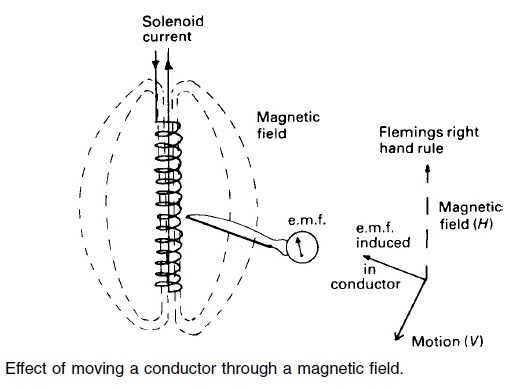
The electromagnetic speed log is based is upon the induction law, which states that if a conductor moves across a magnetic field, an electro motive force (e.m.f.) is set up in the conductor.
Alternatively, the e.m.f. will also be induced if the conductor remains stationary and the magnetic field is moved with respect to it.
The induced e.m.f. is directly proportional to the velocity.
Velocity when integrated with time gives distance
The induced e.m.f. ‘E’ is given by the following:
E = F X L X V
Where F = magnetic field
L = the length of the conductor
V = the velocity of the conductor through the magnetic field.
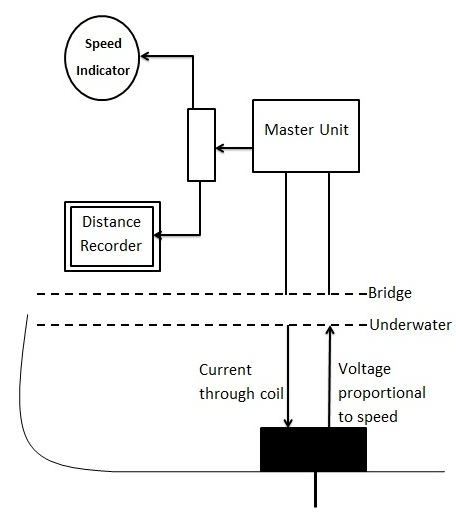
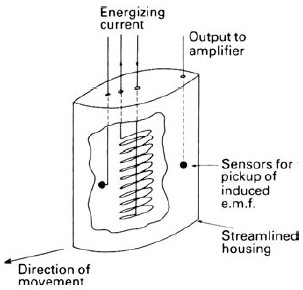
Constructional Details of an electromagnetic log sensor: This type of log consists of
Sensor
Amplifier
Indicator
Working of Electromagnetic Speed Log:
An Electromagnet consisting of a coil carrying alternative Current (A.C.) generates a vertical magnetic field in the water around the probe. The SW Conductor moving horizontally through this magnetic field has an electromotive force induced into it proportional to the seed of the vessel. In the EM log the ‘F’ and ‘L’ are maintained constant, therefore the induced e.m.f. is directly proportional to the velocity ‘V’, which is the velocity of the vessel through the water. The speed output from an EM log depends upon the water flow by way of the sensors. This type of log can give only speed through water and is greatly affected by the current flowing under the ship. The induced e.m.f. and hence the speed indication will vary with the conductivity of the water. This e.m.f. is picked up by 2 electrodes. This induced e.m.f. is very small hence the amplification is required. The amplified signal thus drives the mechanism which is connected to indicator. Hence, the induced e.m.f. which is directly proportional to the velocity is finally displayed on the indicator.
More information:-
The Log Extends up to about 20 cm outside the hull.
It should be retracted in case of reduced UKC & before proceeding to dry dock.
Normally retracted from the engine room.
If sensors are also fitted athwartship, the speed in athwartship direction also can be displayed.
Errors / Limitations of Electromagnetic Speed Log:
Siting of the probe is critical. This is so since if too close to the hull then due to the non-linearity of the hull form the speed of the water flow may give a wrong representation of the vessels speed. This is minimized by careful siting of the sensor as well as by calibrating the instrument while installation.
Pitching and Rollingalso give rise to errors however these are reduced by having an electrical time constant that is longer than a period of vessel motion. A well-adjusted log can have an accuracy of better than 0.1 percent of the speed range.
Sign of Speed, it can show astern speed as well, but without sign if AC current is used, if DC current is used to create the magnetic field it will show sign of speed range. This type of log can give only speed through water and is greatly affected by the current flowing under the ship.
While navigating in area with greater current, one must exercise precautions.
Advantagesof Electro-magnetic log with Doppler log:
Disadvantagesof Electro-magnetic log with Doppler log:
Salinity and temperature of water affects calibration.
Measurements affected by boundary layer, (water speed slowed down close to the hull by friction).
Provides boat/ship speed relative to water not ground. Current affects accuracy.
Difference between “Water Track Speed” and “Ground Track Speed“:
Water Track Speed:- In open seas, the sound pulse from the Doppler transducer may not reach the bottom, but get totally internally reflected from a layer of water in between. This is known as the echo from the ‘Water Track”. When the sound is bounced off a water layer, called a water track, speed indicated is the ‘Speed through Water”. or from a layer of water and the echo is at a higher frequency. The frequency of the echo from the water track will follow the same Doppler principles as the echo from the bottom track. However, the speed measured from the ‘water Track’ will not be ‘Speed over the Ground’, but it will be ‘Speed through Water’.
Ground Track Speed:- Speed over ground is the speed of the ship with respect to the ground or any other fixed object such as fixed buoy or island. Speed through water is the speed of the ship with respect to the water such as anything floating on water. A ship with her engine stopped in water with 2 knots currents will have zero speed through water but will have 2 knots speed over ground.
Difference between the Synchronous Rolling & Parametric Rolling of ships:
Synchronous Rolling:-
Every vessel has a natural rolling period which is inversely proportional to the square root of the GM and directly proportional to the beam of the ship.
Synchronous rolling is caused when the rolling period becomes ‘synchronous’ with the period of wave encounter. When this occurs, the ship will heel over and in exceptional circumstances be rolled further over by the action of the wave.
If the vessel encounters a series of swell in such a manner that the wave period matches the natural rolling period, the vessel will have no time righting itself before the next wave strikes. This situation if not corrected, can result in capsizing of the ship.
The vessel encountering synchronous rolling is in a serious danger that she may heel over beyond a point from which it cannot return to the upright condition. She may end up with negative stability & eventually capsize.
Synchronous rolling can be experienced regardless of the direction of sea w.r.t. the ship’s heading. But it is most likely to happen when natural rolling period of the ship is short or when sailing in high beam or quartering seas.
Other danger associated with it is that of cargo shifting that can result in loss of stability and capsizing. Also, cargo lashings may give way because of the excessive rolling and cause damage to the cargo and in some cases, structural damage to the ship.
A vessel which has suffered engine failure is most vulnerable to synchronized rolling and efforts to bring the vessel’s head into the wind should be made while she still has headway.
To reduce synchronous rolling, following actions are suggested:
Use ballast changes to alter KG and so the GMT of the vessel. By doing so, the rolling period will change making it of a non-synchronous value.
Change the course of the ship so as to effectively change the period of wave encounter and eliminate the condition.
Alter the speed of the ship until the synchronous rolling ceases to exist.
It is imperative that the OOW recognizes the condition of synchronization immediately and immediately alters course to change the period of wave encounter and eliminates the condition.
Parametric Rolling:-
Parametric rolling occurs when the pitching period is either equal to or half of that of the rolling period. Large roll angles may occur quickly in head or stern seas or nearly head or stern seas. The roll angle may increase from a few degrees to over 30 degrees in only a few cycles.
It is caused due to the combination of various factors such as low initial stability, large flare around the water line, waves as long as ship’s length, sufficiently large wave amplitudes, period of encounter half the rolling period and low hydrodynamic roll damping.
Parametric rolling is produced by the pitching motion on vessels which have a very fine bow together with very wide and flat stern like large container ships which have a large flare forward and a flat after ship.
Parametric rolling is more when a ship is operating in heavy sea condition. Such conditions can generate extremely high loads on the lashings and containers. It can even exceed the breaking load of the container lashings. As a result, the cargo & vessel could be damaged & containers could be lost.
Parametric rolling causes heavy stresses in the ship’s structure especially fore and aft parts. It also causes variation in the load of ship’s main engines. If not tackled quickly, it can also result in the capsizing of the vessel.
As the stern dips into the waves, it produces a rolling action. The rolling action is different at the stern than to those at the bow which causes a twisting along the ship leading to the extra rolling motion.
IMO suggests that parametric rolling is dangerous when the wavelength is one to 1.5 times the ship’s length.
Ships which have a high GM will have a shorter roll period and unlikely to have parametric rolling in head/stern seas. Ships which have a low GM will have a long rolling period and are likely to have parametric rolling in head/stern seas.
To reduce parametric rolling, following actions are suggested:
Use ballast changes to alter KG and so the GMT of the vessel. By doing so, the rolling period will change making it of a non-synchronous value.
Anti-rolling stability tanks to be provided to transfer water across the ship. A quick response time is vital to counteract this rolling.
Hydraulic fin stabilizers would help to reduce parametric rolling.
Slow down and alter to a more favourable course to ease vessel’s motion by breaking resonance between rolling period & wave encounter period.