Posted on

Auto Pilot on Ships

Working of a Ship’s Auto Pilot with Sketch:
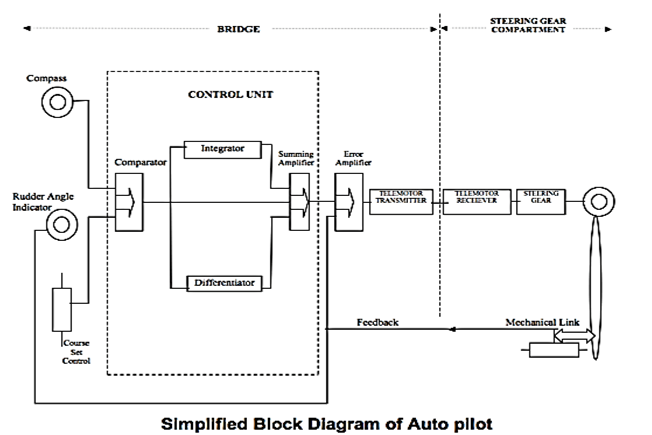
Block Diagram of Ship's Auto Pilot
Block Diagram of Ship’s Auto Pilot
  • An auto pilot is the ship’s steering controller which automatically manipulates the rudder to decrease the error between the reference heading and actual heading.
  • Autopilot relieves the helmsman to great extent but definitely autopilot is not a substitute for helmsman.
  • Autopilot also reduces fuel consumption as the zig-zag course is avoided.

Working of Auto Pilot:-

  • Course is selected by the course selector.
  • Present heading is indicated by the compass.
  • The output from the compass is fed to the comparator in the control unit. The signal from the course selector is also fed to the comparator.
  • Difference between the two signals is causing the output error signal detected by the comparator.
  • Integrator and differentiator also analyze the signal.
  • The signals from the comparator, integrator and differentiator are fed to summing amplifier (control unit).
  • The summing amplifier in turn, passes the signals to error amplifier which also receives feedback from the steering gear.
  • The output of error amplifier is transmitted to steering gear via telemotor transmitter and telemotor receiver.
  • A torque motor may be fitted instead of a telemotor.

Controls available in Auto Pilot console:

The Autopilot Control Unit – The PID Control Unit:- In order to maintain the ship’s course accurately, the deviation signal has to be generated under the following conditions:

  1. When the set course is changed (by the navigator).
  2. When the ship deviates from the set course (due to external factors).

For this purpose, the helm must be provided with data regarding the ship’s movement relative to the course to steer line.

This is achieved by electronic circuits with the help of the following:

  • Proportional control
  • Derivative control
  • Integral control

Proportional Control:-

Proportional Control - Auto Pilot
Proportional Control – Auto Pilot
  • The effect on steering, when only the proportional control is applied, causes the rudder to move by an amount proportional to the off-course error from the course to steer.
  • When the ship has gone off-course to port, an error occurs and helm, proportional to the deviation and hence error signal, is used to bring her back to the set course.
  • As the ship starts to return to the set course, the helm is gradually eased and finally removed when the ship is back on the set course.
  • The rudder will be amidships when the ship reaches its set course and then the heading overshoots resulting in the vessel to go more to starboard. Correcting helm is now applied causing the ship to return to port and back to the original course.
  • The vessel thus keeps on oscillating to port and starboard of the course line.

Derivative Control:-

Derivative Control - Auto Pilot
Derivative Control – Auto Pilot
  • In derivative control, the rudder is shifted by an amount proportional to the rate of change of the ship’s deviation from the course. Any deviation of course to port will cause correcting rudder to be applied to starboard.
  • As the rate of change of course decreases, the automatic rudder control decreases and at a point X, the rudder will return to midships before the vessel reaches its set course.
  • The ship will now make good a course parallel to the required course.

Integral Control:-

Integral Control - Auto Pilot
Integral Control – Auto Pilot
  • Certain errors due to the design of the ship (bow going to port due to transverse thrust, shape of the hull, current draft, etc.) have an impact on the steering capabilities of the ship and have to be corrected for effective overall steering performance.
  • In order to achieve this, signals are produced by sensing the heading error over a period of time and applying an appropriate degree of permanent helm. The rudder used to correct the course will now be about this permanent helm. That is, the permanent helm will now act as midships.
  • Additionally, there are various controls provided on the autopilot system along with a filter system for the action of the winds and waves which supply more data to the autopilot which optimizes the performance of integral control.
  • The output of these three controls is combined and the net resultant thus obtained drives the rudder maintaining the ship on the set course. This type of auto pilot is referred to as PID auto pilot.

Working of “Weather Control” in Auto Pilot System:

Rough weather and hostile sea conditions have adverse effects on the performance of the auto-pilot. Uncontrolled yawing of the ship can result in excessive rudder movement. Modern auto-pilot system has Weather control option in which the system automatically adjusts the setting to adapt to the changing weather and sea conditions. It also provides an option for the user to manual set a specific value.


Working of Yaw Controlin Auto Pilot System:

The setting of the Yaw Control depends upon the wind and weather condition and their effect on the course keeping ability of the ship, in bad weather this setting should be set high and calm weather this should be set low. If Yaw Control is not set properly, the steering gear will over work & there will be excessive load on the system.


Working of “Off Course Alarm” in Auto Pilot System:

Off Course Alarm:- Usually an Off Course Alarm is fitted on the Autopilot. This can be set for the required amount of degrees. So that if at anytime the difference between the actual course and the Autopilot set course is more than the preset degrees, an alarm will warn the officer.

There is however, one limitation which should be noted. In case, the gyro compass itself begins to wander the Autopilot well steer so as to follow the wandering compass and the Off Course Alarm will not sound. It does not ring unless the difference between the course setting and gyro heading is more than the preset limit.


Working of “Rudder Limit” in Auto Pilot System:

Rudder Limit:- This setting specifies the maximum amount of rudder to be used when correcting the ship’s head or when altering course on autopilot. That is, if a setting of 10O is applied for rudder limit, when altering course the rudder will move to a maximum of 10O. This limit can be varied according to the requirements of the navigator.


Purpose of following settings in Autopilot: Rudder

  • This control determines the amount of rudder to be used to correct the slightest amount deviation from the set course.
  • The higher is setting the larger the rudder angle is used to correct a course deviation and this may result in over correcting.
  • But if setting is less, the rudder angle is used to correct deviation may not be sufficient and will take longer time to return to set course.
  • This is proportional controller which transmits a signal which is proportional to course error
    • Controller output = constant (Kp) x Deviation
  • The ratio can be changed by settings (i.e. the ratio between instantaneous heading error and rudder command) also called rudder multiplier.
  • Control Knob alters the ratio of output.
  • Higher setting – Larger rudder angle (results in overcorrecting – overshooting)
  • Lower setting – Less rudder angle (Long time to return to set Co-Sluggish).
  • Therefore, optimum setting required.

Purpose of following settings in Autopilot: Counter Rudder

  • This control determines the amount of counter action by the rudder to be used to steady the ship on the set course keeping the overshoot to minimum.
  • Too low setting will allow the ship to overshoot and too high setting will bring the ship back in long time. 
  • This is Derivative control.
  • Purpose is to apply a relatively greater amount of helm at the beginning of a course alteration to get the ship turning. Once the ship is turning, just enough helm is applied in order to keep her coming around. When new heading is approached, opposite helm is applied to stop the swing. As the ship settles on new heading and the yaw rate disappears, the helm is removed.
  • Produces an output when course of vessel is changing.
  • Depends on rate of change of course:
    • Controller output = constant ( KD ) x change of error / time
  • Determines amount of counter rudder to steady the ship on set course.
  • Keeps over shoot to minimum.
  • Greater the ship’s inertia, greater the setting required. If ship has good dynamic stability, relatively small settings of counter rudder will be sufficient. If the ship is unstable, higher settings will be required.
  • Depends on ship’s characteristics, loaded/ballast conditions and rate of turn.
  • Too high setting will bring the ship to set Co slowly.
  • Too low setting allows overshoot.
  • As counter rudder settings increase, counter rudder increases.
  • KD – Counter rudder time constant (Calibration done at sea trial to set KD).

Purpose of following settings in Autopilot: Constant Helm

Constant / Permanent Helm:

  • This is integral controller. (In NFU this control is out of action).
  • When ship has known imbalance to one side, requiring a certain amount of bias helm (e.g. TT of propeller) manual setting of the approximate bias speed up the effect of the AUTOMATIC PERMANENT HELM calculator, because it started off nearer to its target.
  • Whether the control setting is estimated correctly or left at zero has no effect on the final steering accuracy but only in the time it takes to reach this heading accuracy.
  • If not used as described above , the permanent helm should be left at ZERO and the automatic permanent helm will function normally.
  • Produces output as long a course error persists.
  • Used when beam winds; couple formed causing ship to turn into wind.
  • Rudder position required to counteract is permanent helm.
  • Continuous control calibrated from 20 (P) to 20 (S).

Purpose of following settings in Autopilot: Weather

The setting of the yaw control depends upon the wind and weather condition and their effect on course keeping ability of the ship in bad weather this setting should be set high and calm weather this should be low.


Purpose of following settings in Autopilot: Rudder Limit

Rudder limit: This control specifies the maximum amount of rudder to be used, when correcting the ship’s head or altering the ship’s course.


Auto Pilot should not be used in the following conditions:

  • In narrow channels.
  • At slow speeds.
  • During manoeuvring.
  • During pilotage.
  • During heavy weather conditions.
  • During large alteration of course.
  • Near or in area of restricted visibility.
  • When passing close to vessels etc.
Posted on

Doppler Log on Ships

Principle & Working of Doppler Log: 

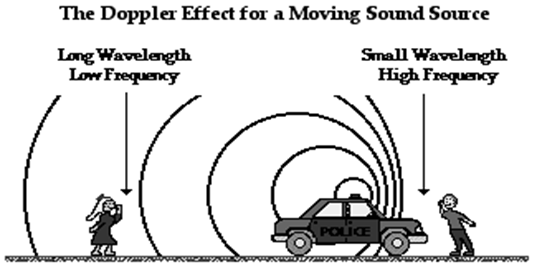
Doppler Effect from a Moving Source
  • Equipment
    to measure ship’s speed.
  • The
    Doppler log is based on measurement of the Doppler effect.
  • The
    Doppler effect can be observed for any type of wave – water wave, sound wave,
    light wave, etc. we are most familiar with the Doppler effect because of our
    experiences with sound waves. For instance, a police car or emergency vehicle
    was travelling towards us on the highway. As the car approached with its siren
    blasting, the pitch of the siren sound (a measure of the siren’s frequency) was
    high; and then suddenly after the car passed by, the pitch off the siren sound
    was low. That was the Doppler Effect – an apparent shift in frequency for a
    sound wave produced by a moving source.
  • The Doppler Effect is a frequency shift that results
    from relative motion between a frequency source and a listener.
  • If
    both source and listener are not moving with respect to each other (although
    both may be moving at the same speed in the same direction), no Doppler
    shift will take place.
  • If
    the source and listener are moving closer to each other, the listener will
    perceive a higher frequency – the faster the source or receiver is
    approaching the higher the Doppler shift.
  • If
    the source and listener are getting further apart, the listener will perceive a
    lower frequency – the faster the source or receiver is moving away the lower
    the frequency.
  • So,
    the Doppler shift is directly proportional to speed between source and
    listener, frequency of the source, and the speed the wave travels.

Explanation of how ship’s speed is transmitted to remote displays:

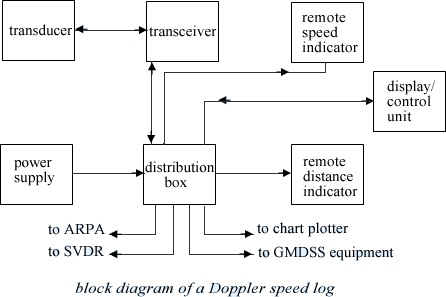
Block Diagram of Doppler Speed Log
  • Distance recording is achieved by using a constant speed motor (10) which drives the distance counter (11), via friction gearing.
  • The constant speed motor has been used in order that a distance indication may be produced that is independent of the non-linear characteristic of the system.
  • The motor is started by contact (5) as previously described.
  • The main shaft (7), whose angle of rotation is directly proportional to the speed of the ship, is fitted with a screw spindle (12).
  • The rotation of the shaft causes a lateral displacement of the friction wheel (13). At zero speed, the friction wheel rests against the apex of the distance cone (14), whilst at maximum speed the wheel has been displaced along the cone to the rim.
  • The distance indicator (11) is driven from the constant speed motor (10) via the cone.
  • The nearer to the rim of the cone the friction wheel rides, the greater will be the distance indication.
  • Revolutions of the distance shaft (15) are transmitted to the remote distance indicator via the servo transmission system (16 and 17).
  • The speed unit provides the following outputs to drive both speed and distance counters:-
    • An analogue voltage, the gradient of which is 0.1 V/knot, to drive the potentiometer servo-type speed indicators.
    • A pulse frequency proportional to speed.
    • The frequency is 200/36 pulses/s/knot. Pulses are gated into the digital counter by a 1.8-s gate pulse.
    • A positive/negative voltage level to set the ahead/astern indication or the B track/W track indication.
    • 2000 pulses per nautical mile to drive the stepping motor in the digital distance indicator.

FORMULA of Doppler Log:-

  • Doppler effect can be further explained by following equations:
    • fr is the frequency received by observer.
    • ft is the transmitted frequency.
    • c is the speed of sound.
    • vO is Velocity of observer
    • vg is Velocity of source
  • If the source moves towards stationary observer, fr = c ft / (c – vg)
  • If the source moves away stationary observer, fr = c ft / (c + vg)
  • If the observer moves towards stationary source, fr = ft (c + vg) / c
  • If the observer moves away from stationary observer, fr = ft (c – vg) / c
  • If the observer & source moves away from each other, fr = ft (c – vg) / (c + vs)
  • If the observer & source moves toward each other, fr = ft (c + vg) / (c – vs)
  • Since,
    in the case of the Doppler log, the source & observer are the same.

Hence,

vO is equal to vS, is equal to v

fr = ft (c+ v) / (c – v)

Principles of Doppler Log

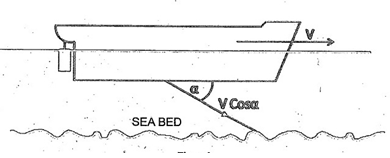
fr = ft (c+ v cos a) / (c – v cos a)

After Further simplification

v = c (fr – ft) / 2 ft cos a

  • Given
    a propogation angle of 60O, cos a = 0.5 (using single transducer
    facing forward)
  • Graphs
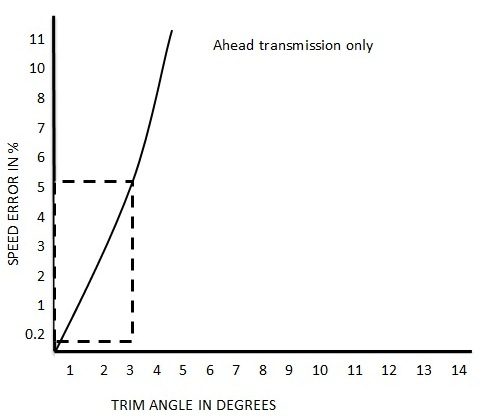
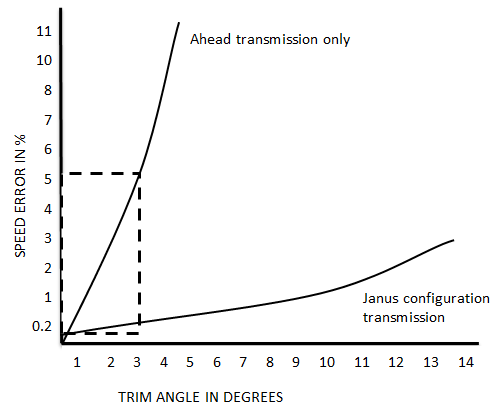
    of speed error caused by variations of the vessel’s trim:
Trim Angle in Degrees - Doppler Log
  • It
    follows that if the angle changes, the speed calculated will be in error
    because the angle of propagation has been applied to the speed calculation
    formula in this way. If the vessel is not in correct trim (or pitching in heavy
    weather) the longitudinal parameters will change and the speed indicated will
    be in error.
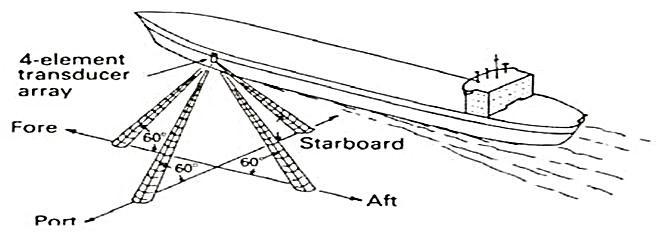
  • To
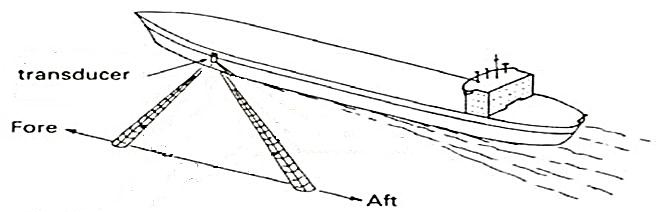
    counteract this effect to some extent, two acoustic beams are transmitted, one
    ahead and one astern. The transducer assembly used for this type of
    transmission is called a ‘Janus’ configuration after the Roman god who
    reputedly possessed two faces and was able to see into both the future and the
    past.
Working of a Doppler Log

After installing transducer facing aft, the Doppler frequency shift formula now becomes:-

        Frt – fra – 4 vft cos a / c

Hence, v = c (frt – fra) / 4 ft cos a

  • Therefore
    the transmission angle can effectively be ignored.
  • The
    advantage of having a Janus configuration over a single transducer arrangement.
    It can be seen that a 3O change of trim on a vessel in a forward
    pointing Doppler system will produce a 5 % velocity error. With a Janus
    configuration transducer system, the error is reduced to 0.2% but is not fully
    eliminated.
Trim Angle in Degrees - Doppler Log
  • The addition of a
    second transducer assembly set at right angles to the first one, enables dual
    axis speed (longitudinal speed and transverse speed) to be indicated.
Working of a Doppler Log

Docking Operation:

  • The placing of the Janus configuration in a fore and aft direction is known as a single axis system and is used to calculate speed over ground in the forward and after direction. A dual axis system places a second grouping of Janus configured transducers in an athwart ships direction allowing for the calculation of a vessel’s speed when moving sideways through the water, as in docking. The beam width of the athwart ship installation is about 8 degrees to account for the possibility of a vessel’s rolling.
  • The Doppler system calculates speed to within an accuracy of about 0.5 percent of the distance traveled. It functions well for all speeds that modern vessels can attain and works from a minimum depth of about 1.5 feet to a maximum depth of about 600 feet. Frequencies employed are between 100 kHz and 600 kHz. There are primarily four errors to be aware of when using the Doppler system:
    • Transducer orientation error caused when the pitching or rolling of the vessel becomes excessive.
    • Vessel motion error caused by excessive vibration of the vessel as it moves through the water.
    • Velocity of sound errors due to changes in water temperature or den­sity due to salinity and particle content.
    • Signal loss errors caused by attenuation of the vibrations during tran­sit through the water or upon reflection from the bottom.
  • The Doppler system normally measures speed over ground to about 600 feet. This depth signals may be returned by a dense, colder layer of water located throughout the oceans called the deep scattering layer (DSL). Signals received off the DSL are not as accurate as signals received from bottom reflections but can still be used to provide an indication of speed through the water instead of speed over ground when bottom tracking. Your unit may have a manual or automatic system which will switch from bottom tracking to water tracking at increased depth.
  • The Doppler system can be connected with other electronic navigation systems providing generally accurate speed input. The navigator should be cautioned that precise speed should be determined not only by using the Doppler but also from careful calculations of distances between accurate navigational fixes.

Errors in a Doppler log & how are some of these errors overcome by the Janus Configuration:

ERRORS OF DOPPLER LOG:- The Log speed indicated is subject to various errors, spanning installation, equipment, data processing, varying propagation conditions and sea conditions.

  • Error in transducer orientation:- The transducers should make a perfect angle of 60° with respect to the keel or else the speed indicated will be inaccurate.
  • Error in oscillator frequency:- The frequency generated by the oscillator must be accurate and constant. Any deviation in the frequency will result in the speed showing in error.
  • Error in propagation:- The velocity of the acoustic wave at a temperature of 16°C and salinity of 3.2% is 1505 m/sec but taken as 1500 m/sec for calculation. This velocity changes with temperature, salinity and pressure. To compensate the error due to temperature change, a thermister is mounted near the transducer and change in velocity of the acoustic wave through the water from the standard value due to the change in sea water temperature is accounted for.
  • Error in ships’ motion:- During the period of transmission and reception, the ship may have a marginal roll or pitch and thereby the angle of transmission and reception can change and a two degree difference in the angle of transmission and reception can have a 0.10% error in the indicated speed, which is marginal and can be neglected.
  • Error due to rolling/pitching:- The effect of pitching will cause an error in the forward speed and not the athwartship speed. Similarly, rolling will have an effect on the athwartship speed, not the forward speed.

Actual speed = Indicated speed/Cosß

  • Error due to inaccuracy in measurement of frequency:- The difference
    in the frequencies received by the forward and aft transducers must be measured
    accurately. Any error in this will be directly reflected in the speed of the
    vessel.
  • Error due to side lobe:- When the side
    lobe reception dominates over the main beam reception, there will be an error
    in the speed indicated. The error is more pronounced on a sloping bottom as the
    side lobe is reflected at a more favourable angle and will have path length
    less than the main beam. This error can be eliminated with the help of the
    Janus configuration and to reduce this error, the beam of the transmitted
    acoustic wave is reduced.

THE ‘SPEED’ FORMULA WITH SHIP MOVEMENTS CORRECTION – JANUS CONFIGURATION:-

As the ship moves forward, she also has an up and down motion in the vertical direction, called ‘heaving’. The vertical motion component is v sin α.

Working of a Doppler Log

As this movement of the ship has an effect on the frequency shift, it should be accounted for. This is done by installing a second set of transducers (for transmitting and receiving) in the aft direction at the same angle of 60º. (Refer figure). This type of installation setup is called Janus Configuration.

The effect of frequency shift due to vertical motion (the component v sin α ) of the ship gets cancelled out in Janus Configuration and the resultant ship speed is calculated by the formulae:

v = c (Frf – Fra) / 4 Ft cos α

Where,

  • v= ship’s speed
  • c= speed of acoustic wave in water
  • Frf = Freq. of the received wave, from fwd direction
  • Fra = Freq. of the received wave, from aft direction
  • Ft = Freq. of the transmitted wave
  • α = angle of acoustic wave transmission

Posted on

Echo Sounder on Ships

Basic Principles of Echo Sounder:

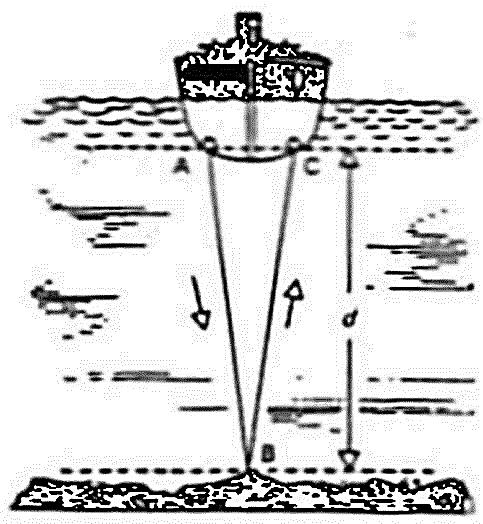
Short pulses of sound vibrations are transmitted from the bottom of the ship to the seabed. These sound waves are reflected back by the seabed and the time taken from transmission to reception of the reflected sound waves is measured. Since the speed of sound in water is about 1500 m/sec, the depth of the sea bed is calculated which will be half the distance travelled by the sound waves.

Principles of Echo Sounder

The received echoes are converted into electrical signal by the receiving transducer and after passing through to stylus which burns out the coating of the thin layer of aluminum powder and produces the black mark on the paper indicating the depth of seabed.

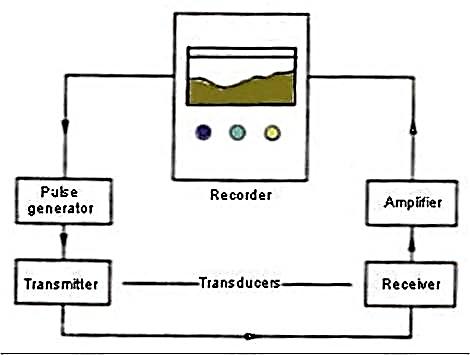
Components of Echo Sounder:

Components of Echo Sounder
  • Basically an echo sounder has following components:
  • Transducer – to generate the sound vibrations and also receive the reflected sound vibration.
  • Pulse generator – to produce electrical oscillations for the transmitting transducer.
  • Amplifier – to amplify the weak electrical oscillations that has been generated by the receiving transducer on reception of the reflected sound vibration.
  • Recorder – for measuring and indicating depth.

CONTROLS:-

  • An echo sounder will normally have the following controls:
  • Range Switch – to select the range between which the depth is be checked e.g.  0- 50 m, 1 – 100 m, 100 – 200 m etc.  Always check the lowest range first before shifting to a higher range.
  • Unit selector switch – to select the unit feet, fathoms or meter as required.
  • Gain switch – to be adjusted such that the clearest echo line is recorded on the paper.
  • Paper speed control – to select the speed of the paper – usually two speeds available.
  • Zero Adjustment or Draught setting control – the echo sounder will normally display the depth below the keel.  This switch can be used to feed the ship’s draught such that the echo sounder will display the total sea depth.  This switch is also used to adjust the start of the transmission of the sound pulse to be in line with the zero of the scale in use.
  • Fix or event marker – this button is used to draw a line on the paper as a mark to indicate certain time e.g. passing a navigational mark, when a position is plotted on the chart etc.
  • Transducer changeover switch – in case vessel has more than one switch e.g. forward and aft transducer.
  • Dimmer – to illuminate the display as required.

Working:

  • The acoustic pulses of very short duration are transmitted vertically at the rate of 5 to 600 pulses per minute having a beam width of 12 to 25°.
  • These pulses strike the seabed and get reflected back towards the receiving transducer as echoes.
  • These received echoes are converted into electrical signals by the receiving transducer and after passing through the different stages of the receiver, the current is supplied to the stylus which bums out the coating of the thin layer of aluminium powder and produces a black mark on the paper indicating the depth of the seabed.

Principle used in the working of an Echo Sounder:-

There are two techniques:-

  • Ranging
  • Phasing

Ranging:-

  • In echo sounder the stylus is mounted on circular belt driven by means of a stylus motor which moves at certain speed and transmission takes place when the stylus passes the zero marks.
  • A magnet fixed on the stylus belt triggers the transmitter to transmit a pulse every rotation of belt when stylus is at zero mark on the paper scale, the transmission of the acoustic waves from the transducer is synchronized with the stylus at the zero mark.
  • The acoustic waves are reflected from the seabed and echoes are received by the transducer and after passing through various stages eventually the current is supplied to stylus which burns out the coating of the thin layer of aluminum powder and produces the black mark on the paper indicating the depth of seabed.
  • This cycle is repeated for every rotation so as the paper is pulled across the display, the profile of seabed is obtained.
  • Suppose the lowest range scale is 0 to 50 M, the transmission will take place when stylus reaches at the zero mark.
  • When the higher range is selected say 0 to 100 M, in order to cater for this range scale, the speed of the stylus motor is reduced, in this process the scale magnification is lost and as we switch over to higher ranges the scale becomes more & more congested.
  • To overcome this problem some of echo sounding machines work on phasing technique.

Phasing:-

  • In phasing the speed of the stylus motor remains constant.
  • Instead of changing the speed of the stylus, the transmission point is advanced.
  • If the first range is 0 to 50 M the second range will be 50 to 100 M (instead of 0 to 100 M).
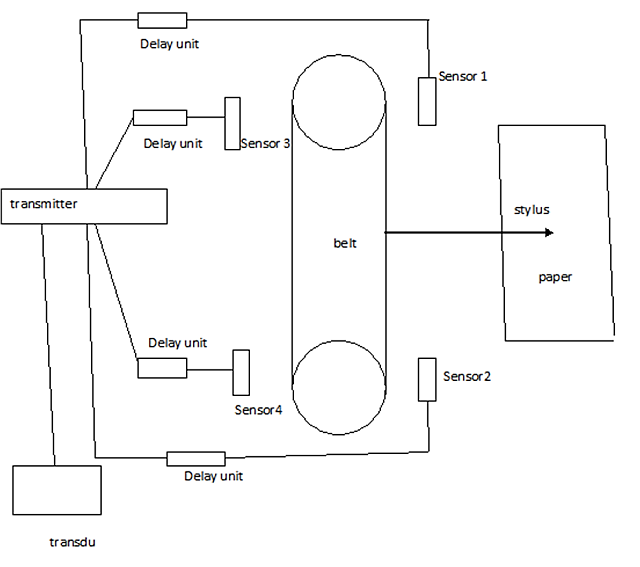
  • Various sensors are positioned around the stylus belt, the magnet generates the pulse when it passes the sensors which in turns activates the transmitter.
  • In the below diagram, when we select the lowest range i.e. 0 to 50 M, the magnet mounted on the stylus belt will activate sensor no. 1, transmission takes place when the stylus exactly passes over the zero mark, when we switch over to higher range, say 50 to 100 M, the magnet mounted on the stylus belt will activate sensor no.2 and transmission will take place early, at the time of the transmission, the stylus will not be passing over 50 M mark on display unit, in other words there will be delay introduced by delay unit no.2 & the stylus will reach the 50 M on display unit after delay of 0.067 seconds. (50 x 2 / 1500, where 50 correspond to the range, multiplied by 2 because double of distance is covered by acoustic waves & the echoes and 1500 is the speed of acoustic waves).
  • Likewise, when we switch over to higher range say, 100 to 150 M, magnet mounted on the stylus belt will activate sensor no. 3 & more delay will be introduced for the stylus to pass over the 100 M.
Working of an Echo Sounder

Caution when using phasing technique: – We must always start sounding at lowest range and check for echoes, adjust the gain control if required and then only switch over to higher range.


Errors of Echo Sounder:

  • Velocity of propagation in water:- The velocity changes with temperature salinity & pressure. The velocity of the acoustic wave assumed at the temperature of 16 degree C & Salinity of 3.4% is 1505 m/sec, but generally it is taken as 1500 m/sec for calculations. As velocity is varying hence depth recorded will be erroneous. Depth indicated in Fresh water can be about 3% higher than the actual depth. NP 139 can be referred in order to obtain the corrections. To compensate the error due to temperature variation, a component called “thermistor” may be mounted near the transducer & change in velocity of the acoustic wave through water from the standard value due to the change in sea water temperature is accounted for. Error due to pressure is not so significant.
  • Stylus speed error:- The speed of the stylus is such that the time taken by the stylus to travel from top to bottom on chart is same as the time taken by sound waves to travel twice the range selected, but due to fluctuation in voltage supplied to stylus motor, will cause error in the recorded depth.
  • Pythagoras error:- This error is found when two transducers are used, one for transmission and the other one for reception. This error is calculated using the Pythagoras principle. This error becomes prominent whenever distance between two transducer is more than 2 mtrs, manual should be referred in order to use the table for corrections.
  • Multiple echoes:- The echo may be reflected no. of times from the bottom of the sea bed, hence providing the multiple depth marks on paper.
  • The thermal and density layers:- The density of the water varies with temperature and salinity, which all tends to form different layers. The sound wave may be reflected from these layers.
  • Zero line adjustment error:- If the zero is not adjusted properly, it will give error in reading.
  • Cross noise:- If sensitivity of the amplifier is high, just after zero marking a narrow line along with the several irregular dots and dashes appear and this is called cross noise. The main reasons for the cross noise are aeration and picking up the transmitted pulse. If intensity of cross noise is high, it will completely mask the shallow water depths. This is controlled by swept gain control circuit.
  • Aeration:- When the sound wave is reflected from the reflected from the air bubbles, it will appear as dots, this is known as aeration.
    • Aeration can be due to pockets of bubble due to heavy weather.
    • Rudder hard over causing drastic alteration of course.
    • Pitching in light condition.
    • Whilst astern propulsion. (Switch over to forward transducer if available.)

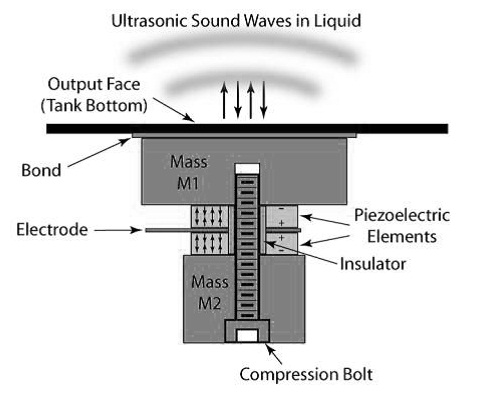
Electrostrictive Transducer with respect to Echo Sounder:

Electrostrictive Transducer
Electrostrictive Transducer (credit)
  • This type of transducer works on the basic principle of piezo-electric effect, i.e., certain crystals such as quartz, have a property that when pressure is applied to the two opposite faces, a difference of potential is created which is proportional to the applied pressure or when an alternating voltage is applied,
    the crystals start vibrating or oscillating. This type of transducer is also known as Piezostrictive transducer.
  • The electrostrictive transducer uses the property of a crystal for transmission and reception of acoustic waves in water. The crystal is firmly fixed between two steel plates so that they act as a single unit.
  • The purpose of the steel plates is to provide solid and robust housing for the crystal as well as a suitable contact surface for seawater.
  • When an alternating voltage is applied between the steel plates, the quartz and the steel plates start vibrating together. The vibration will be of very high amplitude, if the frequency of the alternating voltage is equal to the resonance frequency of the crystal. The lower of the two steel plates is in direct contact with the water, which will cause the vibration in the seawater.
    The vibration is always perpendicular to the plate and hence always kept horizontally.
  • Generally, only one transducer is used for transmission and reception of the signals and this transducer is always mounted as pierced hull.
Posted on

Emergency Position Indicating Radio Beacon (EPIRB) on Ship

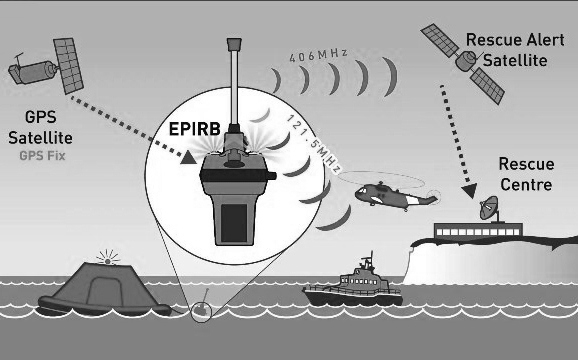
Emergency Position Indicating Radio Beacon (EPIRB):

Emergency Position Indicating Radio Beacon (EPIRB) on ships
  • EPIRB stands for Emergency Position Indicating Radio Beacon.
  • An EPIRB is meant to help rescuers locate you in an emergency situation, and these radios have saved many lives since their creation in the 1970s.
  • Boaters are the main users of EPIRBs.
  • A modern EPIRB is a sophisticated device that contains:
    • A 5-watt radio transmitter operating at 406 MHz (see How the Radio Spectrum Works for details on frequencies).
    • A 0.25-watt radio transmitter operating at 121.5 MHz.
  • A GPS receiver once activated, both of the radios start transmitting. Approximately 24,000 miles (39,000 km) up in space, a GOES weather satellite in a geosynchronous orbit can detect the 406-MHz signal. Embedded in the signal is a unique serial number, and, if the unit is equipped with a GPS receiver, the exact location of the radio is conveyed in the signal as well. If the EPIRB is properly registered, the serial number lets the Coast Guard know who owns the EPIRB. Rescuers in planes or boats can home in on the EPIRB using either the 406-MHz or 121.5-MHz signal.
Posted on

Vessel Traffic Service (VTS)

How do VTS contribute to safety of life at sea?

VESSEL TRAFFIC SERVICE (VTS):- A vessel traffic service (VTS) is a marine traffic monitoring system established by harbour or port authorities, similar to air traffic control for aircraft. Typical VTS systems use radar, closed-circuit television (CCTV), VHF radiotelephony and automatic identification system to keep track of vessel movements and provide navigational safety in a limited geographical area

SOLAS CHAPTER V – REGULATION 12 – Vessel traffic services:-

  1. Vessel traffic services (VTS) contribute to safety of life at sea, safety and efficiency of navigation and protection of the marine environment, adjacent shore areas, work sites and offshore installations from possible adverse effects of maritime traffic.
  2. Contracting Governments undertake to arrange for the establishment of VTS where, in their opinion, the volume of traffic or the degree of risk justifies such services.
  3. Contracting Governments planning and implementing VTS shall, wherever possible, follow the guidelines developed by the Organization*. The use of VTS may only be made mandatory in sea areas within the territorial seas of a coastal State.
  4. Contracting Governments shall endeavor to secure the participation in, and compliance with, the provisions of vessel traffic services by ships entitled to fly their flag.
  5. Nothing in this regulation or the guidelines adopted by the Organization shall prejudice the rights and duties of Governments under international law or the legal regimes of straits used for international navigation and archipelagic sea lanes.

Benefits of implementing a VTS

The purpose of VTS is to improve the maritime safety and efficiency of navigation, safety of life at sea and the protection of the marine environment and/or the adjacent shore area, work sites and offshore installations from possible adverse effects of maritime traffic in a given area. VTS may also have a role to play in security.

The benefits of implementing a VTS:-

  • It allows identification and monitoring of vessels, strategic planning of vessel movements and provision of navigational information and navigational assistance.
  • It can assist in reducing the risk of pollution and, should it occur, coordinating the pollution response. Many authorities express difficulty in establishing justifiable criteria for identifying whether VTS is the most appropriate tool to improve the safety and efficiency of navigation, safety of life and the protection of the environment.
  • A VTS is generally appropriate in areas that may include any, or a combination, of the following:
    • high traffic density;
    • traffic carrying hazardous cargoes;
    • conflicting and complex navigation patterns;
    • difficult hydrographical, hydrological and meteorological elements;
    • shifting shoals and other local hazards and environmental considerations;
    • interference by vessel traffic with other waterborne activities;
    • number of casualties in an area during a specified period;
    • existing or planned vessel traffic services on adjacent waterways and the need for cooperation between neighbouring states, if appropriate;
    • narrow channels, port configuration, bridges, locks, bends and similar areas where the progress of vessels may be restricted; and
    • existing or foreseeable changes in the traffic pattern in the area.

Objectives of VTS:

  1. The purpose of vessel traffic services is to improve the safety and efficiency of navigation, safety of life at sea and the protection of the marine environment and/or the adjacent shore area, worksites and offshore installations from possible adverse effects of maritime traffic.
  2. A clear distinction may need to be made between a Port or Harbour VTS and a Coastal VTS. A Port VTS is mainly concerned with vessel traffic to and from a port or harbour or harbours, while a Coastal VTS is mainly concerned with vessel traffic passing through the area. A VTS could also be a combination of both types. The type and level of service or services rendered could differ between both types of VTS; in a Port or Harbour VTS a navigational assistance service and/or a traffic organization service is usually provided for, while in a Coastal VTS usually only an information service is rendered.
  3. The benefits of implementing a VTS are that it allows identification and monitoring of vessels, strategic planning of vessel movements and provision of navigational information and assistance. It can also assist in prevention of pollution and co-ordination of pollution response. The efficiency of a VTS will depend on the reliability and continuity of communications and on the ability to provide good and unambiguous information. The quality of accident prevention measures will depend on the system’s capability of detecting a developing dangerous situation and on the ability to give timely warning of such dangers.
  4. The precise objective of any vessel traffic service will depend upon the particular circumstances in the VTS area and the volume and character of maritime traffic as set forth in 3.2 of these Guidelines and Criteria.

Use of VTS in navigation:

  • Automatic Identification System (AIS) is a system that makes it possible to monitor and track ships from suitably equipped ships, and shore stations. AIS transmissions consist of bursts of digital data ‘packets’ from individual stations, according to a pre-determined time sequence.
  • AIS makes navigation safer by enhancing situational awareness and increases the possibility of detecting other ships, even if they are behind a bend in a channel or river or behind an island in an archipelago.
  • AIS can also solve the problem inherent with radars, by detecting smaller craft, fitted with AIS, in sea and rain clutter.

Reporting procedures of VTS and SRS:

Reporting procedures of VTS and SRS:- Standard Reporting Procedures, IMO Resolution A.851 (20) – ‘General Principles for Ship Reporting Systems and Ship Reporting Requirements’.

Types of Communication Messages and Message Markers:-

  • To facilitate shore-to-ship and ship-to-shore communication in a VTS environment, one of the following eight message markers should be used to increase the probability of the purpose of the message being properly understood.
  • It is at the discretion of the shore personnel or the ship’s officer whether to use one of the message markers and, if so, which marker is applicable to the situation.
  • If used, the message marker is to be spoken preceding the message or the corresponding part of the message.
  • The contents of all messages directed to a vessel should be clear; IMO Standard Marine Communication Phrases should be used where practicable.

Elements of the Ship’s Routeing System:

The objective of ships’ routeing is to “improve the safety of navigation in converging areas and in areas where the density of traffic is great or where freedom of movement of shipping is inhibited by restricted sea room, the existence of obstructions to navigation, limited depths or unfavourable meteorological conditions”. Ships routeing systems can be established to improve safety of life at sea, safety and efficiency of navigation, and/or increase the protection of the marine environment.

Elements used in traffic routeing systems include:

  • Traffic separation scheme: a routeing measure aimed at the separation of opposing streams of traffic by appropriate means and by the establishment of traffic lanes.
  • Traffic lane: an areas within defined limits in which one-way traffic is established, natural obstacles, including those forming separation zones, may constitute a boundary.
  • Separation zone or line: a zone or line separating traffic lanes in which ships are proceeding in opposite or nearly opposite directions; or separating a traffic lane from the adjacent sea area; or separating traffic lanes designated for particular classes of ship proceeding in the same direction.
  • Roundabout: a separation point or circular separation zone and a circular traffic lane within defined limits.
  • Inshore traffic zone: a designated area between the landward boundary of a traffic separation scheme and the adjacent coast.
  • Recommended route: a route of undefined width, for the convenience of ships in transit, which is often marked by centreline buoys.
  • Deep-water route: a route within defined limits which has been accurately surveyed for clearance of sea bottom and submerged articles.
  • Precautionary area: an area within defined limits where ships must navigate with particular caution and within which the direction of flow of traffic may be recommended.
  • Area to be avoided: an area within defined limits in which either navigation is particularly hazardous or it is exceptionally important to avoid casualties and which should be avoided by all ships, or by certain classes of ships.

Before Implementing or starting a TSS or Vessel routeing system the below mentioned information should be collected:

  1. Data about the area and problem or threat thereof:
    • Resources within are
    • Potential navigation hazard.
    • Environmental factors
  2. Data about the ship traffic (e.g., vol., traffic patterns)
  3. Information regarding existing measures
  4. Foreseeable changes in traffic patterns
  5. Information regarding incident history
  6. Existing aids to navigation
  7. Charts (are they up to date?)
  8. IMO documents (models)


VTS Category – Information Service:

Defined by IMO as ‘a service to ensure that essential information becomes available in time for on-board navigational decision-making’. The information service comprises broadcasts of information at fixed times or when deemed necessary by the VTS Authority or at the request of a vessel, and may include for example :

  1. Reports on the position, identity and intentions of other traffic;
  2. Waterway conditions;
  3. Weather;
  4. Navigational hazards;
  5. Any other factors that may influence the vessel’s transit.

Navigational Assistance Service: Defined by IMO as ‘a service to assist on-board navigational decision-making and to monitor its effects, especially in difficult navigational or meteorological circumstance or in case of defect or deficiencies.’ There may be occasions when an increased or new risk makes it appropriate to enhance the service through the additional provision of a Navigational Assistance Service. The IMO Resolution explains the key tenets of this service as:

  1. A service that is intended to assist in the navigational decision making process on board and to monitor its effects.
  2. Particularly relevant to:
    • Difficult navigational circumstances;
    • Difficult meteorological conditions;
    • Vessel defects or deficiencies.
  3. A service that is rendered at the specific request of a vessel or by a VTS Authority when deemed necessary.
  4. A service that is provided only on specified occasions and under clearly defined circumstances.
  5. The beginning and end of navigational assistance should be clearly stated by the vessel or the VTS and acknowledged by the other party.

The IALA VTS Manual indicates that Navigational Assistance Service can fall into one of two categories, depending on whether navigational information or advice is given. Navigational Assistance Service consisting only of the giving of navigational information is referred to in this guidance as Contributory. Navigational Assistance Service consisting of the giving of navigational advice as well as navigational information is referred to as Participatory. The definitions, particularly of the Participatory service, are open to interpretation and for the avoidance of doubt their meaning is refined and expanded as follows.

  1. Contributory Navigational Assistance Services:

A Contributory Navigational Assistance Service is solely the provision of factual navigational information to assist the on-board decision making process.

The information is provided either in response to a specific request from a vessel or when the VTS Authority perceives that the information would be of use to the vessel.

A Contributory Navigational Assistance Service may include information on :

  1. Courses and speeds made good;
  2. Positions relative to fairway axis and waypoints;
  3. Positions, identities and intentions of surrounding traffic;
  4. Warnings of dangers.
  1. Participatory Navigational Assistance Service:

In a Participatory Navigational Assistance Service, the VTS can become involved in the on-board decision making process by providing navigational advice. Through the exchange of information between vessel and VTS, an agreed course of action may emerge. However, any recommendations from the VTS must be result orientated and must not include specific instructions on courses to steer and speed through the water. As with the Contributory service, it is provided on specific request or when perceived necessary by the VTS Authority, in the interests of safety.

Dependent on the complexity of the situation and the level of risk mitigation required, consideration should be given to the following :

(1) Authorisations of operators providing the service and recording of such authorisations;

(2) The need to reflect this category of service in the On the Job Training of VTS Operators;

(3) Operator work load during Participatory Navigational Assistance Service, including other responsibilities and activities, and the number of vessels being monitored or advised;

(4) Use of a discrete frequency;

(5) Increased traffic restrictions;

(6) The requirements of the Pilotage Act 1987.

Traffic Organisation Service: Defined by IMO as ‘a service to prevent the development of dangerous maritime traffic situations and to provide for the safe and efficient movement of vessel traffic within the VTS Area.’

The provision of a Traffic Organisation Service includes a comprehensive and dedicated service, throughout the declared service period, without which the long term planning of traffic movement and developing situation would not be possible. This service is, by its nature, more comprehensive than an Information Service, the capability of which it necessarily includes.

Where the risks identified through the formal risk assessment are such that the only appropriate mitigating measure is the provision of service that monitors vessel traffic movement and enforces adherence to governing rule and regulation, a Traffic Organisation Service should be considered appropriate.

A Traffic Organisation Service is concerned with, for example :

  1. Forward planning of vessel movements;
  2. Congestion and dangerous situations;
  3. The movement of special transports;
  4. Traffic clearance systems;
  5. VTS sailing plans;
  6. Routes to be followed;
  7. Adherence to governing rules and regulations.

Instructions given as part of a Traffic Organisation Service shall be result orientated, leaving the details of the execution to the vessel.

Posted on

Rate of Turn Indicator on Ship (ROTI)

Rate of Turn Indicator

Introduction:

  • IMO Recommendations on passage planning lay stress on controlled navigation. The passages in narrow channels or harbors are either along straight courses or along arcs of circles.
  • As per SOLAS 2000 Amendment Chapter V Regulation 19.2.9, it is mandatory for ships over 50,000 GRT to have a rate of turn indicator. IMO recommends that large alteration of courses have to be planned along circular tracks with wheel over point marked.
  • The Rate of Turn Indicator (ROTI) is a device which indicates the instantaneous rate at which the ship is turning. It is fitted on ship as an independent fitment integrated with the steering gear/auto pilot.
Rate of Turn Indicator of Ship
  • When the wheel is turned over, the ship actually traverses along a curved track rather than performing a sharp turn about a point. It is very useful knowing the nature of this traversed path the ship takes which can help in planning:
    • The desired turn with given radius
    • Desired speed of the vessel to execute the planned turn.
    • When to apply the turn (wheel over point).

RATE OF TURN FORMULAE:

ROT = v/R

Where,

v – Speed of the vessel .

R – Radius from a fixed point around which to turn the ship.

Note: ROT is directly proportional to the speed.

ROT is inversely proportional to radius.


Use of ROTI (Rate Of Turn Indicator):-

  1. The rate of turn indicator is equipment which indicates the instantaneous rate at which the ship is turning.
  2. This indicator is fed 60 to 200 pulses per minute from the steering repeater and from this input it works out the instantaneous rate of turn.
  3. The dial is marked usually 0O to 60O on either side. As per IMO performance standard the dial should be marked not less than 0O to 30O per minute on either side and graduated in intervals of 1O per minute.
  4. As we know that when ship turn she actually traverses some distance round the arc of a circle and cannot execute a sharp turns about a point.
  5. When ship is making a turn it precise the ship track uncertain due to her characteristic, condition, weight and UKC.
  6. Therefore navigator uses the touch of ship track during the turn that is uncertain of position until the ship is steadied on the new course.
  7. IMO recommends for passage planning is not only monitor the position on straight course but also on curve section of passage. This can be achieved by the technique called radius turn by the help of roti and ship’s log.

Posted on

Ship Reporting System

Ship Reporting System (SRS):

  • A ship reporting system enables the SMC to quickly:
    • Identify vessels in the vicinity of a distress situation, along with their positions, courses, and speeds
    • Be aware of other information about the vessels, which may be valuable (whether a doctor is aboard, etc.)
    • Know how to contact the vessels
  • Masters of vessels are urged to send regular reports to the authority operating a ship reporting system for SAR.

The Automated Mutual-Assistance Vessel Rescue (AMVER) System:-

  • AMVER is a worldwide system operated exclusively to support SAR and make information available to all RCCS.
    • There is no charge for vessels to participate in, nor for RCCs to use AMVER
    • Many land-based providers of communications services world-wide relay ship reports to AMVER free of charge.
  • Any merchant vessel of 1,000 gross tons or more on any voyage of greater than 24 hours is welcome to participate.
  • Benefits of participation include:
    • Improved likelihood of rapid aid during emergencies
    • Reduced number of calls for assistance to vessels unfavorably located to respond
    • Reduced response time to provide assistance.

Types of Reports does a ship need to send out:

Reports should be sent as follows:

  • Sailing plan (SP) – Before or as near as possible to the time of departure from a port within a reporting system or when entering the area covered by a system.
  • Position report (PR) – When necessary to ensure effective operation of the system.
  • Deviation report (DR) – When the ship’s position varies significantly from the position that would have been predicted from previous reports, when changing the reported route, or as decided by the master.
  • Final report (FR) – On arrival at destination and when leaving the area covered by a system.
  • Dangerous goods report (DG) – When an incident takes place involving the loss or likely loss overboard of packaged dangerous goods, including those in freight containers, portable tanks, road and rail vehicles and shipborne barges, into the sea.
  • Harmful substances report (HS) – When an incident takes place involving the discharge or probable discharge of oil (Annex I of MARPOL) or noxious liquid substances in bulk (Annex II of MARPOL).
  • Marine pollutants report (MP) – In the case of loss or likely loss overboard of harmful substances in packaged form, including those in freight containers, portable tanks, road and rail vehicles and shipborne barges, identified in the International Maritime Dangerous Goods Code as marine pollutants (Annex III of MARPOL).
  • Any other report – Any other report should be made in accordance with the system procedures as notified in accordance with paragraph 9 of the General Principles.

Importance of Ship Reporting Systems for safe navigation:

  1. Ship reporting systems contribute to safety of life at sea, safety and efficiency of navigation and/or protection of the marine environment. A ship reporting system, when adopted and implemented in accordance with the guidelines and criteria developed by the Organization pursuant to this regulation, shall be used by all ships, or certain categories of ships or ships carrying certain cargoes in accordance with the provisions of each system so adopted.
  2. The Organization is recognized as the only international body for developing guidelines, criteria and regulations on an international level for ship reporting systems. Contracting Governments shall refer proposals for the adoption of ship reporting systems to the Organization. The Organization will collate and disseminate to Contracting Governments all relevant information with regard to any adopted ship reporting system.
  3. The initiation of action for establishing a ship reporting system is the responsibility of the Government or Governments concerned. In developing such systems provision of the guidelines and criteria developed by the Organization shall be taken into account.
  4. Ship reporting systems not submitted to the Organization for adoption do not necessarily need to comply with this regulation. However, Governments implementing such systems are encouraged to follow, wherever possible, the guidelines and criteria developed by the Organization. Contracting Governments may submit such systems to the Organization for recognition.
  5. Where two or more Governments have a common interest in a particular area, they should formulate proposals for a co-ordinated ship reporting system on the basis of agreement between them. Before proceeding with a proposal for adoption of a ship reporting system, the Organization shall disseminate details of the proposal to those Governments which have a common interest in the area covered by the proposed system. Where a co-ordinated ship reporting system is adopted and established, it shall have uniform procedures and operations.
  6. After adoption of a ship reporting system in accordance with this regulation, the Government or Governments concerned shall take all measures necessary for the promulgation of any information needed for the efficient and effective use of the system. Any adopted ship reporting system shall have the capability of interaction and the ability to assist ships with information when necessary. Such systems shall be operated in accordance with the guidelines and criteria developed by the Organization pursuant to this regulation.
  7. The master of a ship shall comply with the requirements of adopted ship reporting systems and report to the appropriate authority all information required in accordance with the provisions of each such system.
  8. All adopted ship reporting systems and actions taken to enforce compliance with those systems shall be consistent with international law, including the relevant provisions of the United Nations Convention on the Law of the Sea.
  9. Nothing in this regulation or its associated guidelines and criteria shall prejudice the rights and duties of Governments under international law or the legal regimes of straits used for international navigation and archipelagic sea lanes.
  10. The participation of ships in accordance with the provisions of adopted ship reporting systems shall be free of charge to the ships concerned.
  11. The Organization shall ensure that adopted ship reporting systems are reviewed under the guidelines and criteria developed by the Organization.

Explanation of how the ship reporting system provides the necessary information for search & rescue in case of distress:

Ship Reporting System:-

  • A ship reporting system enables the SMC to quickly:
    • identify vessels in the vicinity of a distress situation, along with their positions, courses, and speeds
    • be aware of other information about the vessels, which may be valuable (whether a doctor is aboard, etc.)
    • know how to contact the vessels.
  • Masters of vessels are urged to send regular reports to the authority operating a ship reporting system for SAR.

The Automated Mutual-Assistance Vessel Rescue (AMVER) System:-

  • AMVER is a worldwide system operated exclusively to support SAR and make information available to all RCCS.
    • there is no charge for vessels to participate in, nor for RCCs to use AMVER
    • many land-based providers of communications services world-wide relay ship reports to AMVER free of charge.
  • Any merchant vessel of 1,000 gross tons or more on any voyage of greater than 24 hours is welcome to participate.
  • Benefits of participation include:
    • improved likelihood of rapid aid during emergencies
    • reduced number of calls for assistance to vessels unfavorably located to respond
    • reduced response time to provide assistance.


Short notes on INSPIRES with respect to Ship Reporting System:

INDIAN Ship position and information reporting system (INSPIRES) :

Indian navy in co-ordination with DG of Shipping has established INSPIRES to exercise effective open ocean vessel management, to provide security to vessel, weather forecast to enhance safety of navigation and monitor incidence of pollution. An Indian Naval communication center (COMCENs) Mumbai and Vizag are functioning as the shore stations for receiving INSPIRES messages from vessels. All Indian vessels including coasting/ fishing vessels of tonnage 300 GRT and above shall participate in this reporting system. All vessels other than Indian ships of tonnage 100 GRT and above are encouraged to participate in this reporting system.

INDIAN SHIP REPORTING SYSTEM:

INDIAN SHIP POSITION AND INFORMATION REPORTING SYSTEM (INSPIRES) SHIP REPORTING SYSTEM FOR SAR (INDSAR):

The INSPIRES has been established to achieve the following objectives:

  • To provide up to date information on shipping for search and rescue.
  • For effective vessel traffic management service.
  • For weather forecasting.
  • For prevention and containment of marine pollution.

This reporting system has wider area of coverage in the Indian Ocean. An Indian Naval Communication Centre (COMCENs) Mumbai and Vishakhapatnam are functioning as the shore stations for receiving INSPIRES messages from all vessels.


Posted on

Voyage Data Recorder (VDR)

Explanation of Voyage Data Recorder (VDR):

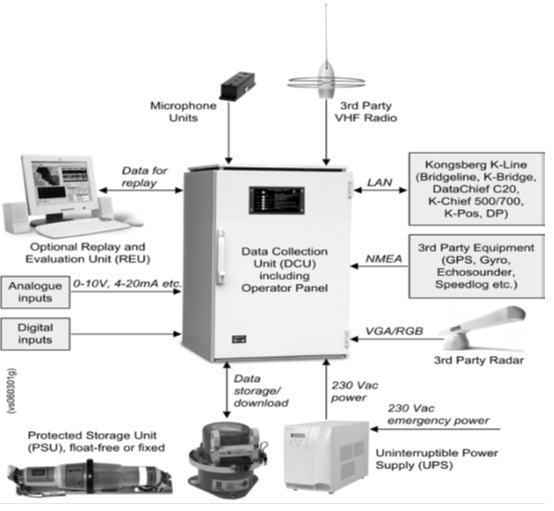
  • A VDR or voyage data recorder is an instrument installed on a ship to continuously record vital information related to the operation of a vessel.
  • It contains a voice recording system for a period of at least last 12 hours.
  • This recording is recovered and made use of for investigation in events of accidents.
  • The data records covering the last 12 hours are continuously overwritten by the latest data.
  • A VDR is capable of withstanding heavy weather, collisions, fires and pressure conditions even when a ship is at a depth of several meters in water.
Voyage Data Recorder (VDR)

Working of VDR:

  • There are various sensors placed on bridge of the ship and on prominent location from which the required data is continuously collected.
  • This data which comprises of voices, various parameters, ships location etc. are then fed to a storage unit where the whole input is recorded and saved for at least 12 hours.
  • There is also a record button provided in the bridge unit so that after pushing button (say during starting of any incident like collision or grounding), the recorder will start recording new set of information from that period of time.
  • The data collected by VDR is digitalised, compressed, and is stored in a protective storage unit which is mounted in a safe place.
  • This tamper proof storage unit can be a retrievable fixed or floating unit connected with EPIRB for early location in the event of accident.

Main Components of VDR:

  • Data Management Unit: It acquires data from various sources using interfaces, processes and stores the data in a specified format.
  • Audio Module:
    • It consists of an audio mixer for recording audio from microphones placed in the wheelhouse, bridge wings, ECR and various other locations.
    • VHF audio signals can also be interfaced with this unit.
  • Final Recording Unit:
    • This is a fire resistant, pressure tight storage medium to store recorded data.
    • The capsule is resistant against shock, penetration, fire, deep sea pressure and immersion. Housed in a highly visible protective capsule which can withstand high temperatures (1100OC) and deep sea pressure of 6000 m.
  • Remote Alarm Module: This is a small panel connected to the Data Management Unit that will sound an alarm should any error or fault develop in the equipment.
  • Replay Station:
    • This is an optional module for downloading and replaying the recorded data.
    • The data when played back can help in casualty investigations as well as for self analysis.
  • Information Recorded:-
    • Date & Time from GPS every 1s
    • Position & Datum – Lat/Long and datum from GPS, Loran-C etc. The source of data is identified on playback.
    • Speed (water / ground) recorded every 1s to 0.1k resolution
    • Heading (gyro or magnetic) is recorded at intervals of 1s to a resolution of 0.1 deg
    • Auto pilot settings for speed, latitude, rudder limit, off-course alarms etc.
    • Bridge audio in real time, both internal & external (150-6000Hz). The mic test beeps every 12 hrs & this is recorded.
    • Radar image recorded every 15s includes range rings, EBLs, VRMs, radar maps, parts of SENC & other essential navigational indications.
    • Wind speed/direction from the Anemometer is recorded & stored individually with time stamps.
    • VHF communication from 2 VHFs are recorded for both transmitted and received audio signals. Audio is compressed and labeled VHF 1 & VHF 2.
    • Hull openings & watertight doors status is received every 1s and stored with time stamps
    • Hull stresses are received and stored with time stamps.
    • Thruster status (bow/stern) can be recorded for their order and response
    • Rudder order and response angle is recorded to a resolution of 1 deg
    • Engine order and response from the telegraph or direct engine control with shaft revolution and ahead and astern indicators are recorded to a resolution of 1 rpm
    • AIS target data is recorded as a source of information regarding other ships.
    • Alarms are recorded with time stamps. All IMO mandatory alarms as well as other audible alarms are stored individually by the bridge audio microphones.

Purpose of VDR:

  • The main purpose of VDR is to record and store ship’s critical parameters to facilitate reconstruction of the incident for the purpose of analysis
  • Additionally navigator can use this for self-analysis, as lessons-learning tool and thus improvement of procedures in the future.
  • VDR can be used to identify cause of an accident and thus make major contribution to maritime safety.
    • The benefits are:
    • Promotion of safe practices
    • Accident investigation and enquiry
    • Response assessment and study
    • Training aid and support
    • Reduction in insurance costs
    • Statistics generation

VOYAGE DATA RECORDER – DATA ITEMS TO BE RECORDED:- IMO Performance Standard (Res. A.861(20)) and IEC Information format (IEC 61996).

DATA ITEM SOURCE
Date & Time Preferably external to ship (e.g.GNSS)
Ship’s position Electronic Positioning system
Speed (through water or over ground) Ship’s SDME
Heading Ship’s compass
Bridge Audio 1 or more bridge microphones
Comms. Audio VHF
Radar data- post display selection Master radar display
Water depth Echo Sounder
Main alarms All mandatory alarms on bridge
Rudder order & response Steering gear & autopilot
Engine order & response Telegraphs, controls and thrusters
Hull openings status All mandatory status information displayed on bridge
Watertight & fire door status All mandatory status information displayed on bridge
Acceleration & hull stresses Hull stress and response monitoring equipment where fitted
Wind speed & direction Anemometer when fitted

Recovery of VDR: Recovery of the VDR is conditional on the accessibility of the VDR or the data contained therein.

  • In the case of a non-catastrophic accident, recovery of the memory should be straightforward. For example, in some VDRs it can be accomplished by removal of a hard disc from the VDR unit. This action will have to be taken soon after the accident to best preserve the relevant evidence for use by both the investigator and the ship owner. As the investigator is very unlikely to be in a position to instigate this action soon enough after the accident, the owner must be responsible, through its on-board standing orders, for ensuring the timely preservation of this evidence in this circumstance.
  • In the case of abandonment of a vessel during an emergency, masters should, where time and other responsibilities permit, recover the memory and remove it to a place of safety and preserve it until it can be passed to the investigator.
  • In the case of a catastrophic accident, where the VDR is inaccessible and the data has not been retrieved prior to abandonment, a decision will need to be taken by the Flag State in co-operation with any other substantially interested States on the viability and cost of recovering the VDR balanced against the potential use of the information. If it is decided to recover the VDR the investigator should be responsible for co-ordinating its recovery. The possibility of the capsule having sustained damage must be considered and specialist expertise will be required to ensure the best chance of recovering and preserving the evidence. In addition the assistance and co-operation of the owners, insurers and the manufacturers of the VDR and those of the protective capsule may be required.

Posted on

Long Range Identification and Tracking (LRIT)

Long Range Identification and Tracking (LRIT) system architecture Explanation:

Purpose of LRIT:-

  • The Long Range Identification and Tracking (LRIT) system is a designated International Maritime Organization (IMO) system designed to collect and disseminate vessel position information received from IMO member States ships.
  • The main purpose of the LRIT ship position reports is to enable a Contracting Government to obtain ship identity and location information in sufficient time to evaluate the security risk posed by a ship off its coast and to respond, if
    necessary, to reduce any risks.
  • LRIT has also become an essential component of SAR operations and marine environment protection.
  • It is a satellite-based, real-time reporting mechanism providing almost worldwide coverage (Inmarsat Coverage) that allows unique visibility to position reports of vessels that would otherwise be invisible and potentially a threat.

CARRIAGE REQUIREMENT of LRIT :- Ships in international voyages

  • Passenger ships
  • Cargo ships over 300 t
  • Mobile platforms

Ships fitted with AIS and sailing in sea A1 areas do not need to transmit LRIT data.

INFORMATION TRANSMITTED in LRIT :-

  • Identity (Ship’s LRIT Identifier)
  • Position (Lat/Long)
  • Date and time (UTC)

UPDATE INTERVAL in LRIT:-

  • Default value 6 hourly
  • Update interval remotely selectable
  • Minimum interval 15 min
  • May be switched off by the Master under certain conditions
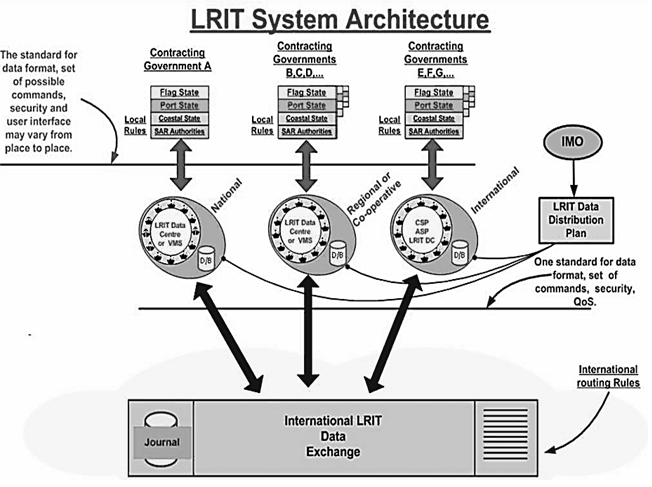
Long Range Identification and Tracking (LRIT) system architecture

THE LRIT SYSTEM CONSISTS OF:

  1. The ship borne LRIT information transmitting equipment.
  2. Communications Service Providers (CSPs).
  3. Application Service Providers (ASPs).
  4. LRIT Data Centres (DC), including any related Vessel Monitoring System(s) (VMSs).
  5. The LRIT Data Distribution Plan (DDP).
  6. The International LRIT Data Exchange (IDE),
  7. LRIT coordinator

How does LRIT differ from AIS Explanation:

  • Some confuse the functions of LRIT with that of AIS (Automatic Identification System), a collision avoidance system also mandated by the IMO, which operates in the VHF radio band, with a range only slightly greater than line-of-sight.
  • (See AIS) While AIS was originally designed for short-range operation as a collision avoidance and navigational aid, it has now been shown to be possible to receive AIS signals by satellite in many, but not all, parts of the world. This is becoming known as S-AIS and is completely different from LRIT.
  • The only similarity is that AIS is also collected from space for determining location of vessels, but requires no action from the vessels themselves except they must have their AIS system turned on.
  • LRIT requires the active, willing participation of the vessel involved, which is, in and of itself, a very useful indication as to whether the vessel in question is a lawful actor.
  • Thus the information collected from the two systems, S-AIS and LRIT, are mutually complementary, and S-AIS clearly does not make LRIT superfluous in any manner.
  • Indeed, because of co-channel interference near densely populated or congested sea areas satellites are having a difficult time in detecting AIS from space in those areas.

Authorized receivers / users of LRIT

LRIT Data Centres:-

  • The primary purposes of an LRIT Data Centre (DC) are to collect, store and make available to authorised entities the LRIT information transmitted by ships instructed by their administrations to utilise the services of that DC. In carrying out these core functions, the DC is required to ensure that LRIT data users are only provided with the LRIT information they are entitled to receive under the terms of SOLAS Regulation V/19.1.
  • In addition, the LRIT DC acts as a “clearing house” by receiving requests for LRIT information lodged in other DCs from its associated Administration(s) and obtaining the data requested. Generally LRIT reports so requested will be exchanged through the International Data Exchange.
  • LRIT Data Centers are required to archive their data so that the reports can be recovered, if required, at a later date and the activities of the DC can be audited by the LRIT Coordinator.
  • LRIT DCs may make a charge for LRIT data they provide to other DCs.
  • DCs may be either National (established to provide service to only one Contracting Government); Cooperative (established to provide services to a number of Contracting Governments) or Regional (established to provide services to a number of Contracting Governments acting through a regional entity of some kind).
    The IMO Performance Standard envisages also an International Data Centre (IDC), to provide LRIT services on an international basis to many countries that do not wish to establish their own DCs, but the IMO Maritime Safety Committee (MSC) has not yet decided to establish such an IDC.

Functions of LRIT National Data Centre

  • The International LRIT Data Exchange (IDE) exists to route LRIT information between LRIT DCs using the information provided in the LRIT Data Distribution Plan. It is therefore connected via the internet to all LRIT DCs and the LRIT Data
    Distribution Plan server.
  • The IDE cannot access and does not archive the LRIT data itself, but it does maintain a journal of message header information – which can be understood as the “envelope” containing the LRIT information. This journal is used for invoicing functions and for audit purposes.
  • The performance of the IDE is audited by the LRIT Coordinator.

How does LRIT differ from AIS?

Explanation:-

  • AIS is a broadcast system and data is available to all receiver in the receiving range whereas LRIT is available only to the authorized person.
  • AIS works on the very high frequency, whereas LRIT is based on the satellite system.
  • AIS range is limited to the VHF range but LRIT range is worldwide.
  • AIS DATA is not stored by any organization whereas LRIT data is stored and available on demand.
  • There is display for AIS ON BOARD but there is no display for LRIT on board the ship.


Compare the AIS & LRIT:

AISLRIT
SatelliteVHF
GlobalOnly where AIS coverage is provided
Secure DataPublic Data
Position, IMO Number, Date TimePosition, IMO Number, Date Time, Vessel Type, Speed, Course
Unlimited rangeLine of sight, up to 40NM
Flag State Owns DataAnyone can see data
Maritime Security and AwarenessNavigation and Anti-collision Tool
Comparison between AIS & LRIT

Posted on

Electronic Chart Display and Information System (ECDIS) on Ships

Electronic Chart Display and Information System (ECDIS) Explanation:-

  • Electronic Chart Display and information Systems (ECIDS) means a navigation information system which with adequate back-up arrangements can be accepted as complying with the up-to-date chart required by regulation V/20 of the 1974 SOLAS Convention, by displaying selected information from a system electronic navigational chart (SENC) with positional information from navigation sensors to assist the mariner in route Monitoring, and if required display additional navigation related information.
  • Generation of ECDIS:-
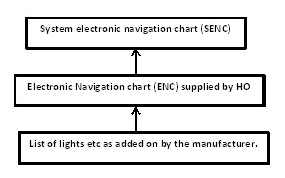
    • The electronic navigation chart is the data base standardized as to content, structure and format and is issued by the hydrographic office (HO) under the authority of the government, the ENC contains all the chart information necessary for safe navigation and may contain supplementary information in addition to that contained in the paper chart (e.g. list of lights and fog signals etc.) which may be considered necessary for safe navigation.
    • The system electronic navigation chart (SENC) is the data base resulting from transformation of the ENC by the ECDIS for appropriate use, updates to the ENC by appropriate means and other data added by the mariner. It is the data base that is actually accessed by the ECDIS for the display generations & other navigational functions and is equivalent to an up-to-date paper chart.
Electronic Chart Display and Information System (ECDIS) Flowchart

ECDIS is basically a CPU with a monitor to display electronic chart, SENC is an integral part and below figure can be referred for better understanding which shows that SENC is interfaced with various equipment as mentioned below results in an ECDIS.


Advantages of Electronic Chart Display and Information System (ECDIS):

  1. Availability: One of the great advantages of ECDIS over paper charts is the availability of electronic charts – especially when voyage orders are received at the last minute.
  2. Speed and Accuracy: With ECDIS as the primary source of navigation, the Navigating Officer can plan and summarise the passage much faster than on Paper Charts. Daily reporting data such as Distance to Go, Distance Covered, Average Speed, etc. can be done quickly with hardly any effort.
  3. Corrections: The Navigating Officer now receives weekly updates to the Electronic Charts via Email which he has to download onto a zip drive and upload them to the ECDIS. Even the dreaded T&P notices are now shown electronically on the ECDIS.
  4. Continuous Monitoring of Vessel’s Position: The ECDIS is interfaced with both the vessel’s independent GPS transceivers, thereby making the system work even if one fails.
  5. Anti-Grounding Alarms and Settings: The ability of the ECDIS to warn the user of approaching shallow waters make it one of the most useful equipment on the bridge.
  6. User Determined Alarm Settings: While there are certain safety critical alarms that are ON by defaults and cannot be changed, there are a host of other alarms and warnings which may be switched on or off by the User depending on the situation.
  7. Enhances Search and Rescue Capability onboard: Modern ECDIS units have the option of interfacing NAVTEX and EGC with the ECDIS display. Warnings and Alerts are automatically displayed on the ECDIS screen, whilst at the same time giving an audible and visual indication on the unit itself.
  8. Cost Efficient: Although, Electronic charts are by no means cheap, they still have an edge over paper charts dollar for dollar.
  9. Environmentally Friendly: The ECDIS does pack in a strong punch in reducing the carbon footprint of every vessel which goes paperless.

Disadvantages of Electronic Chart Display and Information System (ECDIS):

  1. Over-Reliance: A vessel could have switched off its AIS and hence might not be displayed on the ECDIS. If the Radar Overlay is not turned on, the vessel will just not be seen on the ECDIS display. Hence, it is very critical that Navigators continue to maintain an efficient lookout and a good radar watch.
  2. Garbage In Garbage Out (GIGO): Erroneous position inputs from the GPS or loss of GPS signal can have grave consequences with the ECDIS going in DR mode. If the alarm is missed out, the result can be disastrous.
  3. Wrong Settings: Feeding in wrong parameters for safety critical settings such as the Safety Depths, Safety Contours etc can give a false sense of safety.
  4. Alarm Deafness: If alarms start going off too frequently, the navigator could end up in a dangerous situation called Alarm Deafness.
  5. System Lag: Modern ECDIS software can have a lot of data to display and with various equipment interfaced with the ECDIS, the system can slow down very easily leading to system lag.
  6. Different Types: Different vessels will have different types of ECDIS equipment.
  7. Anomalies: Every navigator needs to be aware of the anomalies present in that particular equipment. It could be a simple use of the SCAMIN (Scale Minimum) function or something serious where certain depths or symbols might not be visible at a particular scale or appear differently.
  8. Information Overload: It is very easy to over feed information on the ECDIS. A lot of data which was earlier marked on charts such as position for calling Master notices to Engine Room, Echo Sounder Switch on points, Port Control VHF channels etc now have to be fed on the ECDIS.

Advantages of ECDIS over conventional Paper Charts:

  • Position fixing can be done at required interval without manual interference.
  • Continuous monitoring of the ship’s position.
  • When interfaced with ARPA/RADAR, target can be monitored continuously.
  • If two position fixing system are available, the discrepancy in two systems can be identified.
  • Charts can be corrected with help of CD/Online.
  • Passage planning can be done on ECDIS without referring to other publications.
  • Various alarms can be set on ECDIS.
  • Progress of the passage can be monitored in more disciplined manner, since other navigational data is available on ECDIS.
  • Various alarms can be activated to draw the attention of OOW.
  • More accurate ETA can be calculated.
  • Anchoring can be planned more precisely.

“Zones of Confidence” in ECDIS:-

  • The information presented in a reliability diagram requires knowledge of past and present hydrographic surveying practices — something most mariners neither have nor should need. To address this, the Australian Hydrographic Service developed a system known as “zones of confidence” that has since been adopted internationally.
  • On each nautical chart the accuracy and reliability of the information used to compile the chart is shown on a “zone of confidence” (ZOC) diagram. Within official electronic navigational charts (ENCs), the same information is shown as a layer that can be switched on and off by the mariner.
  • ZOC categories warn mariners which parts of the chart are based on good or poor information and which areas should be navigated with caution. The ZOC system consists of five quality categories for assessed data, with a sixth category for data which has not been assessed.
  • The table accompanying the ZOC diagram on each chart summarizes the meaning of the ZOC categories.

Define ENC as applicable to ECDIS:

Electronic Navigational Chart (ENC) means the database, standardized as to content, structure and format,  issued for use with ECDIS on the authority of government authorized hydrographic offices. The ENC contains all the chart information necessary for safe navigation and may contain supplementary information in addition to that contained in the paper chart (e.g. sailing directions) which may be considered necessary for safe navigation. Vector charts are an example.

Define SENC as applicable to ECDIS:

System Electronic Navigational Chart (SENC) means a database resulting from the transformation of the ENC (a vector chart) by ECDIS for appropriate use, updates to the ENC by appropriate means and other data added by the mariner. It is the database that is actually accessed by ECDIS for the display generation and other navigational functions and is the equivalent to an up-to-date paper chart. The SENC may also contain information from other sources.

Define Standard Display as applicable to ECDIS:

Standard Display means the SENC information that should be shown when a chart is first displayed on ECDIS. Depending upon the needs of the mariner, the level of the information it provides for route planning or route monitoring may be modified by the mariner.

Define Display Base as applicable to ECDIS:

Display Base means the level of SENC information which cannot be removed from the display, consisting of information which is required at all times in all geographic areas and all circumstances. It is not intended to be sufficient for safe navigation.

Define Vector Chart as applicable to ECDIS:

A vector chart is a digital database of all the objects (points, lines, areas, etc.) represented on a chart. Vector charts store information, such as isolated dangers, depths, depth contours, coastline features, cables and pipelines etc in separate layers which can be displayed as per the user’s requirements. Vector charts are also referred to as intelligent charts as they can be interrogated for information not displayed but stored in it’s memory.

Define Raster Chart as applicable to ECDIS:

Raster Chart data is created by scanning the information on a paper chart and storing this information in the form of pixels. Many thousands of pixels together make a flat digital image. Each pixel contains all the data for a particular point: colour, brightness etc. They are also geographically referenced which makes the raster chart identical in every way to the paper chart on which it is based. Raster charts cannot be manipulated or queried. Also referred to as the Raster Chart Display System (RCDS), the information is contained in one single layer only. Information can only be added to this type of chart.