Posted on

Auto Pilot on Ships

Working of a Ship’s Auto Pilot with Sketch:
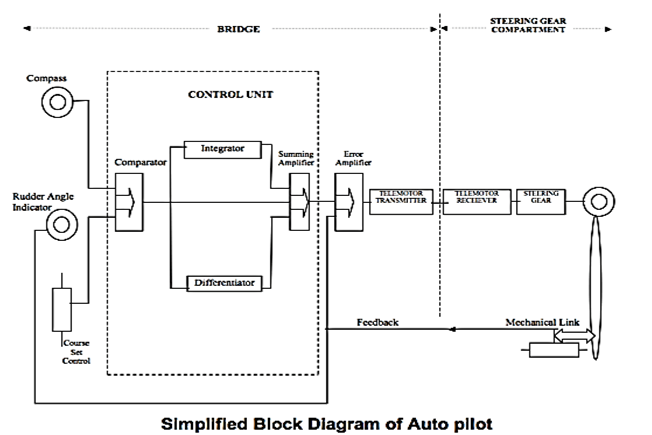
Block Diagram of Ship's Auto Pilot
Block Diagram of Ship’s Auto Pilot
  • An auto pilot is the ship’s steering controller which automatically manipulates the rudder to decrease the error between the reference heading and actual heading.
  • Autopilot relieves the helmsman to great extent but definitely autopilot is not a substitute for helmsman.
  • Autopilot also reduces fuel consumption as the zig-zag course is avoided.

Working of Auto Pilot:-

  • Course is selected by the course selector.
  • Present heading is indicated by the compass.
  • The output from the compass is fed to the comparator in the control unit. The signal from the course selector is also fed to the comparator.
  • Difference between the two signals is causing the output error signal detected by the comparator.
  • Integrator and differentiator also analyze the signal.
  • The signals from the comparator, integrator and differentiator are fed to summing amplifier (control unit).
  • The summing amplifier in turn, passes the signals to error amplifier which also receives feedback from the steering gear.
  • The output of error amplifier is transmitted to steering gear via telemotor transmitter and telemotor receiver.
  • A torque motor may be fitted instead of a telemotor.

Controls available in Auto Pilot console:

The Autopilot Control Unit – The PID Control Unit:- In order to maintain the ship’s course accurately, the deviation signal has to be generated under the following conditions:

  1. When the set course is changed (by the navigator).
  2. When the ship deviates from the set course (due to external factors).

For this purpose, the helm must be provided with data regarding the ship’s movement relative to the course to steer line.

This is achieved by electronic circuits with the help of the following:

  • Proportional control
  • Derivative control
  • Integral control

Proportional Control:-

Proportional Control - Auto Pilot
Proportional Control – Auto Pilot
  • The effect on steering, when only the proportional control is applied, causes the rudder to move by an amount proportional to the off-course error from the course to steer.
  • When the ship has gone off-course to port, an error occurs and helm, proportional to the deviation and hence error signal, is used to bring her back to the set course.
  • As the ship starts to return to the set course, the helm is gradually eased and finally removed when the ship is back on the set course.
  • The rudder will be amidships when the ship reaches its set course and then the heading overshoots resulting in the vessel to go more to starboard. Correcting helm is now applied causing the ship to return to port and back to the original course.
  • The vessel thus keeps on oscillating to port and starboard of the course line.

Derivative Control:-

Derivative Control - Auto Pilot
Derivative Control – Auto Pilot
  • In derivative control, the rudder is shifted by an amount proportional to the rate of change of the ship’s deviation from the course. Any deviation of course to port will cause correcting rudder to be applied to starboard.
  • As the rate of change of course decreases, the automatic rudder control decreases and at a point X, the rudder will return to midships before the vessel reaches its set course.
  • The ship will now make good a course parallel to the required course.

Integral Control:-

Integral Control - Auto Pilot
Integral Control – Auto Pilot
  • Certain errors due to the design of the ship (bow going to port due to transverse thrust, shape of the hull, current draft, etc.) have an impact on the steering capabilities of the ship and have to be corrected for effective overall steering performance.
  • In order to achieve this, signals are produced by sensing the heading error over a period of time and applying an appropriate degree of permanent helm. The rudder used to correct the course will now be about this permanent helm. That is, the permanent helm will now act as midships.
  • Additionally, there are various controls provided on the autopilot system along with a filter system for the action of the winds and waves which supply more data to the autopilot which optimizes the performance of integral control.
  • The output of these three controls is combined and the net resultant thus obtained drives the rudder maintaining the ship on the set course. This type of auto pilot is referred to as PID auto pilot.

Working of “Weather Control” in Auto Pilot System:

Rough weather and hostile sea conditions have adverse effects on the performance of the auto-pilot. Uncontrolled yawing of the ship can result in excessive rudder movement. Modern auto-pilot system has Weather control option in which the system automatically adjusts the setting to adapt to the changing weather and sea conditions. It also provides an option for the user to manual set a specific value.


Working of Yaw Controlin Auto Pilot System:

The setting of the Yaw Control depends upon the wind and weather condition and their effect on the course keeping ability of the ship, in bad weather this setting should be set high and calm weather this should be set low. If Yaw Control is not set properly, the steering gear will over work & there will be excessive load on the system.


Working of “Off Course Alarm” in Auto Pilot System:

Off Course Alarm:- Usually an Off Course Alarm is fitted on the Autopilot. This can be set for the required amount of degrees. So that if at anytime the difference between the actual course and the Autopilot set course is more than the preset degrees, an alarm will warn the officer.

There is however, one limitation which should be noted. In case, the gyro compass itself begins to wander the Autopilot well steer so as to follow the wandering compass and the Off Course Alarm will not sound. It does not ring unless the difference between the course setting and gyro heading is more than the preset limit.


Working of “Rudder Limit” in Auto Pilot System:

Rudder Limit:- This setting specifies the maximum amount of rudder to be used when correcting the ship’s head or when altering course on autopilot. That is, if a setting of 10O is applied for rudder limit, when altering course the rudder will move to a maximum of 10O. This limit can be varied according to the requirements of the navigator.


Purpose of following settings in Autopilot: Rudder

  • This control determines the amount of rudder to be used to correct the slightest amount deviation from the set course.
  • The higher is setting the larger the rudder angle is used to correct a course deviation and this may result in over correcting.
  • But if setting is less, the rudder angle is used to correct deviation may not be sufficient and will take longer time to return to set course.
  • This is proportional controller which transmits a signal which is proportional to course error
    • Controller output = constant (Kp) x Deviation
  • The ratio can be changed by settings (i.e. the ratio between instantaneous heading error and rudder command) also called rudder multiplier.
  • Control Knob alters the ratio of output.
  • Higher setting – Larger rudder angle (results in overcorrecting – overshooting)
  • Lower setting – Less rudder angle (Long time to return to set Co-Sluggish).
  • Therefore, optimum setting required.

Purpose of following settings in Autopilot: Counter Rudder

  • This control determines the amount of counter action by the rudder to be used to steady the ship on the set course keeping the overshoot to minimum.
  • Too low setting will allow the ship to overshoot and too high setting will bring the ship back in long time. 
  • This is Derivative control.
  • Purpose is to apply a relatively greater amount of helm at the beginning of a course alteration to get the ship turning. Once the ship is turning, just enough helm is applied in order to keep her coming around. When new heading is approached, opposite helm is applied to stop the swing. As the ship settles on new heading and the yaw rate disappears, the helm is removed.
  • Produces an output when course of vessel is changing.
  • Depends on rate of change of course:
    • Controller output = constant ( KD ) x change of error / time
  • Determines amount of counter rudder to steady the ship on set course.
  • Keeps over shoot to minimum.
  • Greater the ship’s inertia, greater the setting required. If ship has good dynamic stability, relatively small settings of counter rudder will be sufficient. If the ship is unstable, higher settings will be required.
  • Depends on ship’s characteristics, loaded/ballast conditions and rate of turn.
  • Too high setting will bring the ship to set Co slowly.
  • Too low setting allows overshoot.
  • As counter rudder settings increase, counter rudder increases.
  • KD – Counter rudder time constant (Calibration done at sea trial to set KD).

Purpose of following settings in Autopilot: Constant Helm

Constant / Permanent Helm:

  • This is integral controller. (In NFU this control is out of action).
  • When ship has known imbalance to one side, requiring a certain amount of bias helm (e.g. TT of propeller) manual setting of the approximate bias speed up the effect of the AUTOMATIC PERMANENT HELM calculator, because it started off nearer to its target.
  • Whether the control setting is estimated correctly or left at zero has no effect on the final steering accuracy but only in the time it takes to reach this heading accuracy.
  • If not used as described above , the permanent helm should be left at ZERO and the automatic permanent helm will function normally.
  • Produces output as long a course error persists.
  • Used when beam winds; couple formed causing ship to turn into wind.
  • Rudder position required to counteract is permanent helm.
  • Continuous control calibrated from 20 (P) to 20 (S).

Purpose of following settings in Autopilot: Weather

The setting of the yaw control depends upon the wind and weather condition and their effect on course keeping ability of the ship in bad weather this setting should be set high and calm weather this should be low.


Purpose of following settings in Autopilot: Rudder Limit

Rudder limit: This control specifies the maximum amount of rudder to be used, when correcting the ship’s head or altering the ship’s course.


Auto Pilot should not be used in the following conditions:

  • In narrow channels.
  • At slow speeds.
  • During manoeuvring.
  • During pilotage.
  • During heavy weather conditions.
  • During large alteration of course.
  • Near or in area of restricted visibility.
  • When passing close to vessels etc.
Posted on

Doppler Log on Ships

Principle & Working of Doppler Log: 

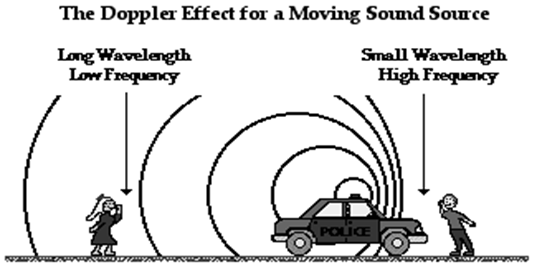
Doppler Effect from a Moving Source
  • Equipment
    to measure ship’s speed.
  • The
    Doppler log is based on measurement of the Doppler effect.
  • The
    Doppler effect can be observed for any type of wave – water wave, sound wave,
    light wave, etc. we are most familiar with the Doppler effect because of our
    experiences with sound waves. For instance, a police car or emergency vehicle
    was travelling towards us on the highway. As the car approached with its siren
    blasting, the pitch of the siren sound (a measure of the siren’s frequency) was
    high; and then suddenly after the car passed by, the pitch off the siren sound
    was low. That was the Doppler Effect – an apparent shift in frequency for a
    sound wave produced by a moving source.
  • The Doppler Effect is a frequency shift that results
    from relative motion between a frequency source and a listener.
  • If
    both source and listener are not moving with respect to each other (although
    both may be moving at the same speed in the same direction), no Doppler
    shift will take place.
  • If
    the source and listener are moving closer to each other, the listener will
    perceive a higher frequency – the faster the source or receiver is
    approaching the higher the Doppler shift.
  • If
    the source and listener are getting further apart, the listener will perceive a
    lower frequency – the faster the source or receiver is moving away the lower
    the frequency.
  • So,
    the Doppler shift is directly proportional to speed between source and
    listener, frequency of the source, and the speed the wave travels.

Explanation of how ship’s speed is transmitted to remote displays:

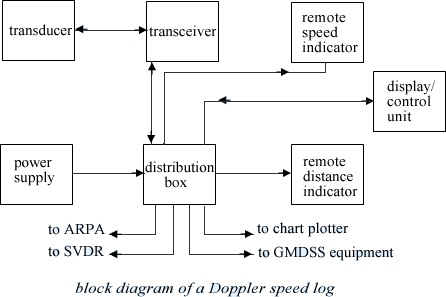
Block Diagram of Doppler Speed Log
  • Distance recording is achieved by using a constant speed motor (10) which drives the distance counter (11), via friction gearing.
  • The constant speed motor has been used in order that a distance indication may be produced that is independent of the non-linear characteristic of the system.
  • The motor is started by contact (5) as previously described.
  • The main shaft (7), whose angle of rotation is directly proportional to the speed of the ship, is fitted with a screw spindle (12).
  • The rotation of the shaft causes a lateral displacement of the friction wheel (13). At zero speed, the friction wheel rests against the apex of the distance cone (14), whilst at maximum speed the wheel has been displaced along the cone to the rim.
  • The distance indicator (11) is driven from the constant speed motor (10) via the cone.
  • The nearer to the rim of the cone the friction wheel rides, the greater will be the distance indication.
  • Revolutions of the distance shaft (15) are transmitted to the remote distance indicator via the servo transmission system (16 and 17).
  • The speed unit provides the following outputs to drive both speed and distance counters:-
    • An analogue voltage, the gradient of which is 0.1 V/knot, to drive the potentiometer servo-type speed indicators.
    • A pulse frequency proportional to speed.
    • The frequency is 200/36 pulses/s/knot. Pulses are gated into the digital counter by a 1.8-s gate pulse.
    • A positive/negative voltage level to set the ahead/astern indication or the B track/W track indication.
    • 2000 pulses per nautical mile to drive the stepping motor in the digital distance indicator.

FORMULA of Doppler Log:-

  • Doppler effect can be further explained by following equations:
    • fr is the frequency received by observer.
    • ft is the transmitted frequency.
    • c is the speed of sound.
    • vO is Velocity of observer
    • vg is Velocity of source
  • If the source moves towards stationary observer, fr = c ft / (c – vg)
  • If the source moves away stationary observer, fr = c ft / (c + vg)
  • If the observer moves towards stationary source, fr = ft (c + vg) / c
  • If the observer moves away from stationary observer, fr = ft (c – vg) / c
  • If the observer & source moves away from each other, fr = ft (c – vg) / (c + vs)
  • If the observer & source moves toward each other, fr = ft (c + vg) / (c – vs)
  • Since,
    in the case of the Doppler log, the source & observer are the same.

Hence,

vO is equal to vS, is equal to v

fr = ft (c+ v) / (c – v)

Principles of Doppler Log

fr = ft (c+ v cos a) / (c – v cos a)

After Further simplification

v = c (fr – ft) / 2 ft cos a

  • Given
    a propogation angle of 60O, cos a = 0.5 (using single transducer
    facing forward)
  • Graphs
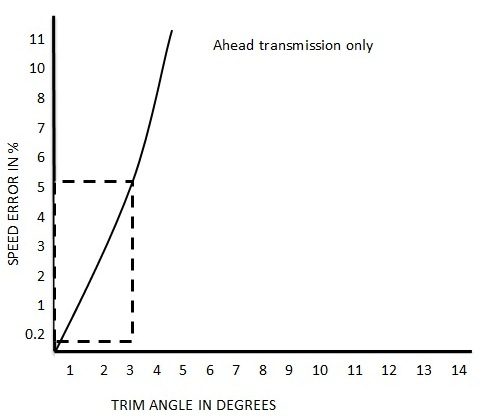
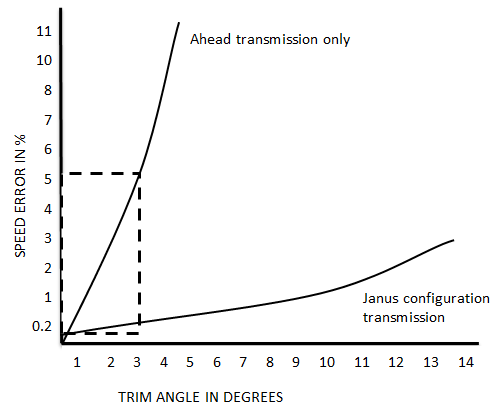
    of speed error caused by variations of the vessel’s trim:
Trim Angle in Degrees - Doppler Log
  • It
    follows that if the angle changes, the speed calculated will be in error
    because the angle of propagation has been applied to the speed calculation
    formula in this way. If the vessel is not in correct trim (or pitching in heavy
    weather) the longitudinal parameters will change and the speed indicated will
    be in error.
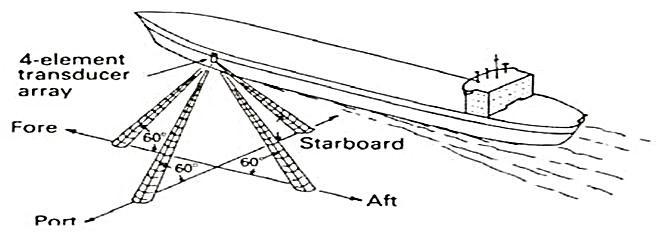
  • To
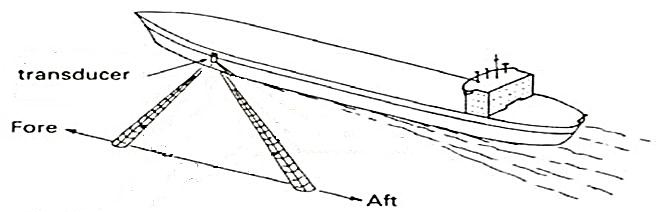
    counteract this effect to some extent, two acoustic beams are transmitted, one
    ahead and one astern. The transducer assembly used for this type of
    transmission is called a ‘Janus’ configuration after the Roman god who
    reputedly possessed two faces and was able to see into both the future and the
    past.
Working of a Doppler Log

After installing transducer facing aft, the Doppler frequency shift formula now becomes:-

        Frt – fra – 4 vft cos a / c

Hence, v = c (frt – fra) / 4 ft cos a

  • Therefore
    the transmission angle can effectively be ignored.
  • The
    advantage of having a Janus configuration over a single transducer arrangement.
    It can be seen that a 3O change of trim on a vessel in a forward
    pointing Doppler system will produce a 5 % velocity error. With a Janus
    configuration transducer system, the error is reduced to 0.2% but is not fully
    eliminated.
Trim Angle in Degrees - Doppler Log
  • The addition of a
    second transducer assembly set at right angles to the first one, enables dual
    axis speed (longitudinal speed and transverse speed) to be indicated.
Working of a Doppler Log

Docking Operation:

  • The placing of the Janus configuration in a fore and aft direction is known as a single axis system and is used to calculate speed over ground in the forward and after direction. A dual axis system places a second grouping of Janus configured transducers in an athwart ships direction allowing for the calculation of a vessel’s speed when moving sideways through the water, as in docking. The beam width of the athwart ship installation is about 8 degrees to account for the possibility of a vessel’s rolling.
  • The Doppler system calculates speed to within an accuracy of about 0.5 percent of the distance traveled. It functions well for all speeds that modern vessels can attain and works from a minimum depth of about 1.5 feet to a maximum depth of about 600 feet. Frequencies employed are between 100 kHz and 600 kHz. There are primarily four errors to be aware of when using the Doppler system:
    • Transducer orientation error caused when the pitching or rolling of the vessel becomes excessive.
    • Vessel motion error caused by excessive vibration of the vessel as it moves through the water.
    • Velocity of sound errors due to changes in water temperature or den­sity due to salinity and particle content.
    • Signal loss errors caused by attenuation of the vibrations during tran­sit through the water or upon reflection from the bottom.
  • The Doppler system normally measures speed over ground to about 600 feet. This depth signals may be returned by a dense, colder layer of water located throughout the oceans called the deep scattering layer (DSL). Signals received off the DSL are not as accurate as signals received from bottom reflections but can still be used to provide an indication of speed through the water instead of speed over ground when bottom tracking. Your unit may have a manual or automatic system which will switch from bottom tracking to water tracking at increased depth.
  • The Doppler system can be connected with other electronic navigation systems providing generally accurate speed input. The navigator should be cautioned that precise speed should be determined not only by using the Doppler but also from careful calculations of distances between accurate navigational fixes.

Errors in a Doppler log & how are some of these errors overcome by the Janus Configuration:

ERRORS OF DOPPLER LOG:- The Log speed indicated is subject to various errors, spanning installation, equipment, data processing, varying propagation conditions and sea conditions.

  • Error in transducer orientation:- The transducers should make a perfect angle of 60° with respect to the keel or else the speed indicated will be inaccurate.
  • Error in oscillator frequency:- The frequency generated by the oscillator must be accurate and constant. Any deviation in the frequency will result in the speed showing in error.
  • Error in propagation:- The velocity of the acoustic wave at a temperature of 16°C and salinity of 3.2% is 1505 m/sec but taken as 1500 m/sec for calculation. This velocity changes with temperature, salinity and pressure. To compensate the error due to temperature change, a thermister is mounted near the transducer and change in velocity of the acoustic wave through the water from the standard value due to the change in sea water temperature is accounted for.
  • Error in ships’ motion:- During the period of transmission and reception, the ship may have a marginal roll or pitch and thereby the angle of transmission and reception can change and a two degree difference in the angle of transmission and reception can have a 0.10% error in the indicated speed, which is marginal and can be neglected.
  • Error due to rolling/pitching:- The effect of pitching will cause an error in the forward speed and not the athwartship speed. Similarly, rolling will have an effect on the athwartship speed, not the forward speed.

Actual speed = Indicated speed/Cosß

  • Error due to inaccuracy in measurement of frequency:- The difference
    in the frequencies received by the forward and aft transducers must be measured
    accurately. Any error in this will be directly reflected in the speed of the
    vessel.
  • Error due to side lobe:- When the side
    lobe reception dominates over the main beam reception, there will be an error
    in the speed indicated. The error is more pronounced on a sloping bottom as the
    side lobe is reflected at a more favourable angle and will have path length
    less than the main beam. This error can be eliminated with the help of the
    Janus configuration and to reduce this error, the beam of the transmitted
    acoustic wave is reduced.

THE ‘SPEED’ FORMULA WITH SHIP MOVEMENTS CORRECTION – JANUS CONFIGURATION:-

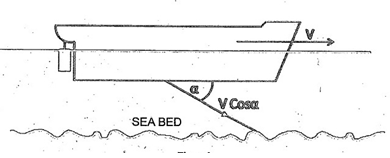
As the ship moves forward, she also has an up and down motion in the vertical direction, called ‘heaving’. The vertical motion component is v sin α.

Working of a Doppler Log

As this movement of the ship has an effect on the frequency shift, it should be accounted for. This is done by installing a second set of transducers (for transmitting and receiving) in the aft direction at the same angle of 60º. (Refer figure). This type of installation setup is called Janus Configuration.

The effect of frequency shift due to vertical motion (the component v sin α ) of the ship gets cancelled out in Janus Configuration and the resultant ship speed is calculated by the formulae:

v = c (Frf – Fra) / 4 Ft cos α

Where,

  • v= ship’s speed
  • c= speed of acoustic wave in water
  • Frf = Freq. of the received wave, from fwd direction
  • Fra = Freq. of the received wave, from aft direction
  • Ft = Freq. of the transmitted wave
  • α = angle of acoustic wave transmission

Posted on

Tonnage

Differences between GRT, NRT and GT, NT?

GRT stands for Gross Register Tonnage and NRT means NET Register Tonnage. Both these terms are now obsolete and have been replaced respectively with GT and NT under International Convention on Tonnage Measurements of Ships.

However, students may note the definitions of GRT and NRT for their reference:

  • Gross Register Tonnage (GRT) meant a measure of the total internal capacity of the ship. It consisted of: under-deck volume excluding double-bottoms, volume of tween deck spaces, volume of superstructures, volume of deck-houses etc. Spaces like navigational areas, galleys, stairways, light and air spaces were exempted. The total volume thus calculated in cubic feet was divided by 100 (1 gross ton = 100 cubic feet). This was the Gross Tonnage entered in the ship’s Register.
  • Net Register Tonnage (NRT) meant a measure of the available space for the carriage of cargo and passengers. This was obtained from GRT after making some deductions. These deductions from GRT included: Master and crew accommodation, safety and storage spaces, water ballast tanks, allowance for propelling machinery. Again the resulting volume in cubic feet was divided by 100 (1 net ton = 100 cubic feet). This was the Net Tonnage entered in the Register.
  • Gross tonnage is a function of volume of enclosed spaces of a ship. It is indicative of ship’s size.
  • Net tonnage refers to volume of cargo carrying spaces. It is indicative of vessel’s earning potential. The NT cannot be less than 30% of the GT of a ship. Net tonnage is used for ship’s dues. Both GT and NT are determined by measuring ship’s volume and then applying a mathematical formula. Both GT and NT are dimensionless numbers and are shown in ship’s International Tonnage Certificate. They do not have any physical units and should not be confused with unit of mass, namely ton.

Differentiate between Enclosed spaces and Excluded Spaces as per International Tonnage Convention 1969 with appropriate sketches.

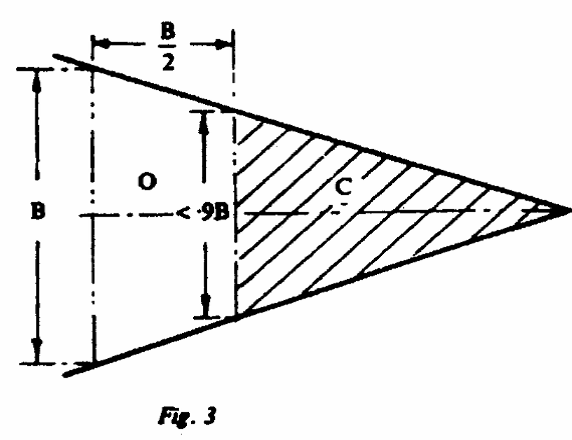
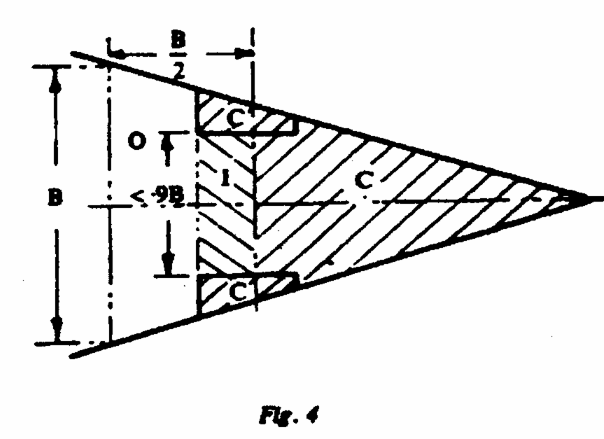
Enclosed spaces are all those spaces which are bounded by the ship’s hull, by fixed or portable partitions or bulkheads, by decks or coverings other than permanent or movable awnings. No break in a deck, nor any opening in the ship’s hull, in a deck or in a covering of a space, or in the partitions or bulkheads of a space, nor the absence of a partition or bulkhead, shall preclude a space from being included in the enclosed space.

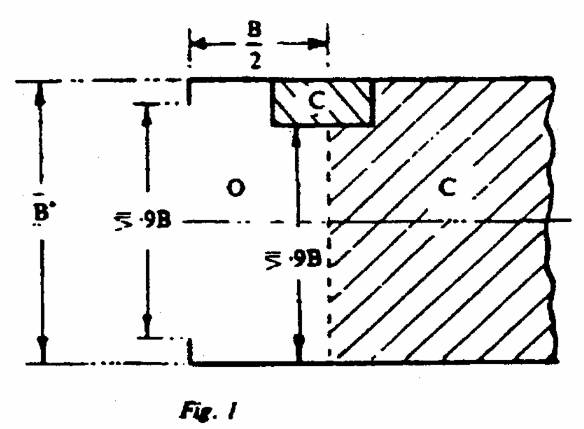
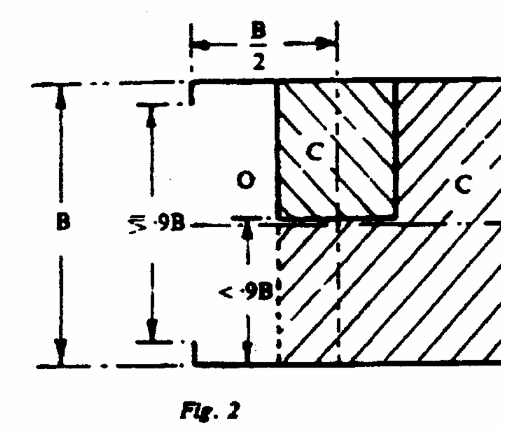
Excluded Spaces – Notwithstanding the provisions of the above paragraph, the spaces referred in sub-paragraphs (a) to (e) shall be called excluded spaces and shall not be included in the volume of enclosed spaces, except that any such space that fulfills atleast one of the following three conditions shall be treated as an enclosed space.

  1. The space is fitted with shelves or other means for securing cargo and/or stores.
  2. The openings are fitted with any means of closure.
  3. The construction provides any possibility of such openings being closed.

A space shall be considered an ‘Excluded space’ in the following cases:

  • A space within an erection opposite to an end opening extending from deck to deck.
  • A space under an overhead deck covering, open to the sea and weather, with no other connection to the ship side other than stanchions.
  • A space in a side-to-side erection directly in way of opposite side openings.
  • A space in erection immediately below an uncovered opening in the deck overhead, which is exposed to weather.
  • A recess in the boundary bulkhead of an erection which is exposed to the weather and the opening of which extends from deck to deck without means of closing.
Excluded Space - Tonnage Convention Fig.1
Excluded Space – Tonnage Convention Fig.1
Excluded Space - Tonnage Convention Fig.2
Excluded Space – Tonnage Convention Fig.2
Excluded Space - Tonnage Convention Fig.3
Excluded Space – Tonnage Convention Fig.3
Excluded Space - Tonnage Convention Fig.4
Excluded Space – Tonnage Convention Fig.4
O = Excluded Space,
C = Enclosed Space, 
I = space to be considered as an enclosed space.
B = breadth of the deck in way of the opening.

Posted on

Bulkheads

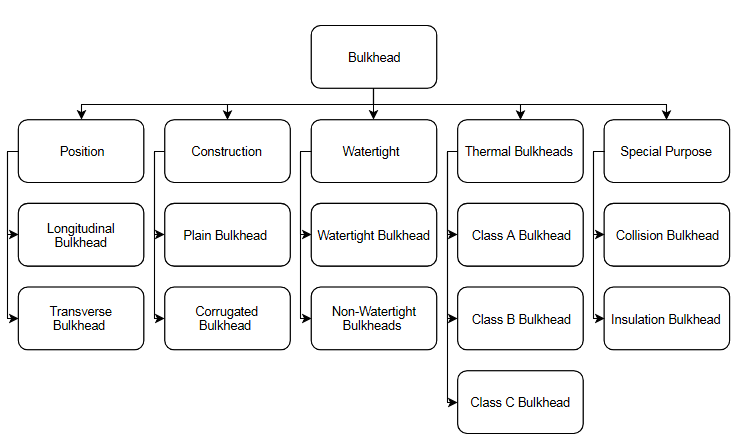
Types of Bulkheads:

Bulkheads:- Vertical partitions on a ship are called bulkheads.

Types of Bulkhead as per Orientation:

  • Longitudinal: Placed in longitudinal direction on a ship.
  • Transverse: placed in Transverse direction on a ship.

Types of Bulkheads as per construction:

  1. Watertight bulkheads: These bulkheads are water tight and prevent flooding. Numbers of Watertight bulkheads: 1- Collision bulkhead, 1- aft peak bulkhead, 1- Bulkhead of engine room and 1- bulkhead aft of engine room. Aft peak bulkhead and bulkhead aft of engine room may be combined into the additional bulkheads are to be provided as per rules depending upon the length of the ship & requirements.
  2. Non-watertight bulkheads:
    • Are screens in accommodation and do not contribute to strength or water tightness.
    • Used to subdivide compartment into smaller units of accommodation of stores Non-watertight Bulkheads.
    • Non-watertight bulkheads perform supporting function.
    • Its stiffeners have to be sufficient for the load carried.
    • Corrugated bulkheads may be used.
  3. On-tight or tank bulkheads: Form boundary of oil tanks. Are oil tight in nature & are tested for the same.
Types of Bulkheads
Types of Bulkheads

Factors to be taken in to account during cargo planning stage in order to minimize the damage to watertight transverse bulkheads and tank tops in bulk carriers having combination cargo/ ballast holds.

The common damage/defects that may occur on watertight transverse bulkheads situated at the ends of dry cargo holds of a bulk carrier:-

  • Fractures that may occur in the deck plating at hatches and in connected comings.
  • Causes of cracking in way of no. 1 cargo hold.

The damages caused by cargoes in cargo holds, especially to tanktop plating and side:

  • At loading and unloading ports for coal or iron ore, large grab buckets, high-capacity cargo.
  • Loaders, bulldozers and pneumatic hammers may be employed for cargo-handling operations.
  • Large grab buckets may cause considerable damage to tank top plating when being dropped to grab cargo.
  • Use of bulldozers and pneumatic hammers may also be harmful to cargo hold structures and may result in damage to tank tops, bilge hoppers, hold frames and end brackets.
  • Lumber cargoes may also cause damage to the cargo hold structures of smaller bulkers that are employed in the carriage of light bulk cargoes and lumbers.
  • Cracking on large bulk carriers, Ballast tanks. Ability to interpret given figures for bending moments and shear forces.

Posted on

Fire Integrity

Standard Fire Test on the Ship

Standard Fire Test:-

  • A standard fire test is a test in which specimens of the relevant bulkhead or decks are exposed in a test furnace to temperatures corresponding approximately to the standard time-temperature curve in accordance with the test method specified in the FTP Code.
  • The specimen must have an exposed surface of 2.44m width and 2.5m height. In case of decks and ceilings, they must be of 2.44mm width and 3.04m length. When the maximum overall height in practice is to be less than that given above, then the test specimen shall be of the maximum height to be used in practice.
  • Orientation of the test piece shall be maintained. A bulkhead shall be tested vertically and a deck or ceiling shall be tested horizontally.
  • Class A and B Class bulkheads and doors shall be tested from each side.
  • A-Class un-insulated steel bulkheads and decks without openings shall be treated as A-0 and no test is required. All other divisions, including class “A-0” divisions with a structural core of aluminum, are required to be tested.
  • Constructions shall be tested without paint or other superimposed finishes,subject to the approval of the Administration.
  • The specimen being tested should resemble as closely as possible the intended construction and include atleast one joint, where applicable.
  • Temperature thermocouples are placed at various points on the specimen to be tested as per FTP Code. During the test, temperatures are recorded at intervals not exceeding 1 minute.
  • The average temperature of the furnace as derived from the furnace thermocouples shall be monitored and controlled such that it follows the standard time-temperature curve. (This is a smooth curve drawn using furnace temperature points measured at 5m, 10m, 15m, 30m and 60m starting from the initial furnace temperature.)
  • The average temperature rise on the unexposed surface shall be calculated as the average of the rises recorded by the individual thermocouples to check if the specimen complies with the requirement on temperature rise.
  • If there is any flaming seen on the unexposed side, the duration and the location shall be recorded. In cases where it is difficult to identify whether or not there are flames then the cotton-wool pad shall be applied to see if ignition of the pad can be initiated.
  • For all “A” class divisions, including those with doors, the test shall continue for a minimum of 60 min. For all “B” class divisions, including those with doors, the test shall continue for a minimum of 30 min.

Limitations in the use of oils as fuel:

The following limitations shall apply to the use of oil as fuel:

  1. Except as otherwise permitted by this paragraph, no oil fuel with a flashpoint of less than 60°C shall be used.
  2. In emergency generators oil fuel with a flashpoint of not less than 43°C may be used.
  3. The use of oil fuel having a flashpoint of less than 60°C but not less than 43°C may be permitted (e.g., for “feeding the emergency fire pump” s engines and the auxiliary machines which are not located in the machinery spaces of category A) subject to the following:
    • Fuel oil tanks except those arranged in double bottom compartments shall be located outside of machinery spaces of category A.
    • Provisions for the measurement of oil temperature are provided on the suction pipe of the oil fuel pump.
    • Stop valves and/or cocks are provided on the inlet side and outlet side of the oil fuel strainers.
    • Pipe joints of welded construction or of circular cone type or spherical type union joint are applied as much as possible.
    • In cargo ships the use of fuel having a lower flashpoint than otherwise specified, for example crude oil, may be permitted provided that such fuel is not stored in any machinery space and subject to the approval by the Administration of the complete installation.

Non Combustible material:

  • It is the one which neither burns nor gives off flammable vapours in sufficient quantity for self-ignition when heated to approximately 7500C, as indicated in the FTP Code.
  • A & B class divisions shall be constructed of non-combustible materials with the following exceptions:
    • Adhesives and vapour barriers, but they should have low flame spread characteristics.
      • Sealing materials used in penetration systems.
      • Seal for gas/weather/water tight doors.

Special category Spaces:

  • Special category spaces are those enclosed vehicle spaces above and below the bulkhead deck, into and from which vehicles can be driven and to which passengers have access. Special category spaces may be accommodated on more than one deck provided that the total overall clear height for vehicles does not exceed 10 m.
  • In passenger ships carrying more than 36 passengers, the bulkheads and decks of special category spaces shall be insulated to’A-60″ class standard.
  • In passenger ships, indicators shall be provided on the navigation bridge to indicate when any fire door leading to or from the special category spaces is closed.
  • In special category spaces to which any passengers carried can have access, the number and locations of the means of escape shall be to the satisfaction of the Administration.
    Walkways to the means of escape must be provided with a breadth of at least 600 mm. The parking arrangements for vehicles shall maintain the walkways clear at all times.
  • The ventilation system for special category spaces must be sufficient to provide 10 air changes per hour.
  • An efficient fire patrol system shall be maintained in special category spaces. If an efficient fire patrol system is maintained by a continuous fire watch at all times during the voyage, a fixed fire detection and fire alarm system is not required.
  • Special category spaces shall be fitted with a fixed water-based fire-fighting system with provision of manual operation, which shall protect all parts of any deck and vehicle platform of such spaces. A sufficient number of drainage valves must be provided to ensure complete drainage of the system. Also, means shall be provided to prevent the blockage of drainage arrangements.
  • There are additional requirements for special category spaces of Ro-Ro Passenger ships. For example, CCTV surveillance and a water leakage detection system is required to be fitted to provide an indication to the navigation bridge and to ECR of any leakage through the bow or stern doors which could lead to flooding of special category spaces or ro-ro spaces.

Posted on

Echo Sounder on Ships

Basic Principles of Echo Sounder:

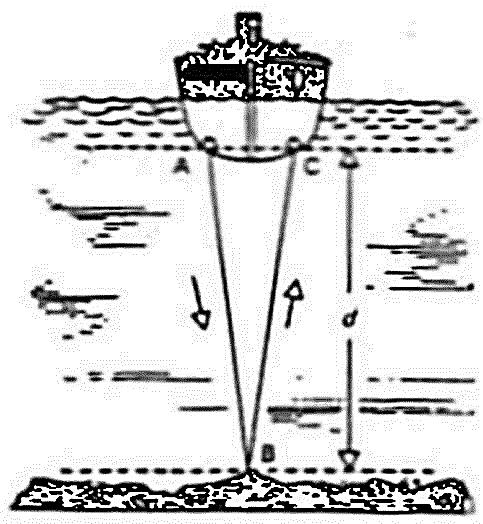
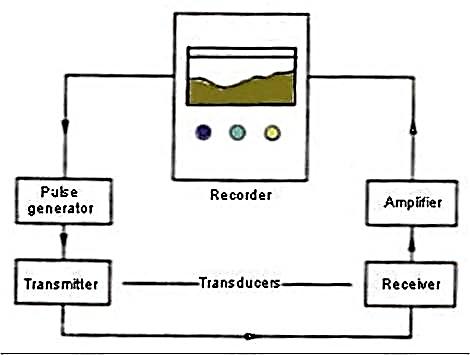
Short pulses of sound vibrations are transmitted from the bottom of the ship to the seabed. These sound waves are reflected back by the seabed and the time taken from transmission to reception of the reflected sound waves is measured. Since the speed of sound in water is about 1500 m/sec, the depth of the sea bed is calculated which will be half the distance travelled by the sound waves.

Principles of Echo Sounder

The received echoes are converted into electrical signal by the receiving transducer and after passing through to stylus which burns out the coating of the thin layer of aluminum powder and produces the black mark on the paper indicating the depth of seabed.

Components of Echo Sounder:

Components of Echo Sounder
  • Basically an echo sounder has following components:
  • Transducer – to generate the sound vibrations and also receive the reflected sound vibration.
  • Pulse generator – to produce electrical oscillations for the transmitting transducer.
  • Amplifier – to amplify the weak electrical oscillations that has been generated by the receiving transducer on reception of the reflected sound vibration.
  • Recorder – for measuring and indicating depth.

CONTROLS:-

  • An echo sounder will normally have the following controls:
  • Range Switch – to select the range between which the depth is be checked e.g.  0- 50 m, 1 – 100 m, 100 – 200 m etc.  Always check the lowest range first before shifting to a higher range.
  • Unit selector switch – to select the unit feet, fathoms or meter as required.
  • Gain switch – to be adjusted such that the clearest echo line is recorded on the paper.
  • Paper speed control – to select the speed of the paper – usually two speeds available.
  • Zero Adjustment or Draught setting control – the echo sounder will normally display the depth below the keel.  This switch can be used to feed the ship’s draught such that the echo sounder will display the total sea depth.  This switch is also used to adjust the start of the transmission of the sound pulse to be in line with the zero of the scale in use.
  • Fix or event marker – this button is used to draw a line on the paper as a mark to indicate certain time e.g. passing a navigational mark, when a position is plotted on the chart etc.
  • Transducer changeover switch – in case vessel has more than one switch e.g. forward and aft transducer.
  • Dimmer – to illuminate the display as required.

Working:

  • The acoustic pulses of very short duration are transmitted vertically at the rate of 5 to 600 pulses per minute having a beam width of 12 to 25°.
  • These pulses strike the seabed and get reflected back towards the receiving transducer as echoes.
  • These received echoes are converted into electrical signals by the receiving transducer and after passing through the different stages of the receiver, the current is supplied to the stylus which bums out the coating of the thin layer of aluminium powder and produces a black mark on the paper indicating the depth of the seabed.

Principle used in the working of an Echo Sounder:-

There are two techniques:-

  • Ranging
  • Phasing

Ranging:-

  • In echo sounder the stylus is mounted on circular belt driven by means of a stylus motor which moves at certain speed and transmission takes place when the stylus passes the zero marks.
  • A magnet fixed on the stylus belt triggers the transmitter to transmit a pulse every rotation of belt when stylus is at zero mark on the paper scale, the transmission of the acoustic waves from the transducer is synchronized with the stylus at the zero mark.
  • The acoustic waves are reflected from the seabed and echoes are received by the transducer and after passing through various stages eventually the current is supplied to stylus which burns out the coating of the thin layer of aluminum powder and produces the black mark on the paper indicating the depth of seabed.
  • This cycle is repeated for every rotation so as the paper is pulled across the display, the profile of seabed is obtained.
  • Suppose the lowest range scale is 0 to 50 M, the transmission will take place when stylus reaches at the zero mark.
  • When the higher range is selected say 0 to 100 M, in order to cater for this range scale, the speed of the stylus motor is reduced, in this process the scale magnification is lost and as we switch over to higher ranges the scale becomes more & more congested.
  • To overcome this problem some of echo sounding machines work on phasing technique.

Phasing:-

  • In phasing the speed of the stylus motor remains constant.
  • Instead of changing the speed of the stylus, the transmission point is advanced.
  • If the first range is 0 to 50 M the second range will be 50 to 100 M (instead of 0 to 100 M).
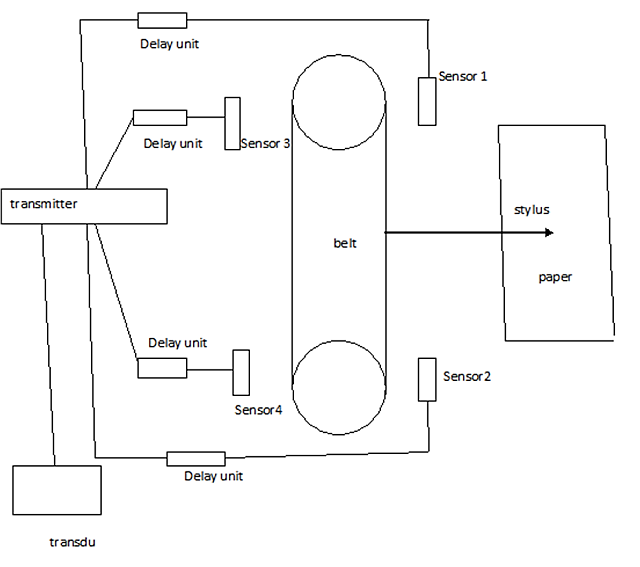
  • Various sensors are positioned around the stylus belt, the magnet generates the pulse when it passes the sensors which in turns activates the transmitter.
  • In the below diagram, when we select the lowest range i.e. 0 to 50 M, the magnet mounted on the stylus belt will activate sensor no. 1, transmission takes place when the stylus exactly passes over the zero mark, when we switch over to higher range, say 50 to 100 M, the magnet mounted on the stylus belt will activate sensor no.2 and transmission will take place early, at the time of the transmission, the stylus will not be passing over 50 M mark on display unit, in other words there will be delay introduced by delay unit no.2 & the stylus will reach the 50 M on display unit after delay of 0.067 seconds. (50 x 2 / 1500, where 50 correspond to the range, multiplied by 2 because double of distance is covered by acoustic waves & the echoes and 1500 is the speed of acoustic waves).
  • Likewise, when we switch over to higher range say, 100 to 150 M, magnet mounted on the stylus belt will activate sensor no. 3 & more delay will be introduced for the stylus to pass over the 100 M.
Working of an Echo Sounder

Caution when using phasing technique: – We must always start sounding at lowest range and check for echoes, adjust the gain control if required and then only switch over to higher range.


Errors of Echo Sounder:

  • Velocity of propagation in water:- The velocity changes with temperature salinity & pressure. The velocity of the acoustic wave assumed at the temperature of 16 degree C & Salinity of 3.4% is 1505 m/sec, but generally it is taken as 1500 m/sec for calculations. As velocity is varying hence depth recorded will be erroneous. Depth indicated in Fresh water can be about 3% higher than the actual depth. NP 139 can be referred in order to obtain the corrections. To compensate the error due to temperature variation, a component called “thermistor” may be mounted near the transducer & change in velocity of the acoustic wave through water from the standard value due to the change in sea water temperature is accounted for. Error due to pressure is not so significant.
  • Stylus speed error:- The speed of the stylus is such that the time taken by the stylus to travel from top to bottom on chart is same as the time taken by sound waves to travel twice the range selected, but due to fluctuation in voltage supplied to stylus motor, will cause error in the recorded depth.
  • Pythagoras error:- This error is found when two transducers are used, one for transmission and the other one for reception. This error is calculated using the Pythagoras principle. This error becomes prominent whenever distance between two transducer is more than 2 mtrs, manual should be referred in order to use the table for corrections.
  • Multiple echoes:- The echo may be reflected no. of times from the bottom of the sea bed, hence providing the multiple depth marks on paper.
  • The thermal and density layers:- The density of the water varies with temperature and salinity, which all tends to form different layers. The sound wave may be reflected from these layers.
  • Zero line adjustment error:- If the zero is not adjusted properly, it will give error in reading.
  • Cross noise:- If sensitivity of the amplifier is high, just after zero marking a narrow line along with the several irregular dots and dashes appear and this is called cross noise. The main reasons for the cross noise are aeration and picking up the transmitted pulse. If intensity of cross noise is high, it will completely mask the shallow water depths. This is controlled by swept gain control circuit.
  • Aeration:- When the sound wave is reflected from the reflected from the air bubbles, it will appear as dots, this is known as aeration.
    • Aeration can be due to pockets of bubble due to heavy weather.
    • Rudder hard over causing drastic alteration of course.
    • Pitching in light condition.
    • Whilst astern propulsion. (Switch over to forward transducer if available.)

Electrostrictive Transducer with respect to Echo Sounder:

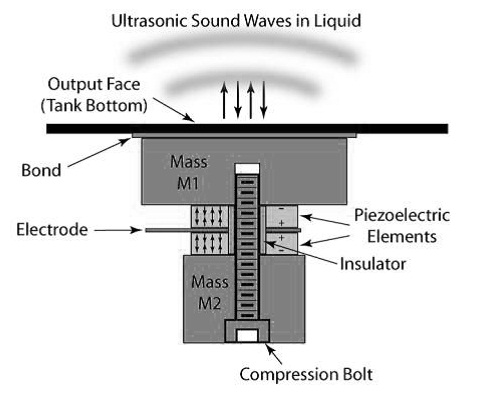
Electrostrictive Transducer
Electrostrictive Transducer (credit)
  • This type of transducer works on the basic principle of piezo-electric effect, i.e., certain crystals such as quartz, have a property that when pressure is applied to the two opposite faces, a difference of potential is created which is proportional to the applied pressure or when an alternating voltage is applied,
    the crystals start vibrating or oscillating. This type of transducer is also known as Piezostrictive transducer.
  • The electrostrictive transducer uses the property of a crystal for transmission and reception of acoustic waves in water. The crystal is firmly fixed between two steel plates so that they act as a single unit.
  • The purpose of the steel plates is to provide solid and robust housing for the crystal as well as a suitable contact surface for seawater.
  • When an alternating voltage is applied between the steel plates, the quartz and the steel plates start vibrating together. The vibration will be of very high amplitude, if the frequency of the alternating voltage is equal to the resonance frequency of the crystal. The lower of the two steel plates is in direct contact with the water, which will cause the vibration in the seawater.
    The vibration is always perpendicular to the plate and hence always kept horizontally.
  • Generally, only one transducer is used for transmission and reception of the signals and this transducer is always mounted as pierced hull.
Posted on

Torsional Stress

Q) Write short notes on Torsional Stress on ships.

Torsional Stress on ships:
  • When a body is subject to a
    twisting moment which is commonly referred to as torque, that body is said to
    be in ‘torsion’. A ship heading obliquely (45°) to a wave will be subjected to
    righting moments of opposite direction at its ends twisting the hull and
    putting it in ‘torsion’.
  • In most ships, these
    torsional moments and stresses are negligible but in ships with extremely wide
    and long deck openings they are significant. A particular example is the larger
    container ship where at the topsides a heavy torsion box girder structure
    including the upper deck is provided to accommodate the torsional stresses.
  • Torsional stresses also
    occur due to unsymmetrical loading along the centre line of the vessel. (For
    example, too much load on the fwd-port side and at the aft-stbd side)
Posted on

Intact Stability

Intact Stability requirements of Oil Tanker Ships

Intact Stability requirements of Oil Tanker Ships: Oil tankers, as defined in the section Definitions, shall comply with regulation 27 (Intact Stability) of Annex I to MARPOL 73/78:-

  1. Every oil tanker of 5,000 tonnes deadweight and above delivered on or after 1 February 2002, as defined in regulation 1.28.7, shall comply with the intact stability criteria specified in paragraphs 1.1 and 1.2 of this regulation, as appropriate, for any operating draught under the worst possible conditions of cargo and ballast loading, consistent with good operational practice, including intermediate stages of liquid transfer operations. Under all conditions the ballast tanks shall be assumed slack.
    1. In port, the initial metacentric height GMo, corrected for the free surface measured at 0° heel, shall be not less than 0.15 m.
    2. At sea, the following criteria shall be applicable:
      1. the area under the righting lever curve (GZ curve) shall be not less than 0.055 m·rad up to θ = 30° angle of heel and not less than 0.09 m·rad up to θ = 40° or other angle of flooding θf* if this angle is less than 40°. Additionally, the area under the righting lever curve (GZ curve) between the angles of heel of 308 and 40° or between 30° and θf, if this angle is less than 40°, shall be not less than 0.03 m·rad;
      2. the righting lever GZ shall be at least 0.20 m at an angle of heel equal to or greater than 30°;
      3. the maximum righting arm shall occur at an angle of heel preferably exceeding 30° but not less than 25°; and
      4. the initial metacentric height GMo, corrected for free surface measured at 0° heel, shall be not less than 0.15 m.
  2. The requirements of paragraph 1 of this regulation shall be met through design measures. For combination carriers simple supplementary operational procedures may be allowed.
  3. Simple supplementary operational procedures for liquid transfer operations referred to in paragraph 2 of this regulation shall mean written procedures made available to the master which:
    1. are approved by the Administration.
    2. Indicate those cargo and ballast tanks which may, under any specific condition of liquid transfer and possible range of cargo densities, be slack and still allow the stability criteria to be met. The slack tanks may vary during the liquid transfer operations and be of any combination provided they satisfy the criteria;
    3. will be readily understandable to the officer-in-charge of liquid transfer operations;
    4. provide for planned sequences of cargo/ballast transfer operations;
    5. allow comparisons of attained and required stability using stability performance criteria in graphical or tabular form;
    6. require no extensive mathematical calculations by the officer-incharge;
    7. provide for corrective actions to be taken by the officer-incharge in case of departure from recommended values and in case of emergency situations; and
    8. are prominently displayed in the approved trim and stability booklet and at the cargo/ballast transfer control station and in any computer software by which stability calculations are performed.

Q) Describe the precautions to be taken while carrying out inclining test.

Precautions to be taken while carrying out Inclining Test:

  1. The ship must be moored in quiet sheltered waters free from the effects of passing vessels.
  2. There must be adequate depth of water under the keel so that the bottom of the ship does not touch the sea bed on inclination.
  3. There should little or no wind. If there is any wind the ship should be head on or stern to it.
  4. The ship should be floating free. There should be no barges alongside.
  5. Moorings should be slackened right down.
  6. Shore side gangway if any must be landed to allow unrestricted heeling.
  7. All loose weights must be removed or secured.
  8. All fittings and equipments such as accommodation ladder , derricks/cranes should be stowed in their normal sea going positions.
  9. Free surface should be minimized. All tanks should be verified as being completely empty or full. Bilges should be dry.
  10. Deck should be free of water. Any water trapped on deck will move during the test and reduce the accuracy of the result.
  11. The ship should be upright at the commencement of the experiment.
  12. All personnel not directly concerned with the experiment should be sent ashore.
  13. In tidal conditions, conduct experiment at slack water.
Posted on

Diesel Engines

Why pre-heating of main engine is carried out?

  • Diesel engines are self-ignition engines i.e. fuel is injected into hot compressed air and is ignited. To obtain this, the air inside the engine should be hot which is achieved by pre-heating the engine. Pre-heating heats all parts of the engine which in turn heats the air in the cylinder.
  • Pre-heating the engine also reduces cold corrosion and there are lesser thermal stresses during starting.
  • Also, when engine is warm, the clearances are correct, thus lubrication is made easier and there is less chance of undue wear of moving parts.
  • Pre-heating is usually done using steam or electrical heaters. Hot water is kept in circulation to engine thus keeping all parts in warm condition.
Posted on

Deck Machinery

Purpose of Deck Mooring Winch and Windlass Winch used on board ship:

Deck Mooring Winch:-

Deck Mooring Winch
Deck Mooring Winch
  • Mooring winch is a mechanical device used for securing a ship to the berth. An equipment with various barrels used for pulling ropes or cables, mooring winches play an important role in berthing the ship ashore.
  • The barrels, also known as winch drums, are used for hauling in or letting out the wires or ropes, which will help in fastening the ship to the berth.
  • Mooring winches assembly comes in various arrangements with different number of barrels, depending on the requirement of the ship.
  • The main parts of mooring winch includes a winch barrel or a drum, a warp end and a driving motor. Modern mooring winches comprises of elaborate designs with various gear assemblies, which can be electric, pneumatic or hydraulic driven.

Windlass Winch:-

Windlass Winch
Windlass Winch
  • A windlass is a machine used on ships that is used to let-out and heave-up equipment such as a ship’s anchor or a fishing trawl. On some ships, it may be located in a specific room called the windlass room.
  • An anchor windlass is a machine that restrains and manipulates the anchor chain on a boat, allowing the anchor to be raised and lowered by means of chain cable. A notched wheel engages the links of the chain or the rope.
  • A trawl windlass is a similar machine that restrains or manipulates the trawl on a commercial fishing vessel. The trawl is a sort of big fishing net that is wound on the windlass.
    The fishermen either let-out the trawl or heave-up the trawl during fishing operations. A brake is provided for additional control. The windlass is usually powered by an electric or hydraulic motor operating via a gear train.
  • Technically speaking, the term “windlass” refers only to horizontal winches. Vertical designs are correctly called capstans. Horizontal windlasses make use of an integral gearbox and motor assembly, all typically located above-deck, with a horizontal shaft through the unit and wheels for chain and/or rope on either side.
    Vertical capstans use a vertical shaft, with the motor and gearbox situated below the winch unit (usually below decks).

Q) List the routine maintenances carried out on board.

Ans:- Efficient planning and adequate usage of equipments is the key to productive maintenance.

Types of Maintenance Procedures:-

  1. Preventive or Scheduled Maintenance System: – It is famously known as the PMS or Planned Maintenance System. In this type of system the maintenance is carried out as per the running hours like 4000 hrs, 8000 hrs etc., or by the calendar intervals like 6 monthly, yearly etc. of the machinery. The maintenance is carried out irrespective of the condition of the machinery. The parts have to be replaced if it is written in the schedule, even if they can be still used.
  2. Corrective or Breakdown Maintenance: – In this system the maintenance is carried out when the machinery breaks down. This is the reason it is known as the breakdown maintenance. This is not a suitable and good method as situations may occur wherein the machinery is required in emergency. The only advantage of this system is that the working of machinery parts is used to its full life or until it breaks. This system might get costly as during breakdown several other parts may also get damaged.
  3. Condition Maintenance system: – In this system the machinery parts are checked regularly. With the help of sensors etc. the condition of the machinery is accessed regularly and the maintenance is done accordingly. This system requires experience and knowledge as wrong interpretation may damage the machinery and lead to costly repairs which may not be acceptable by the company.