Posted on

Cargo Securing Manual

Cargo Securing Manual specifies arrangements and cargo securing devices provided on board the ship for the correct application to and the securing of cargo units, containers, vehicles and other entities, based on transverse, longitudinal and vertical forces which may arise during adverse weather and sea conditions.

Information on the strength and instructions for the use and maintenance of each specific type of cargo securing device, where applicable, is provided in this manual.

It is imperative to the safety of the ship and the protection of the cargo and personnel that the securing of the cargo is carried out properly and that only appropriate securing points or fittings should be used for cargo securing.

Purpose:

Is to ensure that Cargo Securing Manuals cover all relevant aspects of cargo stowage and securing and to provide a uniform approach to the preparation of Cargo Securing Manuals, their layout and content. Administrations may continue accepting Cargo Securing Manuals drafted in accordance with Containers and cargoes (BC) – Cargo Securing Manual (MSC/Circ.385) provided that they satisfy the requirements of these guidelines.

“Cargo Securing Devices” is all fixed and portable devices used to secure and support cargo units.

“Maximum Securing Load” (MSL) is a term used to define the allowable load capacity for a device used to secure cargo to a ship. “Safe Working Load” (SWL) may be substituted for MSL for securing purposes, provided this is equal to or exceeds the strength defined by MSL.

Regulations:-

In accordance with the International Convention for the Safety of Life at Sea, 1974 (SOLAS) chapters VI, VII and the Code of Safe Practice for Cargo Stowage and Securing (CSS Code), cargo units, including containers shall be stowed and secured throughout the voyage in accordance with a Cargo Securing Manual, approved by the Administration.

The Cargo Securing Manual is required on all types of ships engaged in the carriage of all cargoes other than solid and liquid bulk cargoes Content are:

Contents:-

  1. General

1.1 Ship Data

1.2 Definitions

1.3 General Information

1.4 Principal sources of danger

2. Securing Devices and Arrangements

2.1 Specification of Fixed Cargo Securing Devices.

2.2 Specification of Portable Cargo Securing Devices.

2.3 Inspection and Maintenance Schemes

3. Stowage and Securing of cargo

3.1 Handling and safety instructions

3.1.1 General principles of cargo securing.

3.1.2 Safe handling of cargo securing devices

3.1.3 Evaluation of forces acting on cargo units

3.1.4 Forces acting on typical cargo units

3.1.5 Calculation of forces in semi- and non-standardised lashing arrangements

3.1.5.1 MSLs for different securing devices 15

3.1.5.2 Safety factor 15

3.1.5.3 Simplified method – Rule of thumb 15

3.1.5.4 Ship Specific Example based on Alternative Method – using IMO LASCHONTM 16

3.1.5.5 Ship Specific Accelerations from IMO LASCHONTM 19

3.2 Application of portable securing devices

4. Supplementary Requirements for General Cargo/Container vessel

4.1 Bulk Carriers

4.1.1 Extracts from various Timber Deck Codes

4.2 Container Carriers

4.2.1 Handling and Safety Instructions

4.2.2 Stowage and Securing Instructions

4.2.2.1 Stowage and Securing Plan (not included in this model manual) 37

Appendix I – Log for maintenance of cargo securing equipment

Appendix II – Manual procedure for calculation of lashings.

Appendix III – Applicable Annexes from the CSS Code

ANNEX 6 Safe stowage and securing of coiled sheet steel

ANNEX 7  Safe stowage and securing of heavy metal products

ANNEX 8  Safe stowage and securing of anchor chains

ANNEX 9  Safe stowage and securing of metal scrap in bulk

ANNEX 11 General guidelines for the under-deck stowage of logs

ANNEX 12 Safe stowing and securing of unit loads

Appendix IV – LASHCONTM IMO USER GUIDE

  1. General

1.1 Introduction

1.2 System requirements

1.3 User requirements

2. User guide

2.1 Input sequence

2.2 Input data

2.3 Calculation methods

2.4 Special features of Lashcon IMO

2.5 Program assumptions

Appendix V – Certification for fixed cargo securing devices

Appendix VI – Certification for portable cargo securing devices

Posted on

Responsibilities of Chief officer with respect to Documents on board

Responsibilities of Chief Officer with respect to signing of Mates receipts:-

  • Remarks to be made as to the order and condition of the consignment. This document is usually prepared by the terminal or shipper’s representative at the terminal.
  • In addition to the condition of the cargo it will usually the description of the goods, the shipper’s quantity and/or weight and usually the packaging.
  • This receipt is signed, after loading, by the Chief Officer as an official receipt for the goods onboard. The original mate’s receipt is then usually presented to the carrier and exchanged for signed original bills of lading issued by the carrier using the quantities shown on the mate’s receipt. These original bills of lading then act as the receipt for goods.

Responsibilities of Chief Officer with respect to issuance of letter of protest to shippers and cargo receivers:-

  • A Letter of protest, simply known as Protest, is a written communication, intended to record dis-satisfaction on the part of one party concerning any operational matter over which the recipient or other party has control, and holding the other party responsible for the consequences of the matter being complained of.
  • Most commonly a protest is in connection with cargo, although they may be written about almost any matter where there is a contractual arrangement. e.g. Use of berth or use of equipment.
  • A Letter of Protest helps substantiate a claim by owners or vice-versa, and may prove useful, if properly filed, when a dispute is being resolved long after the related event.
  • A Letter of Protest is thus different from a Note of Protest or lodged with a consul or notary public.
Posted on

Inspection of Cargo Gears

Requirements & Procedure to be followed for thorough examination of cargo gears and load testing of lifting appliances as prescribed in Dock Workers (Safety, health and welfare) Act 1990 and rules / regulations framed there under:

Test and periodical Examinations of lifting appliances:-

  1. Before being taken into use for the first time or after It has undergone any alternations or repairs liable to affect its strength or stability and also once at least in every five years, all lifting appliances including all parts and gears thereof, whether fixed or moveable, shall be tested and examined by a competent person in the manner set out in the regulation.
  2. All lifting appliances shall be thoroughly examined by a competent person once at least In every 12 months. Where the competent person making this examination forms the opinion that the lifting appliance cannot continue to
  3. Function safely, he shall forthwith give notice in writing of his opinion to the owner of the lifting appliance or in case of lifting appliance carried on board a ship not registered in India, to the Master or officer-in-charge of the ship.
  4. Thorough examination for the purpose of this regulation shall mean a visual examination, supplemented if necessary by other means such as hammer test, carried out as carefully as the conditions permit, in order to arrive at a reliable conclusion as to the safety of the parts examined; and if necessary for this purpose, parts of the lifting appliance and gear, shall be dismantled.

Maintenance and Inspection of the Cargo Gears:-

  • The maintenances of the cargo handling gear will be included in a planned maintenances system as required by the ISM Code.
  • There are two basic requirements when maintaining cargo gear:
    • To keep the equipment in good safe working order and
    • To keep the supporting documentation in good order.
  • The maintenance of the Derricks and associated gear aboard a ship which has been well maintained can be summarized as follows:
    • Daily, when Derricks are being used to work Cargo: Inspect runner wirers for wear or damage. Check the rig for damage or for fastening.
    • Before Arrival in port: Inspect Derrick in the associated gear to ensure that they comply in every respect with the requirements on the flag state and of the port to be visited.

Test & Periodical Examination of Lifting Appliances:-

  • Before being taken into use for the first time or after it has undergone any alterations or repairs liable to affect its strength or stability and also once in every 5 years, all lifting appliances including, all parts & gears thereof, whether fixed or moving, shall be examined by a competent person in the manner set out in the regulation.
  • All lifting appliances shall be thoroughly examined by a competent person once atleast every 12 months, termed as periodic (visual) survey. The survey must be done by a competent person, often the chief officer, though some authorities require the survey to be carried out by an independent surveyor.
  • When the ship’s cargo gear is in frequent use all checks required by the survey should be done by the ship’s staff move often then once a year, even when regulation require an annual survey.
  • The rigging arrangements must confirm to the rigging plan.

Before Examination:-

  • All assembled items such as goose necks and blocks should be dismantled, so that the component parts can be readily inspected.
  • Shackles, links, rings, hooks, triangle plates, chains, etc. must be sufficiently free of paints & grease scales to enable proper inspection to be made.

Items to be examined:-

  • Deformation, wear, scoring, corrosion, scars, dents or other defects is to the structure & fittings.
  • In structural members, the maximum permitted wear down or corrosion is 10 % of the diameter. If the metal appears to be wasted or worn the thickness should be checked using calipers against the original specification.
  • In loose gear the maximum permitted weardown or corrosion is 5% on any diameter and 2% of any diameter of a pin in a hole.
  • Wire ropes should be inspected over their entire length with particular attention to end fittings, ferrules & splices.
  • Wire ropes must be renewed if the number of broken, warn or corroded wires in any length of 1 diameters exceeds 5 %.
  • ➢    Fibre ropes should be examined over their entire length for external chafe and cutting, for internal wear between strands for mildew, rot chemical attack or other contamination.
  • The Derrick boom, particularly at the point where it rests in its crutch or housing shall be thoroughly checked.
  • A Derrick shall be tested with its boom at the minimum angle to the horizontal (generally 15O) or at such angles as may be indicated in the test certificate. The test load suspended and the boom shall be swing as far as practicable in both directions (P & S).
  • Cranes shall be tested similarly with movable weights, at maximum, minimum & intermediate radius points.

Heat Treatment of Loose Gears:-

  • All chains other than bridle chains attached to the Derricks on mast and all rings, hooks, shackles & swivels used in hosting or lowering shall be subjected to heat treatment at the following intervals:
    • 12.5 mm and smaller chains, rings, hooks, shackle & swivels in general use, once atleast every six months.
    • All other chains, rings, hooks, shackles and swivels in general use once every 12 months.
  • All chains & loose gears made from high tensile steel or alloy steel be plainly marked with an approved mark, shall not be subjected to any form of heat treatment except where necessary for the purpose of repair & under direction of a competent person.

Regular Maintenance of Cranes:-

  • The filters of the hydraulic system must be regularly cleaned or renewed and the hydraulic oil must be charged as required by the manufacturers.
  • The oil in the gear boxes must be kept topped up to the correct level and must be changed at required intervals.
  • Suitable grease must be applied to all moving ports of the system such as bearing of winches, sheaves, pivot points, etc.
  • Wire ropes must be inspected for any signs of worm or corrosion and must be condemned if more than 5 % of the wires in any length of 10 diameters are damaged.
  • The brakes for the hoisting winch & for the stowings & luffing which must be regularly inspected.
  • Limit switches and the over ride keys for the over-hoisting or for the luffing & slewing travelling beyond permitted limits must be tested frequently and certainly before each port visit to ensure correct operation & position at the limit switches.
  • The planned maintenance for a hosting and luffing wires should be when required on working hours or two years, whichever comes first.

Justify the statement the planned maintenance of ship proves cost effective in the long run:

The main aim of any maintenance plan on ship is to get the maintenance and repair work done in the least possible time with minimum costs.

A maintenance plan is therefore followed by every shipping company to ensure that the ship’s machinery maintains a particular standard of operation and safety.

Maintenance plan is an imperative element of ship’s routine operations and also forms an integral component of ship’s maintenance mechanism.

While making a maintenance plan, several aspects are taken into consideration, starting from the International safety management code (ISM) to the guidelines put forth by the machine manufacturers.

Objectives of a maintenance plan:-

  • As mentioned before, the main objective of a maintenance plan is to make sure that the work is done in the least possible time with utmost efficiency and at optimum cost.
  • Various points mentioned in the ISM code are taken into consideration, along with company’s procedures and manufacturer’s guidelines.
  • Other aspects include type of the ship, condition of the ship, age of the ship etc.
Posted on

Duties of Dock Safety Inspector on Ship

Duties of Dock Safety Inspector are as follows:-

  • Perform daily dock check list.
  • Welcome new slip holders and/or transients in a manner which expresses a kind, courteous and professional character.
  • Maintain and clean rest rooms, docks, walkways, ramp ways, grounds, equipment and other areas designated by the Dock Master.
  • Maintain an inventory of supplies as needed.
  • Ensure docks, equipment and facilities are operational at all times.
  • Assist and support special events/activities taking place at the marina.
  • Inspect docked vessels such as dock lines, electrical cords, Comcast cable connections and fenders to ensure safety.
  • Perform daily trash removal (morning and evening trash) and dispose of as directed.
  • Maintain the daily operation of the sewage pumping system.
  • Perform electrical meter readings at slip pedestals and report readings.
  • Insure that no slip holder installs, secures or attaches items to the pier, bulkhead, light poles, pedestals or any other areas which are the property of the marina without written consent to do so
  • Perform marina safety inspections including, but not limited to the following:
    • Wood slat inspections
    • Concrete inspections
    • Light pole inspections
  • Vessel inspections consisting of vessel stability, frayed lines, electrical cords and Comcast connections.
  • Life ring inspection.
  • Report any notice of “sheen” in the water immediately.
  • Immediately notify the appropriate party if fuel is observed either visually or by smell.
  • Other duties as assigned.
Posted on

Tallying of Cargo

Tallying of Cargo as per stowage plan on completion of loading:

Once the cargo has been loaded on board the vessel will expected to make an accurate tally of the total number of units loaded onboard and their destination ports. Although in many ports this will be provided to the vessel by the tally clerks, it is common practice that many ports are entirely dependent on the tally provided by the ships staff. So in this respect it is important that procedure is in place to ensure that ship side tally is well maintained and is reported and confirmed with the operators and stevedores to prevent any short landing / Overlanding Discrepancies.

Tallying of Cargo as per stowage plan on completion of Discharging:

Prior vessel arrives at the first discharge port it is important that a shortlanding/ overlanding checklist is Completed and sent to the respective discharge ports stevedores through the agents. During the loading stage the duty officers and crew where totally involved in the stowage/segregation process so once the vessel leaves the last loading port it is important that the chief officer carries with him all the crew and officers for cargo rounds and familiarize the cargo plan and the precautionary areas where due to location of cargo in hidden spaces / areas they might be overlooked. These areas should be promptly marked and identified on the cargo plan.

Posted on

Definitions as per ILO Conventions applicable to Ships

Definitions as per ILO Conventions occupational Safety and Health Convention 1990, applicable to ships:

Authorised person means a person authorised by the employer, the master of the ship or a responsible person to undertake a specific task or tasks and possessing necessary technical knowledge and experience for undertaking the task or tasks.


Responsible person means a person appointed by the employer, the master of the ship, the owner of the gear or port authorities, as the case may be, to be responsible for the performance of a specific duty or duties and who has sufficient knowledge and experience and the requisite authority for the proper performance of the duty or duties.


Loose Gear” means hook, shackle, swivel, chain, sling, lifting beam, container speader, tray and any other such gear, by means of which the load can be attached to a lifting appliance and includes lifting device.


Competent Person means.-

(i) a person belonging to a testing establishment in India who is approved by the Chief Inspector for the purpose of testing, examination or annealing and certification of lifting appliances, loose gears or wire ropes;

(ii) any other person who is recognised under the relevant regulations in force in other countries as competent for issuing certificates for any of the purposes mentioned in sub-clause (1) for the implementation of the Protection against Accidents (Dockers) Convention (Revised), 1932 (No. 32) and the Convention concerning Occupational Safety and Health in Dock Work (No. 152), 1979, adopted by International Labour Conference.


Powers of Inspector” Powers of Inspectors.-(a) An Inspector may at any port for which he is appointed-

(i) enter, with such assistance, (if any), as he thinks fit, any ship, dock, warehouse or other premises, where any dock work, is being carried on, or where he has reason to believe that any dock work is being carried on;

(ii) make examination of the ship, dock, lifting appliance, loose gear, lifting device, staging, transport equipment, warehouse or other premises, used or to be used, for any dock work;

(iii) Require the production of any testing muster roll or other document relating to the employment of dock workers and examine such document;

(iv) Take on the spot or otherwise such evidence of any person which he may deem necessary:

Provided that no person shall be compelled under sub-regulation 3 (a) (iv) to answer any question or, give any evidence tending to incriminate himself;

(v) take copies of registers, records or other documents or portions thereof as he may consider relevant in respect of any offence which he has reason to believe has been committed or for the purpose of any inquiry;

(vi) take photograph, sketch, sample, weight measure or record as he may consider necessary for the purpose of any examination or inquiry;

(vii) hold an inquiry into the cause of any accident or dangerous occurrence which he has reason to believe was the result of the collapse or failure of any lifting appliance loose gear, transport equipment, staging non-compliance with any of the provisions of the Act or the regulations;

(viii) issue show-cause notice relating to the safety, health and welfare provisions arising under the Act or the regulations;

(ix) prosecute, conduct or defend before any court any complaint or other proceedings, arising under the Act or the regulations;

(x) direct the port authority, dock labour board and other employers of dock workers for getting the dock workers medically examined if considered necessary.

(b) A person having general management and control of the premises or the owner, master, officer-in-charge or agents of the ship, as the case may be, shall provide such means as may be required by the Inspector for entry, inspection, examination, inquiry, otherwise for the exercise of his powers under Act and the regulations in relation to that ship or premises which shall also include the provision of launch or other means of transport.


The term Lifting Appliances  covers all stationary or mobile cargo-handling appliances used on board ship for suspending, raising or lowering loads or moving them from one position to another while suspended or supported.


Responsible person means a person authorized to permit entry into an enclosed space and having sufficient knowledge of the procedures to be established and complied with on board, in order to ensure that the space is safe for entry.

Posted on

Test & Certification Procedure for Approved Loadicator

Testing requirements for the Loadicator:

Testing by ship staff: The Loadicator is required to be tested periodically (interval to be as per SMS of the vessel) by ship staff for its accuracy. The test procedure includes choosing a text condition from the approved test conditions, entering the exact same data in the loadicator and comparing the results with the approved test conditions. The important point to note is that the data need to be manually entered and not opened from a pre-saved file as it is not acceptable to classification society as well as OCIMF to simply retrieve a stored test condition and comparing it with approved test condition.

Annual testing of Loadicator in presence of Class: During annual class surveys, loadicator need to be tested for its accuracy in presence of a class surveyor. The procedure of testing is same as the quarterly testing but in here the class surveyor would ask for the print out of the test condition and he would stamp it and give it to the ship for ship’s records.

Procedure for Certification:- The approved test conditions shall be tested on the loading computer system in presence of a surveyor from the Society, before the loading computer certificate is issued.

During the test, the loading conditions calculated on the installed loading computer system shall be verified to be identical to the approved test conditions. If numerical output from the loading computer system is at significant variance with the approved test conditions, a certificate cannot be issued.

During the tests, at least one of the test conditions shall be built up from scratch, to ensure that the loading methods function properly.

As an alternative to 203 can the following procedure be followed:

Retrieve the test load case and start a calculation run; compare stability results with those in the documentation.

Change several items of deadweight (tank weights and the cargo weight) sufficiently to change the draught or displacement by at least 10%. The results shall be reviewed to ensure that they differ in a logical way from those of the approved test condition.

Revise the above modified load condition to restore the initial test condition and compare the results. The relevant input and output data of the approved test condition shall been replicated.

During the test relevant warnings should be checked, which should include max draught, strength limits and stability limits.

Where the hardware is not type approved, the test shall be carried out on both the first and the second nominated computers prior to issuing of the loading computer certificate.

After completion of satisfactory tests, the loading computer certificate shall be issued.

The loading computer certificate and the approved test conditions shall be kept onboard together with the user’s manual.

The certification shall be carried out onboard.

If the final loading manual or the final stability booklet has not been approved before delivery, testing onboard may take place after these documents have been approved.


SOLAS 1974 / Loadline 1966 & Class requirements for approved Loadicator on Board Cargo Ships:

The requirement of loading instrument for bulk carriers is governed by SOLAS chapter XII, regulation 11. Even though there is no statutory requirement for loading computer onboard other ships, classification societies require all tankers of more than 100 meters to have type approved loading instrument. Even otherwise so, Loadicator has rather been a necessity onboard ships. And once we have something onboard, it is duty of ship staff to ensure that it complies with its testing and record keeping procedures.

There are two parts of the question. First relates to the documents and certificates a ship is required to have onboard with respect to loadicators and second the testing requirement of the loadicator.

Documents required for Loadicator:

There are three main documents ship should have for it to be actually complying with Loadicator requirements. These are:-

  • Class certificate for loadicator: This certificate is issued by the class and gives the details of the loadicator software as well as the hardware on which it is installed, including the details of the Make, model and serial number of the computer. Master and chief officer must ensure that the approved loading computer’s details matches with the details in this certificate. The certificate may even sometimes have the printer’s detail that is connected with the approved loadicator. If you do not find this certificate onboard, you should check in the class survey status report if the loading computer is included in the list. If yes, the certificate can be asked from the class through your office. If No, then shipping office need to consult ship’s classification society for approval of loading computer.
  • Class approved Loadicator Manual: This is the user manual of the loadicator which is from the maker of the loadicator software. A class approved copy of the user manual should be onboard. If there was ever a class change associated with the ship, it is important to ensure that approval stamp of the current classification society is endorsed on the manual.
  • Class approved loadicator test conditions: To be very clear, these are not the conditions in the stability booklet of the ship. The stability conditions in the stability booklet are made by the yard and these are not the print outs from the loadicator software. These are also not the test conditions stamped by the class during annual class surveys. These are usually in the form of a booklet specifically titled “test conditions for loadicator” with class stamp. These are usually provided during yard delivery of the vessel or after the loadicator is installed for the first time and approved by the class.
  • Once we have these three documents / certificates, you are OK with the certification part.
Posted on

Inspection & Maintenances of Wire Ropes

Procedure for Inspection Of Wire Rope:-

A visual and physical examination should take place at regular intervals.  Under normal conditions of use, wire rope can be inspected every 3 months.  If a broken wire is discovered, then it should be inspected more often.  A thorough inspection is given below.

Externally

  1. Inspect termination of rope at the drum and other points.
  2. Inspect for broken wires.
  3. Inspect for corrosion.
  4. Inspect for deformation.
  5. Inspect for surface wear.
  6. Inspect for defective coiling.
  7. Inspect for deterioration due to snatch loading.
  8. Inspect lengths that run through blocks, particularly those which lie on the sheaves when the appliance is in the loaded condition.

Internally

Open the lay.

  1. Check internal lubrication.
  2. Degree of corrosion.
  3. Indentation caused by pressure of wear.
  4. Presence of broken wires.

An accurate log should be kept of inspection dates, rope condition, end for ending, replacement, etc.

Broken Wires: – Broken wires are usually a result of fatigue and wear.

Discard if:

Marine Order (part 32) “The total number of broken wires visible in a length of S.W.R. equal to 10 times it’s diameter should not exceed 5% of the total number of wires constituting the rope”.

Strand Distortion

Strand distortion is generally a result of damage caused by kinking, crushing, bad nips or other violent treatment.  Commonly found in berthing hawsers, and ropes which have to be worked in adverse conditions.

Abrasion

Occurs both internally and externally. 

Caused by:-

  1. Friction over sheaves, leads, sharp or rough objects
  2. Dirt, dust, grit lodging within strand wires.

Indicated by:-

  1. Deposits of fine brown powder between strands
  2. Flattening of internal surfaces of individual wire.

Corrosion

Generally caused by lack of lubrication.  When wire rope is under tension, the fibre heart and cores are also compressed, releasing oil to overcome friction.

Maintenance of wire ropes:-

Uncoiling New Cordage

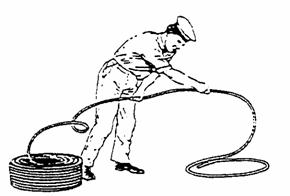
Below 48 mm the rope can be taken direct from the inside of the coil.  This will maintain its protective wrapping.  With right handed rope the coil should be stood on the end which will allow the rope to be taken off left handed from the inside.

Maintenance of Wire Ropes - Uncoiling New Cordage
Maintenance of Wire Ropes – Uncoiling New Cordage

Uncoiling the rope in the wrong direction will insert twist and increase the danger of kinking.

Coiling

Always coil ropes in the direction of Lay,

ie., Left hand (L.H.) lay anti-clockwise

                                               Right hand (R.H.) lay clockwise 

Maintenance of Wire Ropes - Coiling
Maintenance of Wire Ropes – Coiling


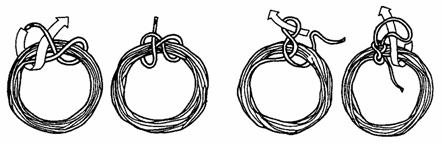
Two methods of finishing coils are shown in the above figure. 

Maintenance of Wire Ropes - Two Methods of finishing coils
Maintenance of Wire Ropes – Two Methods of finishing coils


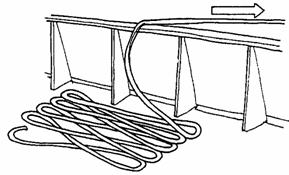
To avoid problems in paying out a rope, it should be flaked down, see Figure.  This avoids it becoming tangled or kinked. 

Maintenance of Wire Ropes - Paying out a rope
Maintenance of Wire Ropes – Paying out a rope

A fancy way to finish a rope is with a Flemish Coil.  It SHOULD ONLY be used for tidiness and never when required to render quickly through a block, see Figure.

Before cutting the desired length of rope, whippings should be applied close to each side of the intended cut.  Failure to observe this precaution can cause excessive unlaying of the rope.

Care and Maintenance

Chemicals: – Natural fibre rope is severely damaged by chemicals. Synthetic ropes are much more resistant.

Heat: – Excessive heat will melt synthetic ropes and make natural ropes dry and brittle.

Storage: – Store ropes in a well-ventilated dry atmosphere away from heat, strong sunlight and corrosive substances.  Natural fibre rope will quickly rot if stowed away wet. Always dry out before storing.  Keep loose coils OFF the deck.

Cleaning of Ropes:

If a rope has been used in mud, sand or grit, it should be cleaned thoroughly before being stored.  To wash rope, hang it up in loose coils or flake it out on the deck and hose with fresh water.

Posted on

Inspection of Vulnerable Areas

Inspection of Vulnerable Areas in the Dry Cargo Holds for Damages:

When a vessel requires repairs to damaged equipment or to the hull it is necessary for the work to be carried out to the satisfaction of the classification society surveyors. In order that the ship maintains its class, approval of the repairs undertaken must be obtained from the surveyors either at the time of the repair or at the earliest opportunity.

Terminal operators should be aware of the damage that their cargo handling equipment can inflict on the ship’s structure. It is important that the protective coatings in cargo holds and water ballast tanks are maintained.

The cargo holds and deck areas should be inspected by the ship’s deck officers upon completion of cargo discharge to identify any signs of physical damage, corrosion or coating damage to the ship’s structure. Where hull damage is identified, which may affect the integrity of the hull structure and the seaworthiness of the ship, it should be reported accordingly to the classification society.

Cargo watch on deck should monitor stevedore grab handling and damage. Crane drivers should be advised to take care not to damage ship structure cargo watch on deck should monitor ballast operations cargo watch on deck when the ship is carrying water-sensitive cargoes should identify the potential for water to leak from a crack or damage in the hold plating following grab damage consider gravitating ballast, to reduce pressure on ballast tank structures a rigorous sounding regime should be maintained in port.

The internal hold structure and protective coatings in the cargo hold and the adjacent double bottom are vulnerable to damage when the cargo is discharged using grabs. The weight of empty grabs can be 35 tonnes. Other types of equipment employed to free and clear cargo, including hydraulic hammers fitted to extending arms of tractors and bulldozers can inflict further damage to the ship’s structure, especially in way of the side shell and the associated frames and end brackets. Chipping (sharp indentations) and the local buckling or detachment of side frames at their lower connection could lead to cracking of the side shell plating which would allow the ingress of water in to the cargo space.

The protective coatings which may be required to be applied in the cargo hold are also subject to deterioration caused by the corrosive nature of the cargo, high temperature cargoes, cargo settlement during the voyage and the abrasive action of the cargo. Where no protective coatings have been applied or the applied protective coatings have broken down, the rate of corrosion in that area will greatly increase, especially when carrying corrosive cargoes, such as coal.

Corrosion will weaken the ship’s structure and may, eventually, seriously affect the ship’s structural integrity. The severity of the corrosion attained by a structural member may not be easily detected without close- up inspection or until the corrosion causes serious structural problems such as the collapse or detachment of hold frames resulting in cracks propagating in the side shell.

Impact damage to the inner bottom plating or the hopper sloping plating will result in the breakdown of coatings in the adjacent water ballast tanks, thereby intensifying the rate of structural deterioration.

Solas 74 as amended Chapter XII: Additional safety measures for bulk carriers Regulation 5: (This regulation applies to bulk carriers constructed on or after 1 July 1999)

Bulk carriers of 150 m in length and upwards of single side skin construction, designed to carry solid bulk cargoes having a density of 1,000 kg/m3 and above, shall have sufficient strength to withstand flooding of any one cargo hold in all loading and ballast conditions, taking also into account dynamic effects resulting from the presence of water in the hold, and taking into account the recommendations adopted by the Organization.

Regulation 6: Structural and other requirements for bulk carriers (This regulation applies to bulk carriers constructed before 1 July 1999):-

  1. Bulk carriers of 150 m in length and upwards of single side skin construction, carrying solid bulk cargoes having a density of 1,780 kg/m3 and above, shall comply with the requirements of this regulation in accordance with the implementation schedule specified in regulation 3.
  2. The transverse watertight bulkhead between the two foremost cargo holds and the double bottom of the foremost cargo hold shall have sufficient strength to withstand flooding of the foremost cargo hold, taking also into account dynamic effects resulting from the presence of water in the hold, in compliance with the bulk carrier bulkhead and double bottom strength standards. For the purpose of this regulation, the bulk carrier bulkhead and double bottom strength standards shall be treated as mandatory.
  3. In considering the need for, and the extent of, strengthening of the transverse watertight bulkhead or double bottom to meet the requirements of paragraph 2, the following restrictions may be taken into account:
    • Restrictions on the distribution of the total cargo weight between the cargo holds; and
    • Restrictions on the maximum deadweight.
  4. For bulk carriers using either of, or both, the restrictions given in paragraphs 3.1 and 3.2 above for the purpose of fulfilling the requirements of paragraph 2, these restrictions shall be complied with whenever solid bulk cargoes having a density of 1,780 kg/m3 and above are carried.

Vulnerable Areas in Ship’s Cargo holds where infestation may take place:

  • Tank top ceiling: If, as often happens, cracks appear between the ceiling boards, food material may be forced down into the underlying space and serve as a focus of infestation for an indefinite period. Insects bred in this space can readily move out to attack food cargoes and establish their progeny in them.
  • ‘Tween-deck centre lines, wooden feeders and bins are often left in place for several voyages and because of their construction are a frequent source of infestation. After unloading a grain cargo, burlap and battens covering the narrow spaces between the planks should be removed and discarded before the holds are cleaned or washed down. These coverings should be replaced by new material in preparation for the next cargo.
  • Transverse beams and longitudinal deck girders which support the decks and hatch openings may have an L-shaped angle-bar construction. Such girders provide ledges where grain may lodge when bulk cargoes are unloaded. The ledges are often in inaccessible places overlooked during cleaning operations.
  • Insulated bulkheads near engine-rooms: When the hold side of an engine-room bulkhead is insulated with a wooden sheathing, the airspace and the cracks between the boards often become filled with grain and other material. Sometimes the airspace is filled with insulating material which may become heavily infested and serves as a place for insect breeding. Temporary wooden bulkheads also provide an ideal place for insect breeding, especially under moist conditions, such as when green lumber is used.
  • Cargo battens: The crevices at the sparring cleats are ideal places for material to lodge and for insects to hide.
  • Bilges: Insects in accumulations of food material are often found in these spaces.
  • Electrical conduit casings: Sometimes the sheet-metal covering is damaged by general cargo and when bulk grain is loaded later, the casings may become completely filled. This residual grain has often been found to be heavily infested. Casings that are damaged should be repaired immediately or, where possible, they should be replaced with steel strapping, which can be cleaned more easily.
  • Other places where material accumulates and where insects breed and hide include:
    • The area underneath burlap, which is used to cover limber boards and sometimes to cover tank top ceilings.
    • Boxing around pipes, especially if it is broken.
    • Corners, where old cereal material is often found.
    • Crevices at plate landings, frames and chocks.
    • Wooden coverings of manholes or wells leading to double-bottom tanks or other places.
    • Cracks in the wooden ceiling protecting the propeller shaft tunnel.
    • Beneath rusty scale and old paint on the inside of hull plates.
    • Shifting boards.
    • Dunnage material, empty bags and used separation cloths.
    • Inside lockers.
Posted on

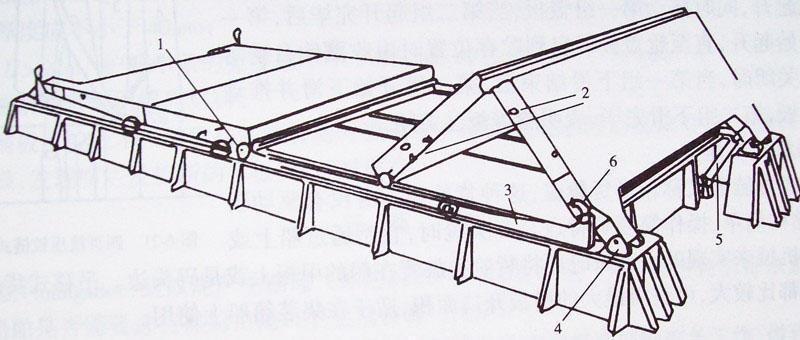
Macgregor Hatch Cover on board of bulk carrier

Maintenance of Macgregor type of steel hatch cover on board of bulk carrier.

Poor maintenance of hatch covers causes leakage leading to cargo damage and represents a hazard to the ship and its crew. Although hatch covers are simple and durable, their sealing gaskets are easily damaged. The quality of sealing is affected by lack of alignment and poor gasket compression. When hatch covers are opened at the end of an ocean voyage, look for signs of leakage such as rust staining or drip marks.

Regular adjustment and repair, by ship’s staff, will reduce the overall cost of maintenance. Painting double drainage channels will help to prevent corrosion.

Always keep a detailed record of maintenance. Take care during extensive hatch cover repair to avoid cover distortion.

Rubber Gaskets: -Keep clean and free from paint. If physically damaged, permanently set-in or aged, replace with minimum 1 metre lengths. Always follow the manufacturer’s instructions when renewing gaskets.

Macgregor Hatch Cover - Rubber Gaskets
Macgregor Hatch Cover – Rubber Gaskets

Gasket Channels:- If gasket channels are badly corroded, causing the hatch packing to hang loose, the packing should be removed and the channel repaired by welding new metal strips which should be painted before fitting new rubber. Always follow proper fire prevention safety procedures. Make sure that cargo spaces are free of cargo and combustible material. When conducting extensive structural repairs, remove the hatch covers to shore.

Macgregor Hatch Cover - Gasket Channels
Macgregor Hatch Cover – Gasket Channels

Hatch Cover Structure:- Repair or replace any damaged, worn or defective hatch covers or comings. Consult with the ship’s classification society before commencing repair. Paint new structure immediately.

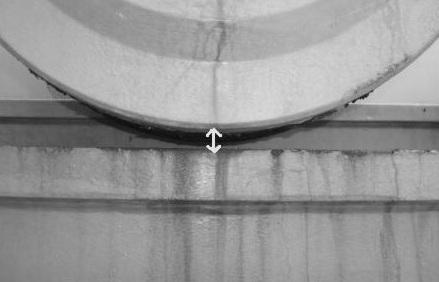
Compression Bars:- Effective sealing is only possible with a straight, undamaged and non-corroded compression bar. Compression bars which are not in this condition should be repaired or replaced, taking care to align the bars properly. Remember to carry out a chalk test to check alignment, both during and after repair.

Landing Pads:- Hatch sealing is arranged by design to give the correct compression of the gasket when there is metal-to-metal contact on the hatch landing pad, side plate, or inter panel block. If landing pads are reduced in height (check with manufacturers’ drawings) because of wear, repair is essential.

Hatch Wheel Track Ways:- Track ways can corrode. They are weakened by abrasive wear and tear. When weakened, track ways can distort and break, affecting hatch movement and alignment. Deterioration is visible to the naked eye. Repair by replacing the worn or damaged material with sufficient new material to restore strength. Always keep hatch wheel track ways clean and painted.

Macgregor Hatch Cover - Hatch Wheel Track Ways
Macgregor Hatch Cover – Hatch Wheel Track Ways

Hatch Coamings:- Look for cracks at coaming corners. If any are found, consult the ship’s classification society before commencing repairs in case the coaming needs to be reinforced. Examine coaming support brackets for corrosion where they connect with the ship’s deck. Make sure coamings and their support brackets are painted. Coamings can be damaged by cargo equipment during loading or discharge. Look out for damage and repair if found.

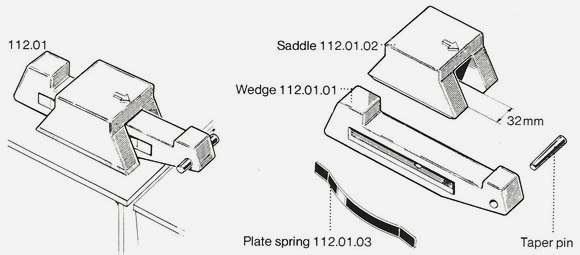
Macgregor Hatch Cover - Hatch Cleats and Wedges
Macgregor Hatch Cover – Hatch Cleats and Wedges

Hatch Cleats and Wedges:- It is important for compression washers to be adjusted correctly. A locking nut for adjusting compression is situated at the base of the cleat. The procedure to alter compression (see illustrations) is as follows:

  • Close hatch and secure for sea;
  • Place the cam of the cleat in the hatch socket as if to lock it, but leave it unlocked (the cam should move freely and fit snugly in its housing);
  • Adjust the locking nut until the compression washer touches the underside of the hatch coaming or its steel washer;
  • Turn the locking nut one full turn to achieve the desired tension;
  • Do not over-tighten;
  • Protect the thread on completion.

When closing and securing a hatch for sea passage, check the tension in side cleats. Cleats should never be adjusted in isolation, adjust all cleats along the hatch skirt at the same time.

Hatch Cross-Joints:- It is essential for the cross-joint to be in good condition and properly aligned.

Maintenance and repair should focus on:

  • Examination of the cross-joint structure for corrosion.
  • Examination of joint hinges for pin wear, blade cracking or weld failure.

(Re-grease the hinge pin bushes making sure grease reaches the hinge pins).

  • Examination of the steel-to-steel inter-panel blocks and locators for wear. (Check the top plate of hatch panels, they should be level when closed).
  • Checking the gap between panels when they are closed. Misalignment could be caused by an incorrectly adjusted cylinder or the wheel tracks could be worn.

Hatch Wheels:- Hatch wheel spindles and bearings (where fitted) need to be greased regularly. Check the wheel spindle for wear and the wheel housing for physical damage. Repair if the spindle is worn or if the wheels are out of alignment.

Drain Channels and Non-Return Valves:- Clean coaming tops and cross-joint channels by removing any loose scale or cargo residue by brushing or hosing. Clean coaming drain holes and check that the nonreturn valve is functioning.

Greasing:- Wheel spindles, cleat spindles, hinge pins, hydraulic cylinder protective sheaths, cleat wedges, drive chain sprockets, toothed rack and cylinder spherical bearings need to be kept well-greased. Re-grease every month if necessary, and always apply new grease after the ship has passed through heavy weather.

Painting:- Corrosion occurs mainly at the panel ends along the cross-joint or where access is difficult, but it can also occur on the underside of a panel, especially along hatch beams. Regular painting will be necessary.

Inert Gas:- Hatch covers with a double skin, in the form of a closed box, are filled with inert gas. After structural repair, the inner spaces must be re-inerted. This is done by inserting special tablets (available from the hatch cover manufacturer) into the space and welding shut. Never allow water to penetrate the box construction.

Hydraulic Systems and Components:- The cleanliness and viscosity of hydraulic oil must be checked. Samples of the oil should be sent to a chemist for testing (use the same company that checks and tests your fuel and lubricating oil). The hydraulic system is provided with bleed points from which samples can be taken. Hydraulic oil should be changed every five years or after there have been significant repairs, such as piping or cylinder replacement. Hydraulic oil filters should be changed every twelve months. Do not contemplate repairing the hydraulic system without the proper components and skilled fitters.