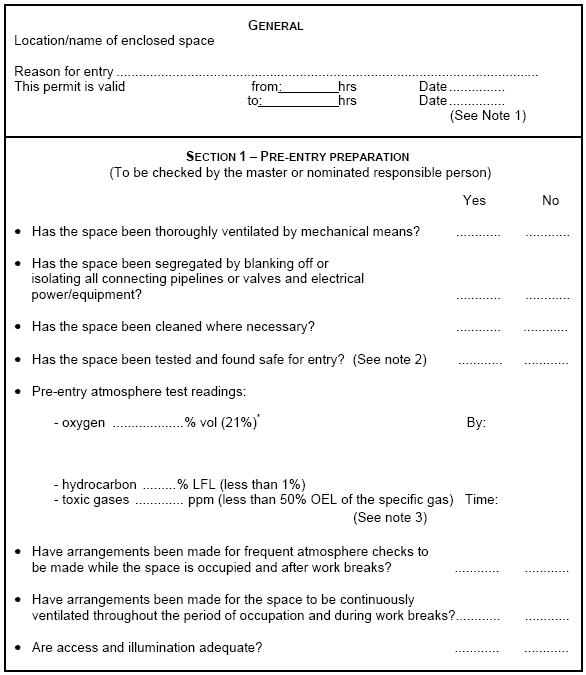
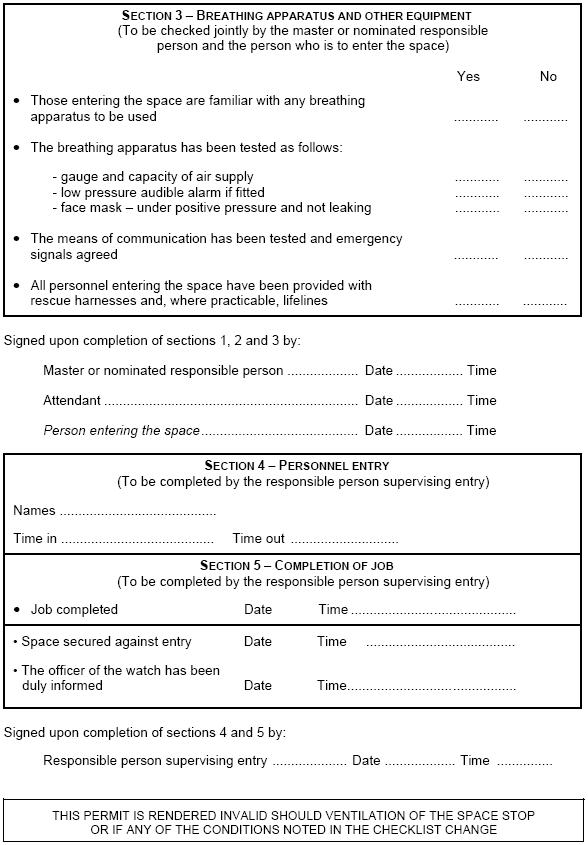
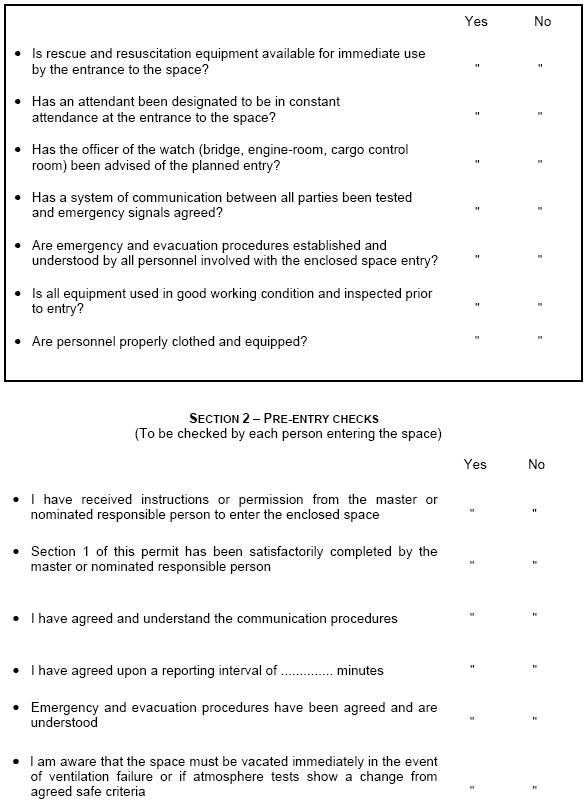
Check list prior to Entry into a space that has been closed for an extensive period of time:
Enclosed Space Entry Permit:- This permit relates to entry into any enclosed space and should be completed by the master or responsible person and by any persons entering the space, e.g. competent person and attendant.
Checklist Enclosed Space Entry Permit on Ships
Precautions to be taken prior, during and after entering enclosed space:
Before Entry
All parties to discuss the job to be done in the space: What are the hazards of the space and how can they be controlled?What are the hazards of the job and how can they be controlled? ย Risk assessment: Document the hazards and necessary safety measures and controls. ย Secure the space: Empty the space if necessary and take steps to prevent the space filling up:Lock out valves and pumps and Place notices forbidding their operation. Is the space adjacent to other tanks, holds, or pipelines which if not secure could present a danger? ย Ventilate: Allow sufficient time for the space to be thoroughly ventilated naturally or mechanically. Guard any openings against accidental and unauthorized entry. ย Test: Test the atmosphere in the space for oxygen content and the presence of flammable and toxic gases or vapours. Do not enter until the atmosphere has been determined to be safe. ย Permit โ complete an enclosed space entry permit to work, confirming that: The hazards of the job and of the space have been dealt with. The atmosphere in the space is safe and ventilated. The space will be adequately illuminated. An attendant at the entrance has been appointed. Communications have been established between bridge and entry point, and entry. Emergency rescue equipment is available at the entrance and there are sufficient personnel on board to form a rescue party. All personnel involved are aware of the task and the hazards, and are competent in their role.
During Entry
Ensure the space is suitably illuminated. Wear the right PPE. Continue to ventilate the space. Test the atmosphere at regular intervals. Communicate regularly. Be alert, and leave the space when requested or if you feel ill.
After Entry
Ensure all equipment and personnel are removed from the space. Close the access of the space to prevent unauthorized entry. Close the entry permit. Reinstate any systems as appropriate.
Bridge Resource Management & Bridge Team Management:
Situational Awareness and the conditions that affect Situational awareness of an OOW as per BRM:
BRM (Bridge Resource Management) addresses the management of operational tasks, as well as stress, attitudes and risk. BRM recognizes there are many elements of job effectiveness and safety, such as individual, organizational and regulatory factors, and they must be anticipated and planned for.
BRM enables the bridge team to mark the abort points and various contingencies (anchorage and berth).
BRM begins before the voyage with the passage plan and continues through the end of the voyage with the passage debrief, debriefing or evaluation helps in improvement.
Situational awareness:
Present state of weather, wind, sea state, swell and visibility and the meterological forecast.
Present draft and depth of water, proximity of hazards and effect of squat.
State of tide and current and effect of the same.
Communications with VTS and any safety related communication with all the stations.
All the displays on bridge โ tachometer, rudder angle indicator, ROTI, UKC, anemometer, inclinometer etc, also displays for course steered and course made good, speed through water and speed over ground.
Awareness of own shipโs configuration, maneuvering characteristics (turning circle, stopping distance etc).
Awareness of the equipment and systems and the limitations. These include bridge equipment, communication equipment, propulsion and steering.
Adjustment of various setting for example radar, auto pilot etc.
Many factors can cause you to lose situational awareness, data not observed, either because it is difficult to observe or your scanning of the environment is deficient due to:
Passive, complacent behavior.
Lack of training, lack of familiarization, lack of experience, lack of competency.
Lack of interest, lack of motivation, fear, lack of communication skill.
Over reliance on a person, system or equipment.
Inability to understand change in traffic/ weather conditions.
High work load, stress and fatigue.
Ambiguity, confusion, distraction and interruptions etc.
Principles of Bridge Resource Management (BRM):
Shared view of goals.
Delegation of responsibilities
Effective organization and sense of team owner ship in achieving goals.
Bridge Resource Management (BRM), or as it is called Bridge Team Management (BTM), is the effective management and utilization of all resources, human and technical, available to the Bridge Team to ensure the safe completion of the vesselโs voyage.
BRM focuses on bridge officerโs skills such as teamwork, team building, communication, leadership, decision making and resource management and incorporate this into the larger picture of organizational and regulatory management.
BRM addresses the management of operational tasks, as well as stress, attitudes and risk. BRM recognizes there are many elements of job effectiveness and safety, such as individual, organizational and regulatory factors and they must be anticipated and planned for.
BRM enables the bridge team to mark the abort points and various contingencies (anchorage and berth).
BRM begins before the voyage with the passage plan and continues through the end of the voyage with the passage debrief, debriefing or evaluation helps in improvement.
Importance of Bridge Resource Management on board & factors that affect the effective use of BRM with onboard situation:
When BRM is practiced correctly onboard the result should be a Bridge Team that.
Maintain its situational awareness hence avoids accidents.
Continually monitors the progress of the vessel making appropriate adjustments and corrections as necessary to maintain a safe passage.
Acquires relevant information early.
Appropriately delegates workload and authority.
Anticipates dangerous situations.
Avoid becoming pre-occupied with minor technical problems and losing sight of the big picture.
Decides on met warnings/ navigational warnings applicable to own vessel.
Can be beneficial to make the short term strategy if required.
Recognizes the development of an error chain; and
Takes appropriate action to break the error-chain sequence.
Debriefing can help in improvement of future passage plan and possible suggestion to improve SMS checklists / procedures.
BRM tends to develop confidence in each individual, as it focuses on the human factor so hence enables to fulfill the various requirements of charter party without compromising with shipโs safety.
How to effectively use the various resources such as Navigational Equipment on the bridge and available man power for safe keeping a safe navigational watch at sea based on the principle of Bridge Resource Management:
Effectively use of Various resources with respect to Navigational Equipment: A mariner has many resources available to him for safe passage planning and execution and monitoring. Some examples include:
Vessel Traffic Services (VTS) and usage of IMO shipโs routeing.
All the displays on bridge tachometer, rudder angle indicator, ROTI, UKC, anemometer, inclinometer etc, also displays for course steered and course made good, speed through water and speed over ground.
Internal and external communication equipment.
Met warnings and navigational warning through ECG, Navtex etc.
Implementing Bridge Resource Management on my vessel:- The Master can implement BRM by considering and addressing the following:
Passage Planning:- covering ocean, coastal and pilotage waters. Particular attention is paid to high traffic areas, shallow waters, or pilotage waters where the plan incorporates appropriate margins of safety and contingency plans for unexpected (abort points and contingency anchorages).
Passage Plan Briefing:- all bridge team members are briefed on the passage plan and understand the intended route and procedures to transit the route.
Bridge Manning:- Master uses passage plan to anticipate areas of high workload and risk and sets manning levels appropriately.
Bridge Team Training (ashore and on-the-job) โ is given all bridge members and they are sure of their roles and responsibilities, both for their routine duties and their duties in the event of an incident / emergency.
Masterโs Standing Orders- are read and signed before the commencement on the voyage. Orders are clear on the chain of command, how decision and instructions are given on the bridge and responded to, and how bridge team members bring safety concerns to the notice of the Master. Masterโs standing orders must not in conflict with companyโs standing orders/ procedures.
Master / Pilot Exchange โ the passage plan is discussed by the Master and the pilot and changes made as necessary. Any new information is communicated to the rest of the bridge team. When the pilot is onboard he/she should be supported as a temporary bridge team member, relevant checklists to be complied with, pilot advice can be challenged as and when required.
End of Voyage Debriefing – provides the opportunity for the bridge team to review the passage planโs strengths and weaknesses, make suggestions for improved safety or communications, and improve team problem solving skills.
Factors to be taken into account when determining bridge manning levels:
Determination of minimum safe manning levels (SOLAS CHAPTER V โ Annex 2):-
The purpose of determining the minimum safe manning level of a ship is to ensure that its complement includes the grades/capacities and number of persons required for the safe operation of the ship and the protection of the marine environment.
The minimum safe manning level of a ship should be established taking into account all relevant factors, including the following:
size and type of ship;
number, size and type of main propulsion units and auxiliaries;
construction and equipment of the ship;
method of maintenance used;
cargo to be carried;
frequency of port calls, length and nature of voyages to be undertaken;
trading area(s), waters and operations in which the ship is involved;
extent to which training activities are conducted on board; and
applicable work hour limits and/or rest requirements.
The determination of the minimum safe manning level of a ship should be based on performance of the functions at the appropriate level(s) of responsibility, as specified in the STCW Code, which include the following:
navigation, comprising the tasks, duties and responsibilities required to:
plan and conduct safe navigation;
maintain a safe navigational watch in accordance with the requirements of the STCW Code;
manoeuvre and handle the ship in all conditions; and
moor and unmoor the ship safely;
ย cargo handling and stowage, comprising the tasks, duties and responsibilities required to:
plan, monitor and ensure safe loading, stowage, securing, care during the voyage and unloading of cargo to be carried on the ship;
operation of the ship and care for persons on board, comprising the tasks, duties and responsibilities required to:
maintain the safety and security of all persons on board and keep life-saving, fire-fighting and other safety systems in operational condition;
operate and maintain all watertight closing arrangements;
perform operations, as appropriate, to muster and disembark all persons on board;
perform operations, as appropriate, to ensure protection of the marine environment;
provide for medical care on board the ship; and
undertake administrative tasks required for the safe operation of the ship;
In determining the minimum safe manning level of a ship, consideration should also be given to:
the number of qualified and other personnel required to meet peak workload situations and conditions, with due regard to the number of hours of shipboard duties and rest periods assigned to seafarers; and
the capability of the master and the ship’s complement to co-ordinate the activities necessary for the safe operation of the ship and the protection of the marine environment.
Define โEmergencyโ. How does SOLAS ensure that shipโs crew can deal with various emergencies that may arise? Describe how this achieved on your last ship:
Emergency:- A serious, unexpected, and often dangerous situation requiring immediate action.
To ensure that Shipโs crew can deal with various emergencies, Emergency Training & Drills are given as per SOLAS Regulation 19
Regulation 19 Emergency training and drills
This regulation applies to all ships.
Familiarity with safety installations and practice musters:
Every crew member with assigned emergency duties shall be familiar with these duties before the voyage begins.
On a ship engaged on a voyage where passengers are scheduled to be on board for more than 24 h, musters of the passengers shall take place within 24 h after their embarkation. Passengers shall be instructed in the use of the lifejackets and the action to take in an emergency.
Drills:
Drills shall, as far as practicable, be conducted as if there were an actual emergency.
Every crew member shall participate in at least one abandon ship drill and one fire drill every month. The drills of the crew shall take place within 24h of the ship leaving a port if more than 25% of the crew have not participated in abandon ship and fire drills on board that particular ship in the previous month. When a ship enters service for the first time, after modification of a major character or when a new crew is engaged, these drills shall be held before sailing.
Abandon ship drill
Each abandon ship drill shall include:
summoning of passengers and crew to muster stations with the alarm required by regulation 6.4.2 followed by drill announcement on the public address or other communication system and ensuring that they are made aware of the order to abandon ship;
reporting to stations and preparing for the duties described in the muster list.
checking that passengers and crew are suitably dressed;
checking that lifejackets are correctly donned;
lowering of at least one lifeboat after any necessary preparation for launching;
starting and operating the lifeboat engine;
operation of davits used for launching liferafts;
a mock search and rescue of passengers trapped in their staterooms; and
instruction in the use of radio life-saving appliances.
Different lifeboats shall, as far as practicable, be lowered in compliance with the requirements of paragraph 3.3.1.5 at successive drills.
Except as provided in paragraphs 3.3.4 and 3.3.5, each lifeboat shall be launched, and manoeuvred in the water by its assigned operating crew, at least once every three months during an abandon ship drill.
In the case of a lifeboat arranged for free-fall launching, at least once every three months during an abandon ship drill the crew shall board the lifeboat, properly secure themselves in their seats and commence launch procedures up to but not including the actual release of the lifeboat (i.e., the release hook shall not be released). The lifeboat shall then either be free-fall launched with only the required operating crew on board, or lowered into the water by means of the secondary means of launching with or without the operating crew on board. In both cases the lifeboat shall thereafter be manoeuvred in the water by the operating crew. At intervals of not more than six months, the lifeboat shall either be launched by free-fall with only the operating crew on board, or simulated launching shall be carried out in accordance with the guidelines developed by the Organization.
As far as is reasonable and practicable, rescue boats other than lifeboats which are also rescue boats, shall be launched each month with their assigned crew aboard and manoeuvred in the water. In all cases this requirement shall be complied with at least once every three months
Emergency lighting for mustering and abandonment shall be tested at each abandon ship drill.
Fire Drills:
Fire drills should be planned in such a way that due consideration is given to regular practice in the various emergencies that may occur depending on the type of ships and the cargo.
Each fire drill shall include:
reporting to stations and preparing for the duties described in the muster list required by regulation 8;
starting of a fire pump, using at least the two required jets of water to show that the system is in proper working order;
checking of firemanโs outfit and other personal rescue equipment;
checking of relevant communication equipment;
checking the operation of watertight doors, fire doors, fire dampers and main inlets and outlets of ventilation systems in the drill area; and
checking the necessary arrangements for subsequent abandoning of the ship.
Leadership with respect to bridge resource management principles:
Explanation:- (Prepare your answer based on the Marks)
Leadership: Becoming an effective leader is not easy, it requires Part Skill Development and Part Experience. Leadership is Action and not Position.
Leadership Principles: A principle is a โTested form of Actionโ, proven useful in the skill of leadership in isolation, principles are ineffective โ must be applied based on the situation.
The Leadership Principles need to have these qualities:
Show interest
Positive approach
Complaints
Promises
Get the facts
Discussion basis
Design an approach
Explain why
Admit mistakes
Reasonable expectations
Be prompt
Compliment
Prepare for change
Show Interest: Develop a Relationship
Frequent personal contact โ Listen to others.
Keep an open and honest attitude.
Take time to learn & understand other peopleโs needs.
Sell ideas based on merit, value to others.
Never force a personal agenda
Offer suggestions to help others solve their OWN problems.
Positive approach:
Consider other personโs feelings & objectives in planning what you do/say.
Plan before you speak.
Give โbenefit of the doubtโ
Avoid jumping to conclusions
Consider otherโs point of view and emotional state
Keep negative emotion out of discussion.
Complaints / Suggestions: View complaints not as personal criticism, but as valuable feedback and suggestions.
Address complaints quickly, listen to whole story.
Remain composed, calm โ avoid interruptions.
Show problem is understood by restating it, ask questions to clarify misunderstandings.
Show appreciation, and indicate what will be done.
Follow Up with action.
Promises: Make few promises, and keep them.
Credibility lost when leadership fails to keep promises.
Ensure commitment is realistic and attainable.
Keep stakeholders informed of progress.
If situations change, and promise cannot be kept:
Immediately contact those affected, avoid rumours
Explain carefully and thoroughly the reasons.
Allow free feedback, consider others.
Follow up with mutually agreed corrective actions.
The Facts: Examine all facets of a situation
Evaluate evidence
Allow everyone involved to express viewpoint
Consider otherโs rights, whatโs fair.
Ignore unsubstantiated information.
Base decisions on logical thinking, not emotions.
Discussion basis: Keep it a business-like discussion
Stick to the subject
Listen respectfully
Avoid getting hung up on personalities
Grant that other person โmay have somethingโ
Do not loose temper
Plan the time and place for the discussion
Design an Approach: Approach appeals to otherโs motivations and emotions.
Be pleasant, remain calm.
Use questions, and listen to responses.
Observe body language, clues to otherโs feelings.
Give direct answers.
Speak in a manner the other participants understand / relate to
Explain Why: Reasons why/why not
Be truthful.
Show willingness to answer questions
Let others โin on the knowโ
Present the complete story.
MAY HAVE TO MODIFY FOR SHIP USE
Effective Communication with the respect to Bridge Resource Management Principles:
Effective Communication: Communication is at the heart of any relationship, be it familial, business, romantic, or friendly.
Communication is not a one-way street.
To have others open up to you, you must open up yourself first.
By overcoming these barriers to communication, you can ensure that the statement you are making is not just heard, but also understood, by the person you are speaking with.
In this way, you can be confident that your point has been expressed and understood.
Types of Communication:
Verbal Communication:
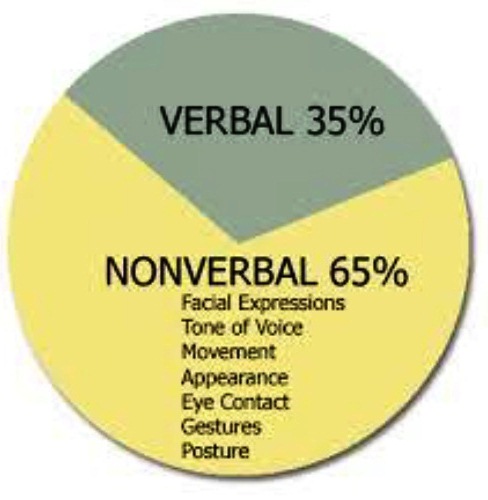
Verbal communication continues to be the most important aspect of our interaction with other people.
Itโs important to understand both the benefits and shortcomings of this most basic communication.
Non-verbal Communication:
It is any kind of communication not involving words.
When the term is used, most people think of facial expressions and gestures, but while these are important elements of non-verbal communication, they are not the only ones.
Non-verbal communication can include vocal sounds that are not words such as grunts, sighs and whimpers.
Even when actual words are being used, there are non-verbal sound elements such as voice tone, pacing of speed and so forth.
Effective Verbal Communication:
It has more to do with listening than it does with speaking because you are always dealing with an audience.
This is true no matter whether you are speaking to a crowd of thousands or to a party of one.
Listening is key because when you address an audience, no matter the size, you have to meet its needs to communicate effectively, and to know the needs of your audience, you have to listen.
Formal Communication:
It can be considered as communication efforts that are โdressed upโ to fit customary rules and ceremony e.g. in a written letter, the formal communication style will demand that the layout of the piece of written communication follow a specific format that includes the date, header, salutation, body of the letter, close, signature lines and any indicators of enclosures all placed neatly upon company letterhead or personal stationery.
By contrast, an informal piece of written communication can be as simple as a jotted note to a friend on a torn slip of paper.
Informal Communication:
If formal communication is viewed like dressing for a black tie affair, informal communication is like dressing casually and wearing slippers around the house.
Much informal communication occurs on a person to person basis, in a face-to-face manner, without ceremony or fanfare.
Other ways to communicate in an informal manner may include texting, post-it notes, an informal drop in visit to another person, or a quick and spontaneous meeting.
Communication through Body Language:
Communication is how human beings interact with the world that surrounds them.
There are many forms of communication, some being more effective at conveying the intent or feelings of the individual expressing than others.
Many people have a hard time with communication, and can find it difficult to tell others what they think or to give them bad news.
Sometimes, they canโt find the right words to express the things they want to say.
There are also those people who are not to be believed due to a history of dishonesty or embellishing the truth.
One form of communication, however, is always honest and can always be counted on.
Bridge Team Management:
The OOW is in charge of the Bridge Team, until properly relieved, in compliance with the SMS and Master’s Standing Orders. This responsibility extends to ensuring that bridge watch manning levels are at all times maintained at a safe level for the prevailing circumstances and conditions. An OOW should be on watch on the bridge at all times at sea or at anchor. All members of the Bridge Team including look-outs and any helmsmen should be fit for duty.
Importance of Communication in Bridge Team Management:
IMPORTANCE OF COMMUNICATION
Verbal Communication:
Is either spoken or written
Helps to build relationships
Helps in task completion
On its own can hinder effective communications
The โhowโ it is said may be more important than โwhatโ is said
Written communications must be clear, precise and informative
Non โ Verbal Communication:
Complements verbal communication by:
Repeating what is being said
Reinforces verbal communications
Enables emphasis to be placed on certain words
Contradicts the verbal message
Substitutes for verbal behaviour
Debriefs โ An Aid to Effective Communication:
Debriefs should be held as they:
Enable learning
Prevent repetition of errors
Enable improvement
Reinforce correct behaviour with positive feedback
Importance of โFeedbackโ for effective communication on bridge:
Effective feedback is critical as it:
Ensures that the sender and receiver are โon the same pageโ.
Closes the communication loop.
Prevents the receiver misunderstanding the original intent of the message.
Assertiveness with on board examples:
Assertiveness is the ability to communicate what you feel is correct in an open and honest manner possibly without hurting the feelings of others.
Passive Behavior: Failing to state your needs, wants, opinions, feelings or beliefs in direct honest and appropriate ways, Stating them in a way that others can easily disregard them.
Aggressive Behavior: Ignoring or dismissing the needs, wants, opinions, feelings, or beliefs of others. Expressing your own needs or wants in inappropriate ways.
Importance of Assertiveness:
Effective communication brings about the achievement of individual and/ or shared goals.
Assertiveness increases your ability to reach these goals while maintaining your rights and dignity.
Guidelines for being assertive:
Decide what you want
Say it clearly and specifically
Support what you say by how you say it.
Donโt be manipulated or sidetracked.
Listen
Aim for a working compromise or โwin winโ situation
Applicability on ship board work:
Reprimanding or criticizing a member of staff
Delegating an unpleasant task
During appraisals
Resolving conflicts
Making sure the things on ship as per valid company requirement and regulations
Actions to be taken while on Navigational Watch: The Steering Gear Failure
If
on Auto-Steering, the first action is to change over to Hand steering.
The
1st suspect is โTelemotor failureโ.
Switch
over to other Telemotor โSystemโ (Marked as System 1 / 2).
It
that still does not solve the problem, the next suspect is the Steering Motor.
Change
from Steering Motor 1 to Steering Motor 2.
It
that still does not solve the problem, next suspect is failure of both
telemotor system.
Turn
the mode selection switch to NFU (non-follow up steering)
Even
if this does not work, it means that all means from steering from the bridge
have failed and the last resort of Emergency steering from the Steering gear
compartment has to be resorted to.
After
each corrective step, the rudder would have to be tried out. Before doing it,
pay heed to traffic around to avoid any Closed Quarterโ situation.
If
in restricted waters with traffic around, if steering is not restored
immediately,
Reduce
to Minimum Steerage way.
Inform
ships around through safety message and burn NUC lights or hoist NUC shapes.
Inform
Master and the Engine Room.
Such
efficiency can only be achieved by planned and frequent training by simulating
steering gear failures.
Details
of drills and their periodicity is strictly laid down in ships training manual.
Company
Superintendents and Surveyors are very particular that these drills are carried
out regularly and recorded correctly as per the ISM procedures.
Actions to be taken while on Navigational Watch: The Auto Pilot Alarm Sounds
Check compass and rudder angle indicator and compare, if the compass moves to port the rudder should move to stbd.
Check wake of the ship for yawing.
Check course recorders heading for a straight line. It does not ring unless the difference between the course setting and gyro heading is more than the preset limit.
Inform Master.
Actions to be taken while on Navigational Watch: Seeing a Man on Deck Falling Overboard:
The initial and
early sighting of the fallen crew plays a vital role in increasing the
percentage of saving his/her life. The actions for an MOB mentioned below are
extremely urgent and must be taken without any delay to save the life of the
person who has fallen overboard.
Change over to hand steering from auto and put the wheel hard over to the respective side (port or starboard).
Release MOB marker from the side of the bridge wing to which MOB has occurred. This marker is buoyant and has a self igniting light as well as a self activating smoke signal.
Press the MOB button on the GPS to mark the position of the casualty for future reference.
Sound โOโ on the whistle (one prolonged blast). This is to let the Master and the crew knows about the emergency situation. Supplement this with the appropriate โOโ flag.
Post extra lookout as soon as possible.
Sound the General Alarm on the shipโs whistle to alert everybody to proceed to stations. This is to ensure that if the crew has not understood the one prolonged blast for MOB, they are alerted regardless and proceed to muster stations to assist in the recovery of the person.
Thereafter, announce the MOB situation on the shipโs PA system.
Inform the engine room of the situation and let them know that maneuvering will be required.
Execute the Williamsons turn (explained later).
Keep a keen eye on the RADAR/ARPA and put the VHF on Channel 16.
Maintain a record of all the events in the Bell book.
Carry out Masterโs orders.
The Chief Mate should take-over all decisions based on deck with regard to lowering survival craft etc.
The Third Mate ought to assist the Master on Bridge.
The officer in charge at the moment must send out an โUrgency signalโ on all the communications systems to let ships in the vicinity know about the situation.
Keep the lifebuoy (MOB marker) in sight.
The rescue boat should be manned adequately with enough personnel to carry out the rescue operation.
Portable handheld VHF must be carried by the officer in the rescue boat.
Once the person is rescued, the rescue boat must be picked up upon arrival close to the ship along with the lifebuoy and hoisted back.
Immediate first aid should be administered if required.
An โUrgency Signalโ must be sent out to cancel the last transmitted MOB alert.
Appropriate entries must be made in the Shipโs Logbook.
The Master must carry out an enquiry with respect to the MOB incident and all entries made in the Shipโs Logbook.
The engines are not
stopped immediately to keep the person away from the propeller. The same is the
case for wheel hard over to the side of the casualty as it is done to keep the
stern away from the casualty. Screaming about the MOB at the instant that the
mishap is realized is of paramount importance to use all manpower available for
immediate use. The lifebuoy also adds to the lifesaving process as the smoke
signal leaves a conspicuous mark by the day or night. It is also important to
pick up the lifebuoy to not confuse any other ships passing by about the status
of the MOB. They must not assume that there is a MOB in the vicinity and
proceed towards helping the person when he has already been rescued. Entries in
the Shipโs Logbook hold great legal importance and should be made carefully.
Always try to succeed in the first attempt as even a little delay can cause a
human life.
The Williamson Turn:
Note the position
of the ship
Put wheel hard over
to the side of the casualty
After the ship has
aletered course by about 60 degrees, put wheel hard over to the other side
When the vessel is
20 degrees short of the reciprocal course, wheel on midship
The Scharnow Turn:
Put the rudder over
hard toward the person
After deviating
from the original course by about 240 degrees, shift the rudder hard to the
opposite side.
When heading about
20 degrees short of the reciprocal course, put the rudder amidships so that
vessel turns onto the reciprocal course.
The Anderson Turn:
Stop the engines.
Put the rudder over
toward the person
When clear of the
person, go all ahead full, still using full rudder.
After deviating
from the original course by about 240 degrees (about 2/3 of a complete circle),
back the engines 2/3 or full.
Stop the engines
when the target point is 15 degrees off the bow. Ease the rudder and back the
engines as required.
Actions to be taken while on Navigational Watch: On observing another vessel dragging her anchor onto you:
Sound โUโ on the whistle: This will also attract the attention of other ships, if any, in the vicinity but none of them would know who is sounding the whistle and for whom the signal is intended. The other ships would thus be alerted and become witnesses.
Inform Master: On hearing the whistle, the Master of the own ship would rush to the bridge.
Call up the other ship by VHF. At this close range, the other shipโs name wold be clearly visible. Inform him that he is dragging anchor on to us.
In case the OOW on that ship does not respond to VHF calls, flash โUโ at him by the Daylight Signaling Lamp. When he responds, ascertain by VHF, what action he is taking.
Inform the engine room: โThis is an emergency. Get engines ready as soon as possible and let us know when you are ready. Switch on power to the windlassโ.
Call anchor stations urgently.
Call for a messenger on the bridge because the quartermaster would be manning the wheel.
Switch on steering motors.
Switch on radar/ ARPA.
Keep a record of all happenings, and their timings in the Bridge Notebook.
Carry out Masterโs orders.
Actions to be taken while on Navigational Watch when underway: Approaching Rain with reducing visibility / Sight a fog bank ahead:
Inform Master.
Inform E/R โWe are
entering fog. Get engines ready for maneuvering and let us know as soon as
readyโ.
Observe visually
and make a note of the movement of all traffic in sight.
Switch on ARPA and
commence plotting.
Switch on
navigation lights.
Change over to hand
steering.
Switch on the other
steering motor also.
Post double
lookouts โ one on the bridge as lookout-cum-messenger and the other on the
forecastle, monkey island or crowโs nest as appropriate (consult Master
regarding the deployment of the second lookoutman).
Try out pneumatic
whistle, electric klaxon and manual foghorn by giving a very short blast on
each.
Stop all noise on
deck so that fog signals of other ships would not get drowned by noises on
board the own ship.
Keep open the outer
doors of the wheelhouse so that fog signals of other ships may be heard.
Commence sounding
fog signals before entering fog.
Reduce to โSafe
speedโ before entering fog.
Restrict hold
ventilation.
Record all
happenings in the bridge notebook.
Actions to be taken while on Navigational Watch: In restricted visibility you pick up a target on your radar:
Stop Engine.
Take her all way
off.
Start radar
plotting.
Compete radar
plotting.
Find out best
course of action.
Do not alter course
before completing radar plotting as because this is a scanty radar information.
Actions to be taken while on Navigational Watch: Own Ship is Dragging Anchor:
Inform Master.
Inform engine room โThis is an emergency, get engines ready as soon as possible and let us know when you are ready. Switch on power to windlassโ.
Call anchor stations.
Call for a messenger on the bridge because the quartermaster would be manning the wheel.
Switch on steering motors.
Switch on radar/ ARPA.
Try out pneumatic whistle and electric klaxon.
The VHF would already be on, while at anchor, guarding Channel 16.
Keep a record of all happenings, and their timings in the Bridge Notebook.
Carry out Masterโs orders.
If the Master is ashore, the Chief Officer would automatically take charge of the situation.
In the rate circumstance of both of them being ashore, the Second officer would have to manage. In such a case, the following point would be of great importance:
The length of cable paid out is only to ensure that the pull on the anchor shank, while it is on the sea bed, is horizontal. Once that is assured, paying out more cable would NOT help.
Heaving up anchor, manoeuvring the ship, and re-anchoring should ONLY be a last resort by the Second Officer.
Inform harbor control by VHF, โMy ship is dragging anchor. Require a pilot immediately to re-anchorโ.
Prepare your vessel for encountering heavy weather/ rain at Sea:
Inform Master.
Inform Chief Officer.
Inform Catering Staff.
Inform Engine Room.
Secure all movable equipment on the bridge.
Switch on ARPA and commence plotting.
Switch on navigation lights. Later on, clouds may result in partial darkness; rain and/or spray may result in decrease of visibility.
Switch on second steering motor also.
Try out pneumatic whistle, electric klaxon and also foghorn.
Keep a record of all relevant actions/ events in the Bridge Notebook.
Inspect the chart and ensure that the intended course is safe bearing in mind the following points:
More under keel clearance would be required because of pitching, rolling and heaving.
The ship would be more difficult to manage in bad weather and hence it may be necessary to give dangers a wider berth than in calm weather.
Failure of main engine, failure of generators, failure of steering systems, etc, in bad weather, as some of the possibilities that must not be overlooked.
Actions to be taken while on Navigational Watch: During open sea watch you observe the barometer falling rapidly:
Prepare for the onset of stormy weather with strong winds.
Inform Master.
Inform Chief Officer.
Inform Catering Staff.
Inform Engine Room.
Secure all movable equipment on the bridge.
Switch on ARPA and commence plotting.
Switch on navigation lights. Later on, clouds may result in partial darkness; rain and/or spray may result in decrease of visibility.
Switch on second steering motor also.
Try out pneumatic whistle, electric klaxon and also foghorn.
Keep a record of all relevant actions/ events in the Bridge Notebook.
Inspect the chart and ensure that the intended course is safe bearing in mind the following points:
More under keel clearance would be required because of pitching, rolling and heaving.
The ship would be more difficult to manage in bad weather and hence it may be necessary to give dangers a wider berth than in calm weather.
Failure of main engine, failure of generators, failure of steering systems, etc, in bad weather, as some of the possibilities that must not be overlooked.
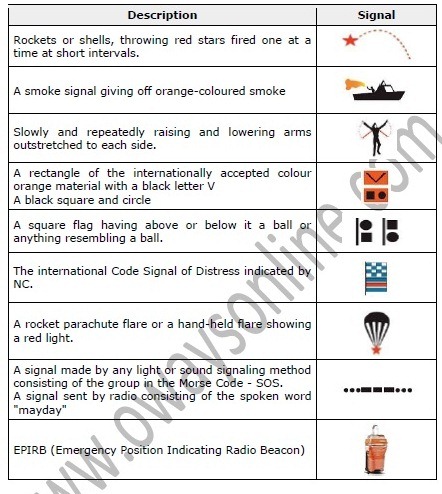
On a navigational watch at sea, signals likely to see or receive, if a vessel in vicinity is in distress:
Mentioned below are the Distress Signals which are used by Vessels: Use of these signals except for the purpose of indicating distress is prohibited:
Distress Signals which are used by Vessels
On a Navigational Watch at sea during night, action will you take if the โsmoke detectorโ indicates a fire in No.2 hold:
Fire in a cargo hold at Sea:-
Sound the Fire
Alarm.
Shut off the
blowers of that hold.
Announce on the PAS
(Public Address System). โFire in No:2 Hold.โ
Mark the position
quickly, for future reference, by pressing the โMan overboardโ button on the
GPS receiver. Such a button is available on most types of receivers.
The Master would
come rushing to the bridge after hearing the fire alarm, possibly before the
announcement on the PAS.
Inform the Engine
room, โFire in no:2 cargo hold. Open water on deckโ. In many ships, the fire
pump is started from the bridge.
Mark the own shipโs
position, by a cross on the chart, for ready reference by the Master. Clearly
write the latitude, longitude, shipโs time and UTC of the incident.
Consult Master
whether to change over to hand steering.
Keep a record of
all events and their timings, in the Bridge Notebook.
Entries in the
Mateโs Logbook should be made at a subsequent, convenient time.
Carry out Masterโs
orders.
Actions to fight an Engine Room fire while your vessel is at sea:
Raise the alarm.
Inform the master.
Reduce the vessels speed & engage manual steering. Display NUC (NOT UNDER COMMAND) lights, Weather reports, open communication with other vessels in the vicinity and send urgency signal.
Close all ventilation, fire and watertight doors.
Muster all crew- take a head count. Emergency fire p/p running.
Isolate all electrical units. Commence boundary cooling.
Fight fire by conventional means.
Main fire party to be properly equipped. Back up party ready at all times.
C/O not to enter as he monitors progress and communication with the bridge. Proper communication between bridge and engine room. Keep bridge informed accordingly of sequence of events.
At all times fire fighters to be well equipped with breathing apparatus and fireman suit. Checks on apparatus must be carried out prior to entering space.
Actions in case of Engine Room fire at Port:
Raise the alarm.
Inform the master
Display NUC (NOT
UNDER COMMAND) lights, Weather reports, open communication with Port
Authorities.
Close all
ventilation, fire and watertight doors.
Muster all crew-
take a head count. Emergency fire p/p running.
Isolate all
electrical units. Commence boundary cooling.
Fight fire by
conventional means.
Main fire party to
be properly equipped. Back up party ready at all times.
C/O not to enter as
he monitors progress and communication with the bridge. Proper communication
between bridge and engine room. Keep bridge informed accordingly of sequence of
events.
At all times fire
fighters to be well equipped with breathing apparatus and fireman suit. Checks
on apparatus must be carried out prior to entering space.
Procedure to enter Engine Room After Fire:
After
the fire has been assumed to be extinguished and before removing the carbon
di-oxide by exhaust blowers, a re-entry using breathing apparatus and firemanโs
outfit has to be done.
Re-entry
is usually done from the lowest space in the engine room and probably from the
emergency escape.
Care
is to be taken not to allow the carbon dioxide to escape.
The
entering personnel must enter with a fire hose and extinguish any local spots
of fire.
If
confirmed that the fire is out then the exhaust blowers can be run and the
gases removed.
However
fire patrols must be kept for a long period after the fire until the engine
room is manned again.
Five likely causes of a fire emergency on board with their precautions:
Fire causes and precautions:- It is noted that the maximum number fires on ships initiates in the shipโs accommodation area due to negligence of the shipโs staff. A ship accommodation is an area where the crew memberโs cabin is located along with galley, recreational room, meeting room etc. The best way to avoid incidents of fire on ship is to take preventive measures than to suffer later.
Do
not smoke cigarette sitting or lying on the bed and also, do not keep or throw
live smoking buds in the dust bins.
Try
not to use essence stick or candles inside the cabins. If they are used, make
sure they are lit up during your own presence and while your going out of the
cabin, are blown off
Never
use hot plate or heater for cooking purpose inside the cabin.
Never
use loose or open wire (without plug or naked wire).
Always
make sure electrical circuit is never overloaded i.e. too many connection in
one socket.
Never
put your clothes near or on room heater or lamps.
Do
not bring oily rags inside your boiler suit pocket into the cabin.
Never
leave iron unattended when ironing clothes in laundry room.
Always
make sure all the electrical circuits in accommodation are in sound condition
to avoid short circuit fire.
Chief
cook should make sure that galley is always attended when hot plate is on.
Never
leave oil pan unattended in galley.
Toaster
and kettle must never be over heated.
If
any welding or gas cutting operation is carried out inside accommodation, all
the precaution that are necessary, must be taken.
In
tanker ship, accommodation ventilation suction should be away from cargo holds
as their vapour can enter inside the accommodation and create a flammable
atmosphere.
All
the visitors coming on board when the ship is at port must be briefed about the
fire hazards.
Safe Lookout / Sole Lookout as per STCW:
Under the STCW Code, the OOW may, be the sole lookout in daylight provided that on each such occasion:
The situation has been carefully assessed and it has been established without doubt that it is safe to operate with a sole lookout.
Full account has been taken of all relevant factors, including, but not limited to:
State of weather.
Visibility.
Traffic density.
Proximity of dangers to navigation.
The attention necessary when navigating in or near traffic separation schemes.
When deemed necessary, assistance is immediately summoned to the bridge.
If sole lookout watchkeeping practices are to be followed, clear guidance on how they should operate will need to be given in the SMS.
Actions to be taken in case of dragging anchor & delay in readiness of the engines:
Inform Master.
Sound Uniform on ship whistle (two short blast followed by one long blast; to attract the attention of other vessel and to indicate that โYou are running into danger.)
Stop all cargo operations and prepare vessel for manoeuvring. Let go cargo barges and crane barges if they are alongside.
Inform and alert Vessel traffic system (VTS) and other vessels nearby about the condition and inform about the actions taken. Seek permission for re-anchoring.
Start heaving up the anchor and once the vesselโs maneuverability is restored, shift the anchorage position where drifting can be safer or take to the open sea.
Deploy more cables or drop a second anchor (not recommended for big vessels) before the speed of dragging of the vessel increases.
This can stop the small vessel from dragging anchor at very early stage before the ship is pressed to leeward side with increasing speed.
If the scenario permits, let the vessel drag in a controlled manner. But this is not recommended in areas where offshore work such as oil and gas operations are being carried out, which can result in damaging the submerged pipe lines, cables etc.
Release the bitter end and let go the anchor completely, when weighing of anchor is not possible. A ship without minimum of 2 anchors is not considered to be sea worthy, a careful assessment is to be made prior making this decision.
If Weather permits, call (tugs) for assistance.
Responsibility of the OOW in the following in circumstances: Action on receiving storm warning
Prepare for the onset of stormy weather with strong winds.
Inform Master.
Inform Chief Officer.
Inform Catering Staff.
Inform Engine Room.
Secure all movable equipment on the bridge.
Switch on ARPA and commence plotting.
Switch on navigation lights. Later on, clouds may result in partial darkness; rain and/or spray may result in decrease of visibility.
Switch on second steering motor also.
Try out pneumatic whistle, electric klaxon and also foghorn.
Keep a record of all relevant actions/ events in the Bridge Notebook.
Inspect the chart and ensure that the intended course is safe bearing in mind the following points:
More under keel clearance would be required because of pitching, rolling and heaving.
The ship would be more difficult to manage in bad weather and hence it may be necessary to give dangers a wider berth than in calm weather.
Failure of main engine, failure of generators, failure of steering systems, etc., in bad weather, as some of the possibilities that must not be overlooked.
While keeping bridge watch at sea, Actions to be taken when following alarms are activated: Gyro failure
Inform the Master
Change over to 2nd gyrocompass if available, Otherwise, following procedure to be followed.
Change over to Hand steering for steering with magnetic compass.
Apply Compass deviation value to magnetic compass course with the help Deviation card and observation,
Consider effect on other navigational and communication equipment which have a gyro feed especially Radar/ ARPA and ECDIS and enter headings manually.
Plot positions more frequently to confirm course made good and accordingly allow correction to course steered. In coastal waters, make good use of parallel indexing technique to keep vessel on charted track.
Also secure True course run (Course made good) by plotting GPS position and verify with Heading of Magnetic compass.
Reduce speed if considered necessary.
In the meantime, to
check Instruction Manual for troubleshooting guide.
Basic Principles of Safety at sea while performing Navigational Watch as an officer on watch (OOW) in General:-
Compare compasses, all repeaters must be synchronized with Master Gyro. (Including radar, ECDIS etc.)
Keep proper look out by sight, hearing and all available means (Radar, ARPA, VHF, MF, HF, AIS, binoculars etc.) be alert have good perception of the environment (situational awareness.)
Plot the vesselโs position as per position plotting interval decided by Master or as per companyโs instructions.
Keep sharp look out for suspicious boat, especially when plying in pirate infested area/ high risk area.
Position must be double checked by mean of alternative means of position fixing, visual fixes to be taken if possible.
Check UKC even though not in soundings, uncharted dangers may exist.
Acquire all targets and assess the risk of collision. Check for presence of all the vessels in the vicinity and data pertaining to CPA, TCPA, range bearing, bow crossing range, bow crossing distance, visual bearing are of great use.
Use long range scanning for early detection, use higher range to make land fall on radar.
Abide by passage plan, alter course(s) as required, double check the plotted course prior to alteration with due regard of observation of hood seamanship.
Abide by COLREGS, check the effectiveness of the action until other vessel is final past and clear.
All the displays on bridge โ tachometer, rudder angle indicator, ROTI, etc, also displays for course steered and course made good, speed through water and speed over ground.
Ensure vessel is not proceeding towards no. go areas.
Try out hand steering once in a watch.
Adjust settings on radar, auto pilot etc, as and when required, adjust the dimmers of various displays as required.
Establish compass error once a watch also after major alteration of course, sights must be taken as per Masterโs / companyโs instructions.
If sole look out, then assess continuously if additional persons required on bridge.
Abide by instructions pertaining to hold ventilation.
Acknowledge all alarms on bridge as and when required.
Read and sign the navigation & meteorological warnings received on EGC, Navtex, check if any information is relevant to own vessel.
Receive the weather fax and mark as required.
If any routine/ commercial message is received, inform the master accordingly (depending on the content / priority of the message.)
Continuously assess the state of visibility.
Keep eye on state of seas, swell, wind, temperature, relative humidity etc.
Check barometric pressure and compare it against normal pressure of the area vessel is plying.
Look out for distress signal and those in distress.
Look out for dangers to navigation like ice, derelict etc and prepare danger message.
Retard/ advance clocks / calendar as instructed.
Keep track of ballast exchange if in progress.
Keep eyes on crew working on the deck stop any kind of unsafe practices.
Follow the permit system and keep track of those involved, stop any kind of unsafe practices.
Follow instructions pertaining to removal of anchor lashings.
Give notices to Master, E/R (for example 1 hr notice), anchor party, officers, helmsman, look out man as instructed.
Test controls prior arrival as per instructions, make all preparations for arrival port.
Display lights, shapes as required, appropriate flags to be kept ready / hoisted as per local and international rules.
Abide by all instructions for safely board pilot.
Comply with all kind of procedures / check lists as per companyโs SMS and additional precautions as per risk assessment.
Call the Master as and when required as per Masterโs standing orders, bridge order book or whenever in doubt.
Navigational Watch as an Officer in Restricted Visibility / Congested waters:
Inform the Master: During restricted visibility, it
is important that the master is on the bridge. The OOW must constantly assess
the state of visibility and inform the master immediately, once Master is on
bridge hand over the con to him.
Inform E/R & reduction of speed: OOW should notify
the engine room, later on the tachometer must be checked to ensure RPM is being
reduced, bring down the ship to maneuvering RPM, in order to comply with
COLREGS rule no 19. (Power Driver v/l must have engines ready for immediate
maneuver).
Visual Observance: Check all the targets visually,
especially smaller targets that may not be picked up by radar.
Change in bridge watch keeping level: It is important
that enough man power is present on the bridge, additional officers and rating
should be called on the bridge, lookout(s) must be posted at different
locations on the ship, Master can be consulted regarding the deployment of look
outs, check for any sounding signal from other vessels in the vicinity.
Whistle: Ensure that the whistle is working
properly by trying out all the whistlers start blowing the whistle below
entering restricted visibility, as the rules applies to vessels navigating in
or near the area of restricted visibility.
Navigation Lights: Switch on the navigation lights if
not already done, ensure all these lights are burning properly.
Radar & ARPA: Switch on other radar, switch on the ARPA
and start acquiring the targets, check AIS targets and compare data of both
ARPA and AIS, adjust A/C rain & A/C sea as required.
Hand steering: Revert to hand steering, switch on other
steering pump if not done earlier.
Stop works on deck: Stop any job which may prevent
sound signal of other vessels to be heard properly. No one to be allowed on
main deck, this is to prevent injury to personnel working on open deck in case
collision / allusion (physical contact with fixed or floating objects.)
Open Bridge Doors: Ensure that the bridge doors are
kept open and is without any obstruction for easy bridge wing access.
VHF: Ensure VHF channel 16 is switched on and is audible
enough for all the safety related messages.
Keeping record: Keep record of all activities on the
bridge.
Follow All Procedures: Follow all the important procedures
as per SMS manual including compliance of any check list for restricted
visibility, company instructions for bridge manning level must be complied
with.Resting periods must be taken
care, all precautions as per risk assessment to be fulfilled.
COLREG Rule -19: Always comply with COLREG Rule -19, if
necessary; navigate with extreme caution till risk of collision is over keel.
Coastal
and congested waters:- (Including
above points)
The largest scale
chart on board, suitable for the area and corrected with the latest available
information, shall be used. Fixes shall be taken at frequent intervals, and
shall be carried out by more than one method whenever circumstances allow. When
using ECDIS, appropriate usage code (scale) electronic navigational charts
shall be used and the shipโs position shall be checked by an independent means
of position fixing at appropriate intervals.
The officer in
charge of the navigational watch shall positively identify all relevant
navigation marks.
Taking over a watch at sea in good weather:
Be on watch about 15 min before, at night time it helps to adjust the night vision.
Read and sign any orders from master in night order book/ bridge order book, check for any other verbal instructions by the Master / mate.
Inspect all the charts likely to be used in the watch for the following:-
Check courses to be steered and distances marked on the chart, also check the courses and distances as per the passage plan for the voyage.
Ensure the largest scale chart to be used.
Check courses are plotted clear of dangers to surface navigation.
Check the no go areas, mark them if not done.
Check the unit of depth and that the courses are plotted clear of shallows in accordance with companyโs UKC policy. Info regarding draft & display to be available on the bridge.
Check estimated time for next alteration of course.
Check wheel over positions, abort points & contingency anchorages.
Check info related to parallel indexing.
Check for land / island on the chart, check radar conspicuous objects, check for approx.. time for the land fall on the radar.
Check the nav marks and their characteristics, sector light etc, check general direction of buoyage system.
Check the charts to find info regarding geodetic datum, geodetic datum may be unknowns and so significant to surface navigation.
Check if any reporting to be done by SRS / VTS.
Check for any instructions marked by master regarding notices to E/R, removing anchor lashings etc.
Read all relevant notes on the chart:- local magnetic anomalies, correct, submarine exercise areas, firing zones, PSSA, Marpol special areas, information pertaining to offshore installations, sand waves etc.
Check the source data, very old survey may be unreliable for the soundings.
Check the T & P notices relevant to the chart.
Check if any low pressure marked on the chart (including forecast for that low.)
Check if clocks/ calendar to be advanced.
Refer to routeing chart for all the climatological info, check normal atmospheric pressure for the area where the vessel is navigating.
Check last position plotted and means of position fixing, always check the position plotting interval, it should be as per Masterโs / companyโs instructions.
Check tidal info by means of tide tables, tidal stream atlast & tidal diamonds.
Ensure all the relevant publications are available for use.
Read and sigh the navigation & meteorological warnings received on EGC, navtex, check if any information to relevant to own vessel.
Check the updates related to piracy, especially when plying in pirate infested area/ high risk area.
Check the weather fax received during previous watch, check if any information is relevant to own vessel, any weather fax to be received in the watch (time & freq. as per ALRS.)
Check if any commercial message is received and if Master informed.
Check the state of visibility. Check the manning level of the bridge is as per companyโs instructions. Manning level may be there for weather conditions.
Ensure watch keeping, ratings are fit for watch, if sole look out, OOW must know how to call them just in case.
Understand the traffic situation, consult the outgoing OOW but must verify visually, also by means binoculars and radar, check ARPA info some targets may have to be acquired if not done by outgoing OOW, always check the manning level of the bridge is as per companyโs instructions for traffic situation.
Check CPA/ TCPA limits on ARPA, true vector/ relative vector.
Check ARPA is sea stabilized or ground stabilized.
Check gyro & magnetic courses steered by auto pilot/ auto pilot, course might have altered due to traffic.
If set was allowed, ask when it was allowed, check difference between gyro course and course made good.
Check the tachometer & note down RPM, if CPP check the pitch of the propeller, if on main eng. On UMS mode, the duty eng. Must be known (duty eng roster is sometimes available on bridge).
Check BNWAS to know the dormant period, confirm who the backup officer is.
Ensure VHF is switch on and level of volume is audible enough.
In case of selected ship (VOF), find if coded msg to be prepared.
Check GPS is on which geodetic datum, confirm cross track limits.
Check the radar picture & all settings and all the targets on PPI.
Identify the shore lights, some of vessels may not be visually identified due to shore light.
Check targets on AIS, check info reg. draft & no. of crew is correct.
Adjust all the dimmers as required.
Check smoke detector panel. (no circuits to be kept isolated).
Check status of automatic fire doors / water tight doors (if fitted).
Check if any permit has been issued.
Should inquire as to where crew is working (hold, tank etc.)
Check nav lights are burning, confirm that it is matching with the status of nav light on the sentinel.
Confirm if the compressed air is available for shipโs whistle.
Check that day light signaling lamp is working.
Check operational condition of all nav & GMDSS equipment.
Check if vessel is unusually trimmed or listed.
Ask if any ballast exchange in progress and the planned sequence.
Confirm if compass error established.
Change echo sounder unit same as that on the chart. (if applicable)
Master Gyro to be synchronized with all repeaters.
If daytime check for any sign of visual damages to ship.
Check wind, sea, swell etc.
Check any deck cargo if loaded is missing.
Check appropriate manual inputs for gyro if applicable.
Once outgoing OOW has plotted the position, check the position & cross track error.
Exchange courses, compass compasses.
Check if any action to be taken to abide with COLREGS.
Change settings on auto pilot if required.
Change settings on radar if required.
Comp checklist for taking over watch & relevant procedures in the SMS to be complied with.
P.S.:- Watch should
not be taken over when course is being altered for traffic or in case of a way
point.
Responsibility of the OOW in the following in circumstances: Approaching a port
Responsibility of the OOW – Approaching a port:
The Master and all navigational watchkeeping officers should, well before hand, thoroughly study the Sailing Directions (Often referred to as the Pilot Book) and the chart of the approaches to the port.
The passage plan for arrival at the port should be prepared and kept handy so that the OOW would be able to monitor the navigation of the vessel at all times, even when the Master or the pilot is directing the process. This serves as a second check on the navigational safety of the ship.
Communicate to the arrival port, by VHF, the ETA of the ship as and when instructed by the Master.
Inform the Master at the time indicated by him.
Give notice to the engine room at the time or charted position, as instructed by the Master. Inform Master when this has been done.
Synchronise clocks of the bridge, the engine room and the auto-recorder of the bridge โ ER telegraph.
Call up a seaman to act as the bridge messenger.
Change over to hand steering.
Switch on the other steering motor also.
Try out the steering system. After a long sea passage, it is necessary to try out the steering system about two hours before reaching confined waters. This done by:
Changing over to hand steering and then putting the helm hardover to one side and then the other whilst using one steering motor.
The same is then repeated while using the other steering motor.
If the ship is fitted with electro-hydraulic steering system, it is necessary to try out the steering on the electric and the hydraulic systems separately.
On ships fitted with a shaft generator, it would normally be necessary to inform the Engine Room before making sudden helm movements in order to prevent the generator from tripping off. If this happens, a diesel generator would automatically come on but, in the intervening couple of minutes, there would be no electric supply on the ship.
Take in the log (retract log sensor).
If daytime, keep flags ready โ Red Ensign, courtesy flag, house flag, G, Q, H, etc.
If night time, try out lights of Christmas Tree by switching them on momentarily.
Try out pneumatic whistle and electric klaxon by giving a very short blast on each.
Rig up the daylight signaling lamp and try it out on the mains and also the battery.
Check communication system to the forward and aft stations and to the steering gear compartment.
Have pilot ladder, life buoy with rope attached, heaving line and boat rope kept ready to be rigged (also flood light at night).
Give adequate notice to the crew for coming on arrival stations.
Electric power to be switched on to the windlass.
Keep a record of all events and their timings in the Bridge Notebook. The important entries are to be copied into the Mates Logbook later on.
Keep โPilot information cardโ ready for presentation to the pilot as soon as he enters the wheelhouse. This card contains the necessary information regarding the shipโs particulars, navigational equipment, etc. in a standard format as given in the โBridge Procedure Guideโ published by the International Chamber of Shipping (ICS). This card is separate from, and in addition to, the โWheel-house Posterโ displayed in the wheelhouse.
After ringing Stand-By Below (SBB) on the telegraph, the Master would try out the engine by going astern. An entry, โEngine tried out asternโ should be made in the Bridge Notebook and later copied into the Shipโs Logbook.
Anti-pilferage watches to be arranged on deck to commence before arrival port.
While going alongside, the pump room blowers should be switched off. This is to prevent sparks from the funnels of tugs used from being drawn into the pump room.
Taking over an anchor watch:-
Read instructions
from Master or Chief Officer.
Check position of
own vessel to ensure she is not dragging anchor.
Check UKC, maintain
VHF watch for instruction.
Check distance of
all other vesselโs at anchorage. Look out for other vesselโs dragging.
Look out for
vesselโs approaching the anchorage area.
Check the wind,
sea, swell, continuously asses the visibility.
Read & sign all
met warningโs & nav warnings received during watch.
Establish compass
error.
Check SAT-C for
routine messages notify Master accordingly.
If bunker barge
expected, keep look out for the same, if bunker barge is already alongside,
keep track of all timings, ensure no sheen is visible, if so inform master.
Keep look out for
bunker overflow.
Abide by all ISPS
procedures, do not let unauthorized vessel(s) be alongside own vessel.
Ensure appropriate
lights & shapes are displayed.
Ensure appropriate
flags are hoisted/ lowered.
Keep eye on crew
working on deck, stop any kind of unsafe practices, abide by all international
& local regs.
Some boats/
launches may be expected carrying stores, crew, port officials, surveyors,
auditors, inspectors, ship chandler etc., ensures these boats are tended to
safety.
Test the controls
as instructed.
Try out m/eng as
instructed.
Keep track of
vessel berthing/ unberthing intended berth.
Receive
instructions from VTS/ Ports Control & notify all parties as instructed.
Abide by companyโs
sms procedures, checklists and all additional measures as per Risk assessments.
Taking over a Navigational watch at sea, in restricted visibility / Taking over a navigational watch at night, while underway at sea:
Know your Ship inside-out: An efficient navigating officer must know each and every aspect of his or her ship in order to prevent any kind of accident. From dimensions to the characteristics of the ships, the officer should know how the ship will behave under different circumstances. For restricted visibility situation, it is important that the OOW know the stopping distance of the ship at any particular RPM in order to control the ship during emergencies.
Inform the Master:- During restricted visibility, it is important that the master is on the bridge. The OOW must call or inform the master regarding the navigating condition. The officer should also inform the engine room and ask the duty engineer to man the engine room in case it is on โunmannedโ mode.
Appoint Adequate Man Power: It is important that enough man power is present on the bridge in order to keep a close watch on the shipโs course. Additional personnel must be appointed as โlookoutโ at different locations on the ship. If there is traffic in the area, the officer must inform the engine room to have enough manpower so that the engine is also ready for immediate maneuvering.
Keep the Fog Horn Ready:- Ensure that the fog horn is working properly for the restricted area. If the horn is air operated, drain the line prior to opening the air to the horn.
Reduce Speed: Reduce the speed of the ship depending on the visibility level. If the visibility is less, bring down the ship to maneuvering RPM.
Ensure Navigation Equipment and Light Are Working Properly: Ensure that all important navigating equipment and navigation lights are working properly during restricted visibility. The OOW must ensure that the navigation charts are properly checked for correct routeing and a good radar watch is carried out.
Stop All Other Works: Though itโs obvious, but never multi-task during restricted visibility even if there are more than sufficient people present on the bridge. Also stop all other deck work and order the crew to go to their respective rooms. This is to prevent injury to personnel working on open deck in case collision or grounding takes place.
Open/Close Bridge Doors: Ensure that the bridge door is kept open and is without any obstruction for easy bridge wing access (Considering that the bridge wing is not enclosed). Also, in case of dust or sand storm, close all the bridge openings.
Shut Ventilation: If the ship is passing through a sand storm, the ventilation fans and accommodation/ engine room ports must be closed to avoid sand particles from entering bridge, accommodation and engine room.
Follow All Procedures: Follow all the important procedures for restricted visibility as mentioned in COLREG Rule -19. Also monitor channel 16 in the radio and ensure that all important parameters of the ship such as latitude and longitude, time, speed etc. are noted in the log book.
Entries you need to make in the deck log book during a watch at sea.
The position of the ship in Latitude and Longitude at different intervals.
Time to be noted when Navigation marks are passed
Time, details and reason if there is any course alteration
Meteorological and weather conditions including details of sea, swell etc along with the Beaufort scale that is prevalent
Movement of the ship at sea including rolling, pitching, heaving etc
Details of any abnormal condition
Speed of the propulsion engine and speed of the ship in knots
If involved in any kind of accidents like stranding, grounding etc. then details for the same
Entry to be made if any physical contact with floating object or vessel is made
Details of the distress signal received
Entry for what kind of assistance is given to the distress signal sender
If salvage operation is performed, complete details to be entered
If there is an oil spill or other pollution accident, position of the ship, time and complete incident to be recorded
Record of general watch routines performed including fire watch
Time of arrival and departure and ETA.
If berthing or anchoring is planned, time for the same to be noted.
Heading and Compass error
Drills and training carried out as well as inspections with regard to stowaways and security related measures
Record of stores, fresh water etc received
Also, any other entries as required by master, company, and administration should also be recorded in the log book without fail.
Additionally,
An
original page should never be removed from the Log Book. This is because the
Deck Log Book is used as official evidence in case of an unfortunate event
Only
official designations and symbols to be used
If
there is insufficient space in the Remarks section, insert a gummed paper strip
instead of making the log book clumsy. This shouldnโt be necessary as there is
ideal space to record everything in precise language
Control Testing:
Within twelve hours before departure of the ship from port, following systems to be checked and tested:
Main
steering gear and system
Auxiliary
steering gear and system
The
remote control systems of steering gear
The
steering position indicator on the navigation bridge
The
emergency power supply to one of the steering unit
The
rudder angle indicators showing actual position of the rudder
Power
failure alarms for the remote steering gear control system
Power
unit failure alarms for the steering gear unit
Automatic
isolating arrangements and other automatic equipment
Following listed procedure must be included along with the check and tests described above:
The full movement of the rudder as per the required capabilities of the steering gear system present onboard.
A visual inspection of all the linkages and connection in the steering gear.
The means of communication between the steering gear room and navigational bridge must always be operational
Other Important requirements related to steering gear are:
A
block diagram displaying the steering system, the changeover procedure from
remote to local steering and steering gear power unit indicating the emergency
supply unit must be clearly mentioned.
This
diagram must be pasted in Navigation Bridge and steering gear compartment
All
officers and crew concerned with the operation and maintenance of steering gear
system must be familiar with changeover procedure from one to other system
Emergency
steering drills to be carried out inn not more than three months period.
Date
and time for the tests, checks and drills carried out in steering gear system
must be recorded.
Procedure for testing of controls prior departure from port:
Steering Gear โ Testing and Drills: Within twelve hours before departure of the ship from port, following systems to be checked and tested:
Main steering gear and system.
Auxiliary steering gear and system.
The remote control systems of steering gear.
The steering position indicator on the navigation bridge.
The emergency power supply to one of the steering unit.
The rudder angle indicators showing actual position of the rudder.
Power failure alarms for the remote steering gear control system.
Power unit failure alarms for the steering gear unit.
Automatic isolating arrangements and other automatic equipment.
Following listed procedure must be included along with the check and tests described above:
The full movement of the rudder as per the required capabilities of the steering gear system present onboard.
A visual inspection of all the linkages and connection in the steering gear.
The means of communication between the steering gear room and navigational bridge must always be operational.
Other Important requirements related to steering gear are:
A
block diagram displaying the steering system, the changeover procedure from
remote to local steering and steering gear power unit indicating the emergency
supply unit must be clearly mentioned.
This
diagram must be pasted in Navigation Bridge and steering gear compartment
All
officers and crew concerned with the operation and maintenance of steering gear
system must be familiar with changeover procedure from one to other system
Emergency
steering drills to be carried out inn not more than three months period.
Date
and time for the tests, checks and drills carried out in steering gear system
must be recorded.
Procedure for embarking a Pilot:
Procedures for pilotage – Embarkation & disembarkation:-
Deck
Officer will be designated, who shall be responsible for the safe embarkation
and disembarkation of the pilot.
He
shall be responsible for verifying the safe condition, safe access and
appropriate rigging of the pilot ladder / combination ladder (accommodation
ladder) per local requirement and ensure that a heaving line and lighted life
buoy is available at the point of embarkation or disembarkation.
He
shall stay in contact with the bridge and escort the pilot to and from the
bridge.
The
Master shall further assure the safety of the pilot during embarking or
disembarking by providing a good lee to the pilot boat.
Various occasions when you should call Master on the bridge while keeping navigation watch:
The Officer on Watch (OOW) when on duty is in charge of the shipโs navigation and safety. While on the bridge, he is the representative of the shipโs master and must carry out all the orders as put forth by the latter.
While navigating
the ship, the officer in charge has to take independent decisions to ensure a
smooth passage of the ship. However, every shipping company provides a list of
situations, wherein the officer on watch must call the shipโs master to the
bridge to avoid any kind of danger for the ship.
These instructions
are given in the shipboard operational procedures, and it is imperative for
every OOW to follow them.
Below is the
checklist of situations, wherein the officer on watch should call the shipโs
master:-
Danger
to the ship because of traffic or movement of other ships
Danger
to ship or shipโs stability because of heavy weather
Malfunctioning
of alarms or signalling equipment
On
encountering restricted visibility
Difficulty
in maintaining a proper course
Breakdown
of propulsion system, steering gear, or machinery
Malfunctioning
of radio equipment
During
maneuvering
On
sighting land or navigation mark that can turn out to be dangerous
Breakdown
of essential navigational equipment
On
encountering navigational hazards such as rocks, icebergs, or shipwrecks
Failure
to sight land or navigation mark
Sudden
change in sounding or readings at inappropriate time
On
encountering suspicious ship or boat heading towards the ship
On
receiving emergency or important message from nearby port or ship
On
encountering any suspicious floating object in piracy affected area
Apart from the
above mentioned situations, the officer in charge should always call the master
in case of an emergency or when in doubt about a particular situation.
Once on the ship,
the master would take the control of the ship. This has to be recorded in the
shipโs logbook.
Take over a bridge watch, during night and while navigating in piracy prone areas:
Be on watch about 15 min before, at night time it helps to adjust the night vision.
Read and sign any orders from master in night order book / bridge order book.
Inspect all the charts likely to be used in the watch for the following:-
Check courses to be steered and distances marked on the chart, also check the courses and distances as per the passage plan for the voyage.
Ensure the largest scale chart to be used.
Check courses are plotted clear of dangers to surface navigation.
Check the no go areas, mark them if not done.
Check the unit of depth and that the courses are plotted clear of shallows in accordance with companyโs UKC policy. Info regarding draft & display to be available on the bridge.
Check estimated time for next alteration of course.
Check wheel over positions, abort points & contingency anchorages.
Check info related to parallel indexing.
Check for land/ island on the chart, check radar conspicuous objects, check for approx time for the land fall on the radar.
Check the nav marks and their characteristics, sector light etc, check general direction of buoyage system.
Check the charts to find info regarding geodetic datum, geodetic datum may be unknown and so significant to surface navigation.
Check if any reporting to be done to SRS/ VTS.
Check for any instructions marked by master regarding notices to E/R, removing anchor lashings etc.
Read all relevant notes on the chart:- local magnetic anomalies, current, submarine exercise areas, firing zones, PSSA, Marpol special areas, information pertaining to offshore installations, sand waves etc.
Check the source data, very old survey may be unreliable for the soundings.
Check the T & P notices relevant to the chart.
Check if any low pressure marked on the chart. (including forecast for that low.)
Check if clocks / calendar to be advanced.
Refer to the routeing chart for all the climatological infos, check the normal atmospheric pressure for the area where the vessel is navigating.
Check last position plotted and means of position fixing fixing, always check the position plotting interval, it should be as per Masters / companyโs instructions.
Check tidal info by means of tide tables, tidal stream atlast & tidal diamonds.
Ensure all the relevant publications are available for use.
Read and sign the navigation & meteorological warnings rcvd on EGC, navtex, check if any information to relevant to own vessel.
Check the updates related to piracy, especially when plying in pirate infested area/ high risk area.
Check the weather fax rcvd during previous watch, check if any information is relevant to own vessel, any weather fax to be recvd in the watch (time & freq as per ALRS.)
Check if any commercial message is recvd and if Master informed.
Check the state of visibility. Check the manning level of the bridge is as per companyโs instructions. Manning level may be there for weather conditions.
Ensure watch keeping ratings are fit for watch, if sole look out, OOW must know how to call them just in case.
Understand the traffic situation, consult the outgoing OOW but must verify visually, also by means binoculars and radar, check ARPA info, some targets may have to be acquired if not done by outgoing OOW, always check the manning level of the bridge is as per companyโs instructions for traffic situation.
Check CPA/TCPA limits on ARPA, true vector / relative vector.
Check ARPA is sea stabilized or ground stabilized.
Check gyro & magnetic courses steered by auto pilot / auto pilot, course might have altered due to traffic.
If set was allowed, ask when it was allowed, check difference between gyro course and course made good.
Check the tachometer & note down RPM, if CPP check the pitch of the propeller, if on main eng on UMS mode, the duty eng must be known, (duty eng roster is sometimes available on bridge)
Check BNWAS to know the dormant period, confirm who is the back up officer.
Ensure VHF is switched on and level of volume is audible enough.
In case of selected ship (VOF), find if coded msg to be prepared.
Check GPS is on which geodetic datum, confirm cross track limits.
Check various settings on ECDIS.
Check VDR/ S-VDR remote module for any alarm.
Check auto pilot for the settings.
Check the radar picture & all settings and all the targets on PPI.
Identify the shore lights, some of vessels may not be visually identified due to shore light.
Check targets on AIS, check info reg draft & no. of crew is correct.
Adjust all the dimmers as required.
Check smoke detector panel. (no circuits to be kept isolated)
Check status of automatic fire doors / water tight doors (if fitted)
Check if any permit has been issued.
Should inquire as to where crew is working. (hold, tank etc).
Check nav lights are burning, confirm that it is matching with the status of nav light on the sentinel.
Confirm if the compressed air is available for shipโs whistle.
Check that day light signaling lamp is working.
Check operational condition of all nav & GMDSS equipment.
Check if vessel is unusually trimmed or listed.
Ask if any ballast exchange in progress and the planned sequence.
Confirm if compass error established.
Change echo sounder unit same as that on the chart. (if applicable)
Master Gyro to be synchronized with all repeaters.
If daytime check for any sign of visual damages to ship.
Check wind, sea, swell etc.
Check any deck cargo if loaded is missing.
Check appropriate manual inputs for gyro is applicable.
Once outgoing OOW has plotted the position, check the position & cross track error.
Exchange courses, compare compasses.
Check if any action to be taken to abide with COLREGS.
Change settings an auto pilot if required.
Change settings on radar if required.
Comp c/list for taking over watch & relevant procedures in the SMS to be complied with.
PS:-
Watch should not be taken over when course is being altered for traffic or in
case of a way point.
Duties of OOW:
As per the International Regulations for Preventing Collisions at Sea (COLREGS), the duties of the Officer on Watch (OOW) on a vessel include:
Navigational duties: The OOW is responsible for the safe navigation of the vessel, including maintaining a proper lookout, plotting the vessel’s position, monitoring the vessel’s movement, and ensuring that the vessel complies with all relevant regulations and laws.
Communications: The OOW is responsible for maintaining communication with other vessels, shore authorities, and the vessel’s crew. This includes monitoring radio traffic, responding to requests for information, and transmitting any necessary information.
Safety: The OOW is responsible for ensuring the safety of the vessel, the crew, and any other persons on board. This includes taking appropriate action to avoid collisions, grounding, or other accidents.
Security: The OOW is responsible for maintaining the security of the vessel, the crew, and any cargo on board. This includes monitoring the vessel for any security threats and taking appropriate action to address any potential security breaches.
Watchkeeping: The OOW is responsible for maintaining an appropriate watch schedule, ensuring that the vessel is properly manned at all times, and monitoring the performance of the vessel’s crew.
Emergency response: The OOW is responsible for responding to any emergency situations that may arise, including taking appropriate action to ensure the safety of the vessel, crew, and any other persons on board.
Record keeping: The OOW is responsible for maintaining accurate and complete records of the vessel’s position, movement, and other relevant information. This includes maintaining the vessel’s log book and other required documents.
Entries to be made in the radar Log at the end of your watch at sea:
A
daily entry about the status of equipment.
Any
problems picking up targets or interference, it is meant to track problems for
the person who has to trouble shoot problems.
To hoist flags to indicate the latitude of 20ยฐ02′ N, the following procedure can be followed:
Hoist the 2 flags representing the digits “2” and “0” on the flagstaff in that order, starting from the top. These flags are the numeral pennants 2 and 0.
Hoist the flag representing the letter “N” below the numeral pennants. This flag is the flag of the letter N in the International Code of Signals.
So the final configuration would be: Numeral pennant 2, numeral pennant 0, flag of the letter N.
Q) While transiting within a TSS you observe a vessel crossing from you Starboard side, on a Collision course. Will you leave the TSS to avoid collision?
Ans:- Crossing situation in traffic separation scheme (vessel A using traffic separation scheme has vessel B on her own starboard side)
TSS you observe a vessel crossing from you Starboard side, on a Collision course
Description of scenario TSS:
Vessel A: power-driven vessel using traffic separation scheme
Vessel B: power-driven vessel of 20 m or more in length crossing traffic separation scheme
Area: Traffic separation scheme
Visibility: Good (Vessels in sight of one another)
Vessel A and vessel B are crossing so as to involve risk of collision
Vessel A has vessel B on her own starboard side
Rule(s) to be applied during TSS:
Rule 10 (Traffic separation schemes)
Rule 15 (Crossing situation)
Rule 16 (Action by give-way vessel)
Applying the Rule(s) and comments:
In
accordance with Rule 10 (c) (Traffic
separation scheme), a vessel (vessel B) shall so far as practicable avoid
crossing traffic lanes, but if obliged to do so shall cross on a heading as
nearly as practicable at right angles to the general direction of traffic flow.
In
accordance with Rule 15 (Crossing
situation), when two power-driven vessels are crossing so as to involve risk of
collision, the vessel (vessel A) which has the other (vessel B) on her own
starboard side shall keep out of the way.
In
accordance with Rule 15 (Crossing
situation), vessel A shall, if the circumstances of the case admit, avoid
crossing ahead of vessel B.
In
accordance with Rule 16 (Action by
give-way vessel), every vessel (vessel A) which is directed to keep out of the
way of another vessel (vessel B) shall, so far as possible, take early and
substantial action to keep well clear.
Factors to consider before approaching and using a Traffic Separation Scheme?
Proceed in the appropriate traffic lane in the general direction of traffic flow for that lane.
So far as is practicable keep clear of a traffic separation line or separation zone.
Normally join or leave a traffic lane at the termination of the lane, but when joining or leaving from either side shall do so at as small an angle to the general direction of traffic flow as practicable.
A vessel shall so far as practicable avoid crossing traffic lanes, but if obliged to do so shall cross on a heading as nearly as practicable at right angles to the general direction of traffic flow.
A vessel shall not use an inshore traffic zone when she can safely use the appropriate traffic lane within the adjacent traffic separation scheme. However, vessels of less than 20 meters in length, sailing vessels and vessels engaged in fishing may use the inshore traffic zone.
Notwithstanding subparagraph (d)(i), a vessel may use an inshore traffic Zone when en route to or from a port, offshore installation or structure, pilot station or any other place situated within the inshore traffic zone, or to avoid immediate danger.
A vessel, other than a crossing vessel or a vessel joining or leaving a lane shall not normally enter a separation zone or cross a separation line except:
in cases of emergency to avoid immediate danger;
to engage in fishing within a separation zone.
A vessel navigating in areas near the terminations of traffic separation schemes shall do so with particular caution.
A vessel shall so far as practicable avoid anchoring in a traffic separation scheme or in areas near its terminations.
A vessel not using a traffic separating scheme shall avoid it by as wide a margin as is practicable.
A vessel engaged in fishing shall not impede the passage of any vessel following a traffic lane.
A vessel of less than 20 meters in length or a sailing vessel shall not impede the safe passage of a power driven vessel following a traffic lane.
A vessel restricted in her ability to maneuver when engaged in an operation for the maintenance of safety of navigation in a traffic separating scheme is exempted from complying with this Rule to the extent necessary to carry out the operation.
A vessel restricted in her ability to maneuver when engaged in an operation for the laying, servicing or picking up a submarine cable, within a traffic separating scheme, is exempted from complying with this Rule to the extent necessary to carry out the operation.
Bridge Procedure Guide:- The Bridge Procedures Guide (BPG) is an International Chamber of Shipping (ICS) publication that aims to reflect Best Practice aboard Merchant Ships embracing standards and recommendations promoted by the IMO. This includes the concept of โcontinuous improvementโ as described in the ISM Code and the watchkeeping requirements of STCW Chapter VIII. Questions on the content of the bridge procedures guide make a regular appearance in both SQA and oral examinations.
PART
A: GUIDANCE FOR MASTERS AND WATCH KEEPING OFFICERS
As per Bridge procedure guide, Duties of the officer of the watch:
The Officer of the Watch (OOW) is the Master’s representative and is responsible at all times for the safe navigation of the ship, in full compliance with the Convention on time International Regulations for the Prevention of Collisions at Sea (COLREGS).
The presence of the Master on the bridge does not relieve the OOW of responsibility for the watch. A decision by the Master to assume responsibility for the watch should be unambiguously advised to the OOW and other members of the Bridge Team.
The OOW should
comply with the requirements of the SMS and the Master’s standing and daily orders.
Compliance ensures that agreed and robust procedures which promote safety and
mitigate risks are followed by Bridge Teams to execute and monitor the passage
plan.
The primary duty of
the OOW is to maintain a safe navigational watch at sea or at anchor, which
will require ensuring:
Compliance with the Company’s navigational policies and requirements;
Effective watch handovers;
Management of the Bridge Team;
Keeping a proper look-out;
Familiarity with the bridge layout and equipment;
Familiarity with bridge procedures;
Maintaining situational awareness;
Surveillance of the ship;
Execution of the passage plan;
Navigation and control of the vessel;
Collision avoidance in compliance with the COLREGS;
GMDSS watchkeeping;
Compliance with environmental requirements;
Monitoring the performance of navigational equipment;
Recording bridge activities;
Management of emergency situations; and
Security awareness.
Purpose of the log book:
Deck log book:- The Deck log book is an important document and serves as necessary evidence in case of any Accidents and Casualties. It must contain Factual Entries with Time in each entry. It is essential that clear and accurate record of the activities of the ship are kept, as the Log book will form a main part of the collection of evidence in case of any incidents. Vesselโs official language is mentioned on very first page of the log book.
Entries you will make in the log book from the time pilot on board until vessel secured alongside the berth while vessel at Port:
Record of Pilotage
events during watch:
Pilot on board.
Passing abeam to break water.
Passing under the bridge.
Passing few navigation marks/ signal stations.
Change of pilot(s).
Any emergency during pilotage.
Position and name of tugs made fast, first line ashore.
All fast fwd n aft (configuration of rope example:- 4+2+2 F&A).
Alongside on which side.
Name of wharf etc.
Tugs cast off.
M/E blown through, finished with engines, bunkers, LO & FW ROB.